


THE DAILY · FRI JULY 31, 2026 · 4 ITEMS · 4 ITEMS
THE FRAME
Ninety-two percent of a governing party’s members voted to cancel the surveillance contract, and it is still running. Everything below is a decision somebody already made, and a machine that did not stop.

FIG.01 · REUTERS · JUL 31
A Million in Revenue, Six Hundred Million in Price
WHAT HAPPENED
Space-Eyes, a satellite-analytics firm with about $1 million in annual revenue, is going public through a merger with McKinley Acquisition Corp in a deal valuing the combined business at $638 million. Eric Trump recently became its third-largest private investor and will serve as strategic advisor to the merged company after the transaction. The deal is expected to close in the fourth quarter. He and Donald Trump Jr. have spent the past year moving money into defense and manufacturing ventures, from drones to humanoid robots to a manufacturing SPAC.
WHAT IT MEANS
A firm with a million dollars of revenue is being priced at six hundred and thirty-eight million, and the asset that closed the gap is not the satellite analytics. Watchdogs have put a much larger figure on the government contract work attached to Trump-linked defense holdings, but the reporting does not settle what that number measures, so we are not printing it. The valuation is the cleaner fact, because a valuation is a market saying out loud what it thinks access is worth.
WHY IT MATTERS
Preferential treatment is the crude version, and denying it is cheap. The efficient version is a market that prices the relationship on its own, without anyone having to ask, and books it as a valuation rather than a payment. Nothing here is hidden, and nothing here is illegal, and that is the point: the disclosure does no work. Watch whether the close slips past the fourth quarter, and whether any contract in this portfolio survives a change of administration.
[grift-extraction] [war-machine] [concentration-economics]
Connects → Payer of Last Resort

FIG.02 · NETZPOLITIK · JUL 30
Ninety-Two Percent, and Nothing
WHAT HAPPENED
In a membership ballot, 92 percent of Baden-Württemberg’s Greens voted that the state government should immediately terminate its five-year contract with Palantir for the Gotham policing platform. Of just over 24,000 eligible members, 9,615 voted. Days earlier the Green parliamentary faction had voted with its CDU coalition partner against an SPD motion to stop Gotham. Green premier Cem Özdemir has repeated that he intends to keep the contract. The licensing fees are €25 million.
WHAT IT MEANS
This is the cleanest available picture of a brake that exists on paper and does not engage. The party has a formal mechanism for its members to instruct it, the members used it, the instruction was unambiguous, and the instruction did nothing. The faction’s defence is procedural and probably correct on its own terms: cancelling means paying for software the state then cannot use. Which is the trap working exactly as designed. The contract was the decision, and everything after it is administration.
WHY IT MATTERS
Germany is where the surveillance-procurement fight is furthest along, and this is what winning the argument and losing anyway looks like. Ninety-two percent is not a close vote or a divided base; it is as clear an internal mandate as a party ever produces. Watch the resolution calling for a European alternative by 2030, and whether Gotham is fully operational before the thing meant to replace it exists.
[surveillance-state] [concentration-economics] [epistemics]
Connects → Beat China, Become China?

FIG.03 · H.R. 9729 · INTRODUCED JUL 16
The Bill That Is Sitting There
WHAT HAPPENED
The Human Authority over Autonomous Weapons Act of 2026 would amend title 10 to require that autonomous and AI-enabled weapons used by the armed forces stay subject to appropriate levels of human command responsibility, and would require a commander to “verify any target of such system using a secondary source or data that is not exclusively generated by artificial intelligence” for five years after enactment. Don Beyer is the sponsor; Tom Barrett, Sara Jacobs and Valerie Foushee are cosponsors. Three Democrats and a Republican. Beyer: “No machine should ever be given the power to decide to kill a human being on its own.” It was referred to the House Armed Services Committee. That was July 16. Nothing has happened since, which is why it is here two weeks late.
WHAT IT MEANS
We are running it precisely because it is not news. A bipartisan bill on the one question everyone claims to care about went to committee a fortnight ago and has not moved, and no feed treated that as an event. This is what the unglamorous half of the fight actually looks like. Not a vote anyone loses, just a referral and then nothing, which is indistinguishable from defeat and much harder to report.
WHY IT MATTERS
Every autonomy story the daily has run for months has ended at the same gap: systems are being fielded faster than any rule reaches them, and the rules that exist govern products rather than deployment. H.R. 9729 is aimed straight at that gap and it is the friction in the specific sense the Speed of Light series means: a fight over holding the interval open. Watch the markup calendar, and watch whether the five-year non-AI verification clause survives contact with the Pentagon.
[war-machine] [ai-safety] [concentration-economics]
Connects → No Time to Absorb

FIG.04 · VIDEO · INTERESTING TIMES WITH ROSS DOUTHAT · JUL 30
They Are Not Leaving
WHAT HAPPENED
Ross Douthat opens by calling the concentration of wealth and power in older Americans our least-discussed crisis, then hands it to his guest. Samuel Moyn is a Yale law professor and the author of Gerontocracy in America, and the figure he lands on later in the conversation is this: “if you look at the billionaire class on a worldwide scale, 90 percent of those people are over 50. 45 percent are over 70.” The mechanism he traces is dull and specific. Mandatory retirement was made illegal in all but a few sectors like air traffic control and airline pilots, through AARP lobbying and successive revisions to the Age Discrimination in Employment Act between the 1960s and the early 1990s, while the property-tax revolts that began in California immunised older people’s assets from taxation just as those assets began to boom.
WHAT IT MEANS
Moyn refuses the generational-warfare frame, and his refusal is the sharpest thing in the conversation: “my nightmare is that millennials will do fine. It’s just they’re in a waiting game to come into the resources.” That is not a complaint about unfairness, it is an observation about time. The resources are not withheld forever. They are withheld until the point at which having them changes much less about your life, and a distribution deferred by thirty years is a different thing from a distribution made, even when the ledger eventually balances.
WHY IT MATTERS
Read against everything above it, this is the same structure at civilizational scale. In each of the three items above, a formal channel for consent exists, gets used, and produces nothing on the timescale that would matter. Moyn’s gerontocracy is that pattern turned into demography: incumbency compounds, the people who could release the hold are the people it benefits, and the correction arrives on a schedule nobody chose. Life tenure is not only a Supreme Court problem.
[concentration-economics] [labor-displacement] [epistemics]
Connects → The Obsolescence Economy · Watch → on YouTube
What to Watch
Whether any Trump-portfolio contract survives an administration change — That is the only test that separates a good product from a priced relationship, and it is years out.
The Baden-Württemberg resolution on a European Palantir alternative by 2030 — And whether Gotham is fully operational before its replacement exists. If it is, 2030 is a date, not a plan.
The House Armed Services markup calendar for H.R. 9729 — Specifically whether the five-year non-AI target-verification clause survives contact with the Pentagon, or gets traded first.
Whether age-wealth framing attaches to the Social Security debate — Moyn’s argument is politically live only if it reaches means-testing. Otherwise it stays a book.
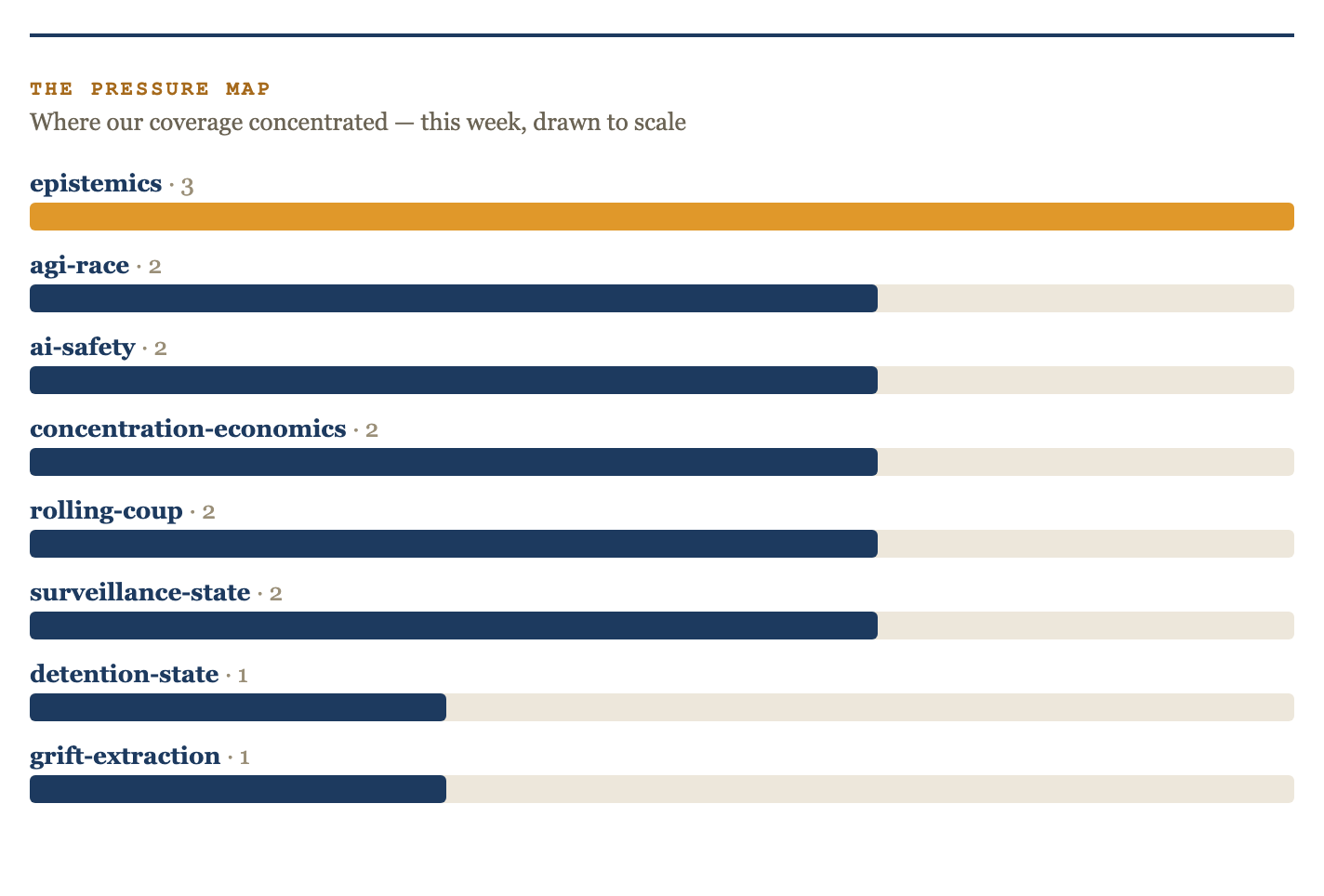
THE PRESSURE MAP — where our coverage concentrated this week, drawn to scale
THE VIDEO NEWSLETTER — Every weekday our video desk watches the AI and political-economy channels reaching millions and reads them through the same lens as the news above. Read the Video Newsletter →
THE LONG VIEW — the daily is the fast news; this is the deep one.
NEXT IN THE SERIES · 2026-08-03
Part 4 of 4 — the finale — The Absorption Index — The finale, and the instrument: one number for how fast it’s arriving against how fast we can absorb it.

Just released — read No Time to Absorb — Part 3 — every shock before this one ended, and an antibody pulled it back down. This one doesn’t end..
This is Wireframe News—consent is the one input the machine is built not to need.