

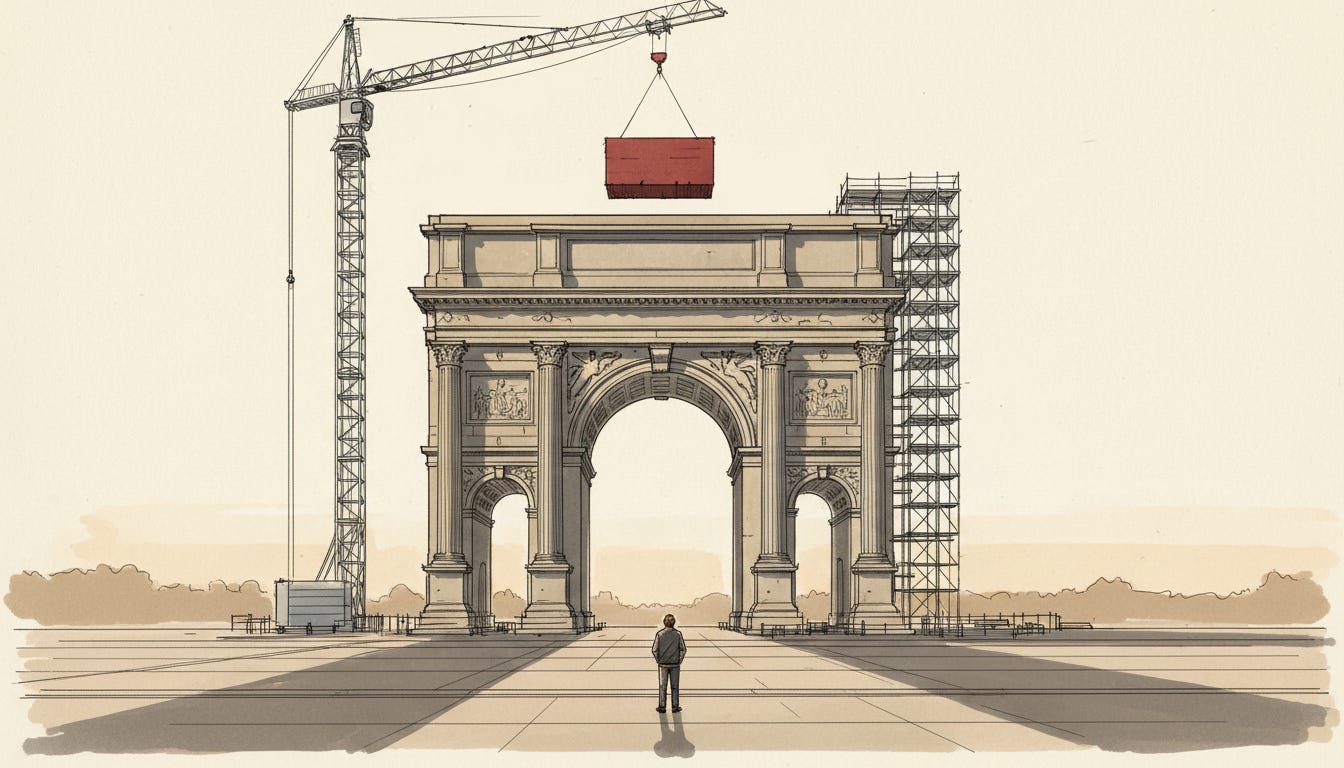
“Because I found out that nobody cared. I’m allowed to.”
— Donald Trump, asked by the New York Times why his family is doing business deals in his second term. Oval Office, January 7, 2026.
On Monday morning, July 6, 2026, Senator Ted Cruz stood in the White House at an event about children’s savings accounts and thanked the President of the United States for fixing a soccer game.
“On behalf of all Americans,” Cruz said, “thank you for getting rid of that ridiculous red card.”
Gianni Infantino, the president of FIFA, was standing in the room. He had brought the World Cup trophy with him.
Rewind five days. Santa Clara, California, round of 32. The United States is beating Bosnia and Herzegovina 2–0 when striker Folarin Balogun comes down on the ankle of defender Tarik Muharemović. The referee, Raphael Claus of Brazil, reviews the video and shows Balogun a straight red card.
You know what a red card means even if you’ve never watched a full match. Off the field. Out of the next game. It is the one punishment in sports that every eight-year-old on every pitch on earth understands, because it is absolute. FIFA’s own competition regulations say no protest may be made against a referee’s decision on the field. The disciplinary code says a sending-off automatically triggers suspension from the next match. Automatic. Not reviewable. That word is the entire point of the rule: there is no one to call.
The President of the United States called.
He confirmed it himself, on camera: “Yes, I asked for a review by FIFA.” The review that the rules of world football say cannot exist. Four days after the card, FIFA’s disciplinary committee announced that Balogun’s automatic ban was “suspended for a probationary period of one year” under a provision of its code that, per the BBC, had never once been used to suspend an automatic red-card ban at a World Cup. The committee offered almost no explanation. Belgium, who the United States happened to be playing next, filed a challenge. FIFA ruled it inadmissible. Belgium, it explained, was not a party to the proceedings.
The card still exists. The consequence is gone.
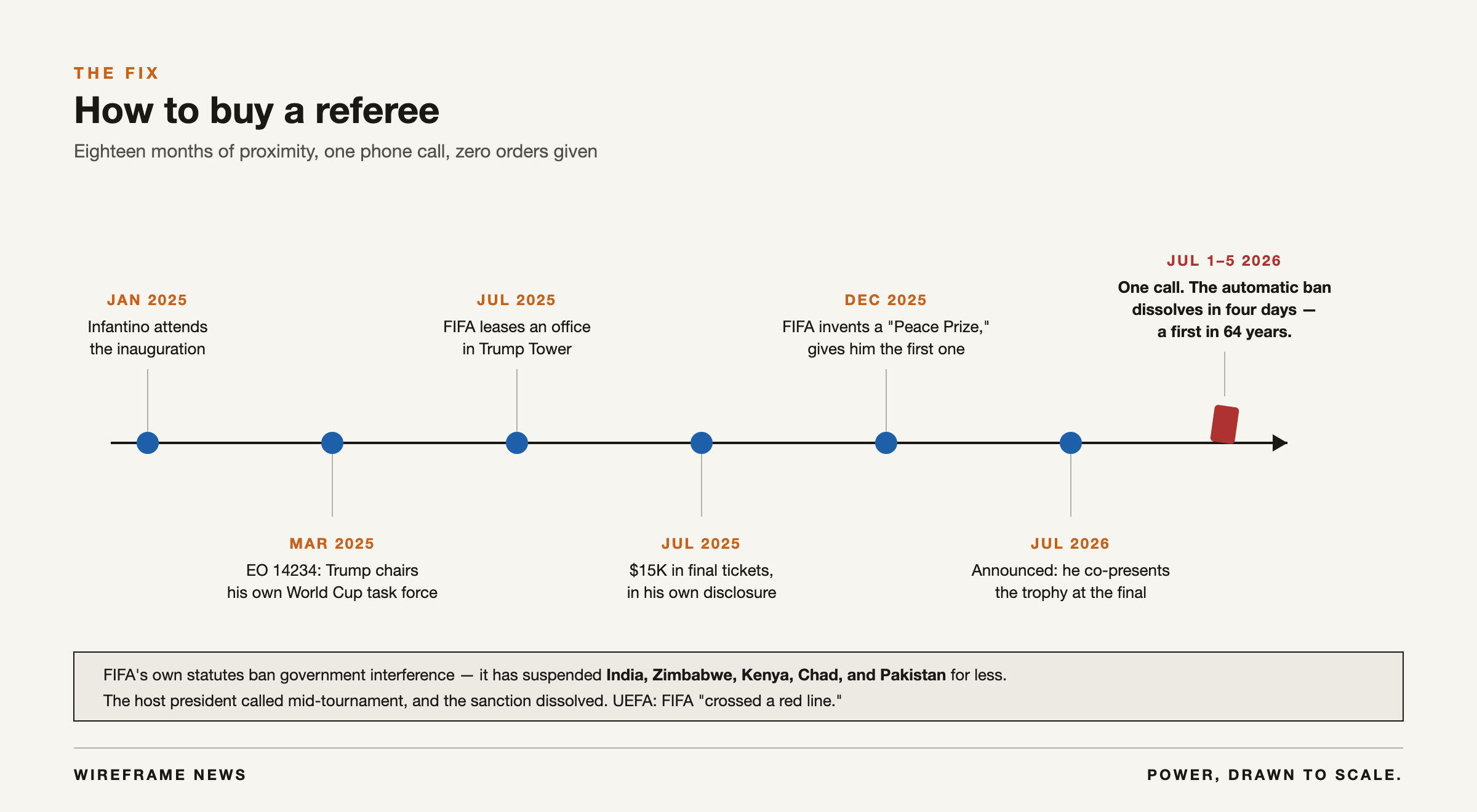
UEFA, the European football confederation, said FIFA had “crossed a red line” and called the decision “unprecedented, incomprehensible and unjustifiable.” Belgium’s coach, Rudi Garcia, went with sarcasm: “I didn’t know that in the offices of FIFA the 5th of July was the 1st of April in Europe.” And here is the detail that makes it more than a sports story: FIFA suspends entire countries for this. India, Zimbabwe, Kenya, Chad, Pakistan — national federations banned from world football because a government touched them. A court appointed an administrator; a ministry dissolved a board; suspension, immediate effect. That is the standard when the interfering government is Chad’s.
When the interfering government is the host’s, and the host’s president chairs the World Cup task force he created for himself by executive order, and FIFA rents an office in his family’s tower, and its president handed him an inaugural “FIFA Peace Prize” at the Kennedy Center seven months ago, the sanction dissolves in four days and a senator says thank you while the trophy sits in the room.
The last time a World Cup red card went unpunished was 1962. Garrincha, Brazil’s winger, in the semifinal. The deciding witness left the country before testifying, the president of Chile signed the petition, and the president of Peru personally called the referee. It took two heads of state and a vanished linesman.
Sixty-four years later it took one phone call, because this time nobody had to hide anything.
Is this really America in 2026? It is. And the red card is the smallest item on the ledger, it just happens to be the one where you can see the whole machine in ninety seconds. A rule that binds everyone. A phone call that unbinds one man. An institution that rewrites its own code to accommodate him. And an official thank-you, delivered in public, because no one involved believes there is anything to be embarrassed about anymore.
The rest of this piece is about the bigger items. What they have in common is not that they were hidden. It is that they were filed.
The Fix
How do you buy a referee? Not the one on the pitch. The institution above him.
You don’t do it with a bribe. Bribes are for amateurs and they leave paper. You do it the way it was done here, in eighteen months, in public, one unremarkable step at a time.
The president of FIFA attends the inauguration and posts that together “we will make not only America great again but also the entire world.” Seven weeks later, the president of the United States signs Executive Order 14234 creating a White House task force for the World Cup and names himself its chairman. Rudy Giuliani’s son is installed as executive director. That summer, FIFA leases an office in Trump Tower, in the family’s own building; the New York Times later reports the office sits largely unused, which tells you what was actually being rented. Infantino hands over ten tickets to the Club World Cup final, fifteen thousand dollars’ worth, an amount we know precisely because it appears in the president’s own financial disclosure. In December, at the World Cup draw, FIFA invents a “Peace Prize” and gives the first one to Trump at the Kennedy Center, arranged so hastily it never appeared on a FIFA Council agenda. A London rights group files an ethics complaint citing FIFA’s own political-neutrality rule; fifty members of the European Parliament sign a letter demanding it be acted on. Nothing happens. By summer, Infantino has announced that the president will personally co-present the trophy at the final on July 19.
Then, and only then, comes the phone call about the red card. By the time it was placed, there was no one left on the other end who could afford to say no.
The red card wasn’t a breakdown of the Trump–FIFA relationship. It was the relationship’s first invoice.
And FIFA is one mid-sized institution. It just happens to be the one whose surrender was televised during a group stage. The same proximity playbook, run against institutions that actually spend your money, is the rest of this piece.
Someone Else Always Pays
Every project has the same press release. Someone else is paying. Mexico. Qatar. Private donors. “Me, personally.” And every project has the same closing entry in the books, discovered later, in a government document, after the announcement has done its work: you paid, and you paid more than the number they announced.
Anyone who has ever run a construction project knows this contractor. The bid comes in impossibly low, because the bid’s job is to win the job. The truth arrives afterward, change order by change order, when the client is too committed to walk away. The client who accepts a lowball bid still holds one protection: the contract, and the right to audit against it. Now remove the audit. Remove the contract. Make the client legally obligated to keep paying whatever the number becomes.
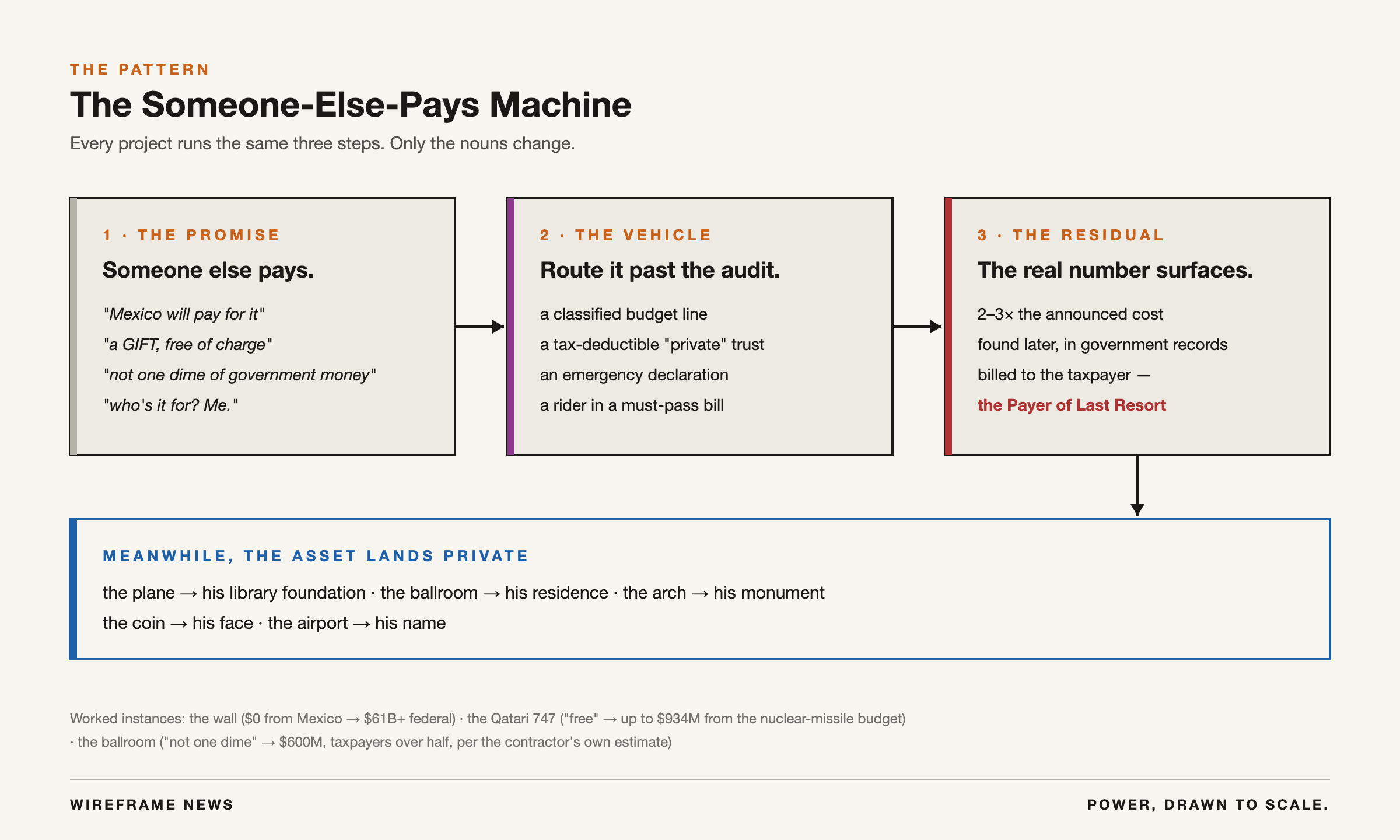
The pattern was prototyped before he ever took office, on the wall. Mexico will pay for it, the single most repeated promise of the 2016 campaign. Mexico paid nothing. You paid roughly fifteen to sixteen billion dollars for it in the first term, more than half of it quietly diverted from military construction budgets under an emergency declaration. And then last July, in the big reconciliation bill, Congress appropriated $46.5 billion more for wall construction in a single line, three times the entire first-term spend. Notice what didn’t happen: nobody claimed Mexico would pay. The promise had done its work a decade ago. The invoices simply switched to your name, and everyone had been trained not to read them.
Once you see the three steps, you see them everywhere.
Announce that someone else pays. Route the money through a vehicle nobody can audit. Let the real number surface later, after the asset is already his.
The plane ran the full sequence in fourteen months. Qatar’s 747 was “a GIFT,” in his capitalization, and “free” in his telling: “I could be a stupid person and say, ‘No, we don’t want a free, very expensive airplane.’” Start with the word gift: CNN reported that the administration approached Qatar about the plane first, not the other way around. Then the word free: the jet, which Bloomberg valued at $100 to $125 million used, needed conversion into a flying command post. The Air Force secretary told Congress the retrofit would run “probably less than $400 million.” The New York Times then found $934 million moved out of the Sentinel program, the nuclear-missile modernization that is already tens of billions over budget, toward an unnamed classified project that Air Force officials privately identified as the plane. Independent experts put the true conversion cost above a billion dollars. You will never see the final number, because it is classified inside the nuclear deterrent’s budget line. And the destination completes the pattern: by January 1, 2029, the aircraft transfers to the Donald J. Trump Presidential Library Foundation. The public paid to gut-renovate the nuclear deterrent’s piggy bank into a private plane for a foundation with his name on it. That is what free costs.
The ballroom is the same machine with a shorter timeline and better documentation. July 2025: a $200 million ballroom, paid for by Trump and private donors, “not one dime of government money.” October: the East Wing of the White House, which he had said the project would not touch, is demolished. March 2026: he concedes the number is $400 million, still insisting “we have no taxpayer putting up 10 cents.” What he knew by then, and what the Washington Post pulled out of internal records in June, is that his own contractor had already put the figure at $600 million, with the private share at $293 million and the majority of the balance assigned to you, through the Secret Service and the White House Military Office. Senate Republicans meanwhile tried to slip an additional one billion dollars of “security improvements” into the border bill; the parliamentarian struck it. And the “private” money deserves its own asterisk: it flows through a nonprofit, tax-deductible, from donors named Amazon, Meta, Google, and Lutnick; companies and families with business in front of the administration. The one name missing from the donor list is the man who promised to pay for it himself.
Three projects, one client. The client from the contractor story, the one with no audit, no contract, and a legal obligation to keep paying whatever the number becomes, has a name in this administration’s books: the Payer of Last Resort. It’s you.
From there the ledger accelerates, so read it the way it reads best, as line items:
A 250-foot triumphal arch for the capital. Asked who it’s for: “Me. It’s going to be beautiful.” Fifteen million dollars of National Endowment for the Humanities money committed to it in the same period the administration is zeroing out humanities grants for everyone else.
A $30 million military parade on his birthday. $13.1 million to repaint the Lincoln Memorial’s reflecting pool basin “American flag blue,” $40 million for a statue garden, $162.5 million of vanity work itemized by Forbes before the ballroom is counted.
$101.2 million of your money on golf-trip security by March, on pace to more than double the first term’s total.
$257 million to the Kennedy Center, six times its normal federal support, in the same bill cycle that eliminated the National Endowment for the Arts, followed in December by his handpicked board voting to add his name to the building, a rename federal law reserves for Congress, on a call where a dissenting board member says she was muted.
And when money isn’t the instrument, the name is:
Per NBC’s reporting, a proposition delivered to Chuck Schumer: sixteen billion dollars in withheld Gateway tunnel funds could move if Penn Station and Dulles airport were renamed for Trump. Public infrastructure money, held as ransom for monuments.
The Mint has approved a $1 coin with his face for the semiquincentennial. Treasury confirms it is doing “planning and due diligence” on a $250 bill with his portrait. Federal law has required currency portraits to be of the dead since 1866, a rule written after the last time a living official put himself on the money.
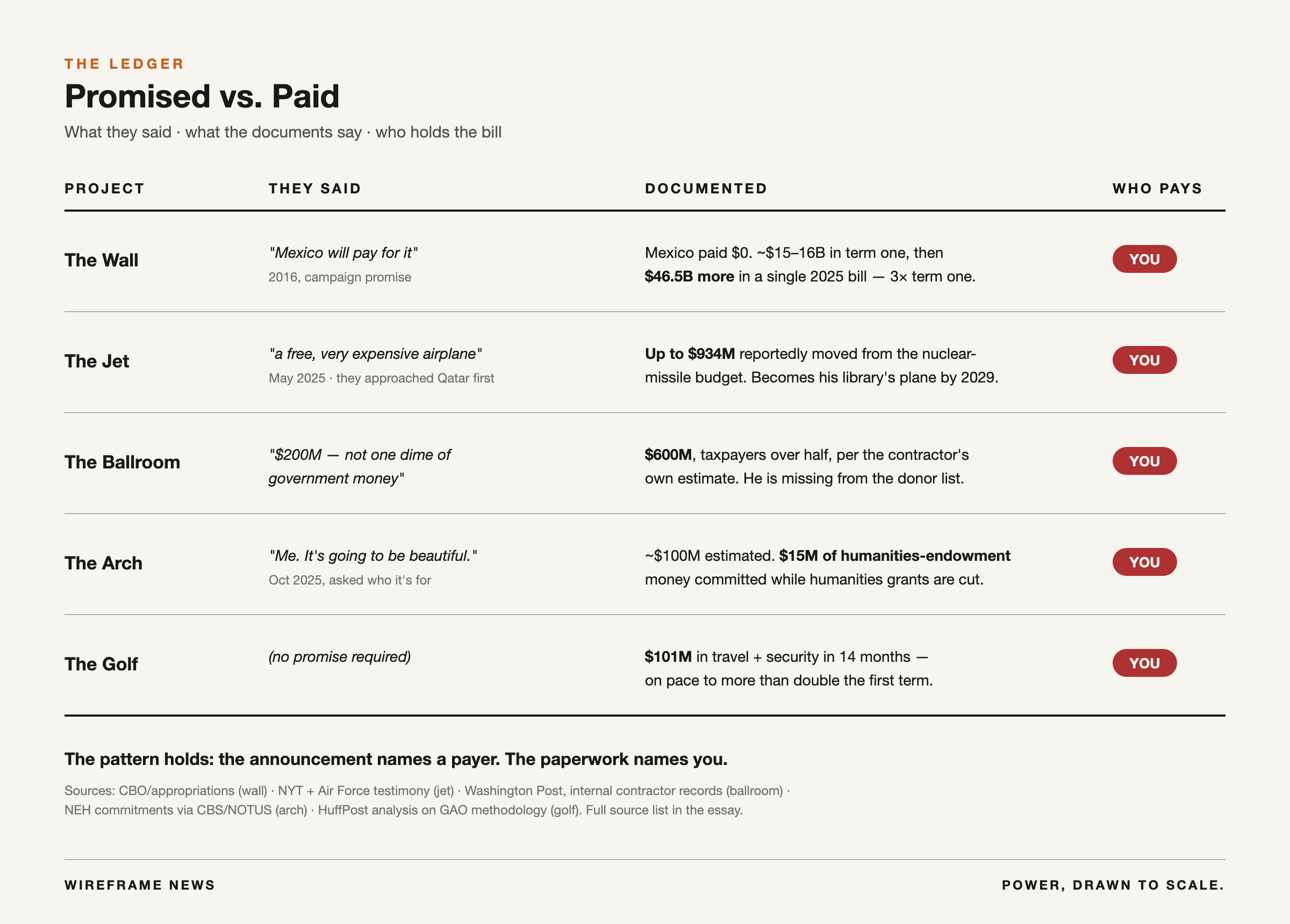
Look down the asset column of that ledger and notice where everything lands. The plane goes to his library. The ballroom attaches to his residence. The arch is his monument, the coin is his face, the airport would be his name. The cost column lands on the Payer of Last Resort; the asset column lands on him, often with licensing attached to the name for the family.
A gift for the country in this administration is something you will eventually pay for at three times the sticker price, and never own. And pay the family in perpetuity for the pleasure of the gift.
The Filing Cabinet
Last winter I closed a three-part series on presidential corruption by asking whether we’d notice. The trilogy tallied the machine’s first-year throughput from the outside, deal by reported deal. What’s changed since isn’t the machine. It’s the paperwork. The machine now files an annual report.
On June 30, the Office of Government Ethics released the president’s 2025 financial disclosure. He took a 45-day extension and paid late-filing fees, the way you or I might pay a parking ticket. The filing runs 927 pages and discloses roughly $2.2 billion in income for the year, along with more than 21,000 stock trades executed on his behalf, which is more in-office trading than every previous president combined has ever disclosed.
The largest share is crypto: $635 million in royalties from the company that issues the $TRUMP memecoin, more than half a billion from token sales at World Liberty Financial, the family’s crypto venture, plus equity sales on top. Against that, the entire legacy empire; Doral at $121.8 million, Mar-a-Lago at $77.4 million after the initiation fee doubled to $1 million, looks almost quaint.
A sitting president earned more from tokens his administration regulates than from every hotel and golf course he owns.
Every one of those crypto dollars has a counterparty, and the government’s filing doesn’t list them. Other documents do. The $TRUMP coin’s retail side was measured this month by the analytics firm Nansen, relayed by the Times: nearly a million investors lost a combined $3.8 billion on the coin whose issuer paid him $635 million in royalties. One of them is Nicholas Pinto, who told the Times he voted for Trump in 2024 and lost hundreds of thousands of dollars of his own money in the coin. His verdict: “It is almost a legal scam.” Sit with the almost, it is carrying the entire body of American anti-corruption law. The loss is not a bug in the scheme; it is the scheme. Blockchain-analytics firms tracked $324 million in trading fees flowing to creator-linked wallets, and then the analytics firms stopped covering the coin. Even the meter reader went home.
At World Liberty Financial, the counterparties are governments. Four days before the inauguration, a vehicle controlled by Sheikh Tahnoon bin Zayed, Abu Dhabi’s national security adviser, paid $500 million for 49 percent of the venture; roughly $187 million of it flowed through to Trump family entities, and $31 million to the family of Steve Witkoff, the president’s Middle East envoy. The deal wasn’t disclosed to you; the Wall Street Journal found it a year later. Abu Dhabi’s state fund MGX then paid its $2 billion Binance investment in USD1, the family’s stablecoin, which Binance itself holds 87 percent of, a two-billion-dollar deposit generating yield for the family in perpetuity. Binance’s founder, a convicted felon, spent $800,000 lobbying for clemency, including $450,000 to a firm run by one of Don Jr.’s longtime associates, and received a full pardon. He is not unique. Trevor Milton, the Nikola founder convicted of securities fraud, donated $1.8 million to the campaign in October 2024 and was pardoned two weeks after prosecutors asked a court for $680 million in restitution to the shareholders he defrauded. The pardon extinguished the request. Across both terms, the pardons have erased roughly two billion dollars in court-ordered restitution, forfeitures, and fines. The victims found out from the news.
Then there is the leg of the machine that runs on your money going out rather than tribute coming in. The Times found at least fourteen companies tied to the president’s sons and the commerce secretary’s family seeking $8.9 billion in federal support for critical-minerals projects. One of them is on file at the SEC: the Commerce Department took a 10 percent stake in USA Rare Earth in a $1.6 billion package, and the firm hired Cantor Fitzgerald, the bank chaired by Commerce Secretary Lutnick’s son, as lead placement agent on the accompanying raise. Don Jr.’s venture firm grew from $200 million to $3.5 billion under management in a year while its portfolio companies collected north of $735 million in federal contracts. The sons’ drone company took its first Air Force order in April and is going public by merging into the family’s Nasdaq-listed golf-course vehicle, which is a sentence I did not expect to type either. The public underwrites the risk; the family banks the equity.
One more receipt, because it is the purest of them all. Remember the settlements — ABC’s $16 million, Meta’s $24.5 million, Paramount’s $16 million, X’s $8 million, YouTube’s $22 million, some $63 million in corporate legal surrender pledged to the Donald J. Trump Presidential Library Foundation. In September, Florida administratively dissolved that foundation for failing to file its annual report. In December, it was formally dissolved.
Sixty-three million dollars, pledged under regulatory pressure to an entity that no longer exists, and as of this writing no one, not the senators demanding answers, not the companies that paid, can say where the money went.
And at the retail end of the same instinct: 590,000 people put down $100 deposits on a gold Trump-branded phone. This May, the fine print was rewritten to say the device “does not guarantee” it will ever be produced.
Not one number in this section is leaked, alleged, or anonymous. It is OGE filings, SEC documents, court records, state dissolution records, and the family’s own announcements. The trilogy’s question, whether we’d notice, assumed the evidence would need finding. It didn’t. The take was never hidden. It was filed. What he found out, in his own words, is that nobody cared. The next act is about how he made sure of that in advance.
The Alibi
Go back to the January interview the epigraph comes from. Four reporters from the New York Times, in the Oval Office, asked him directly why the family deals are happening now, in the second term, when he’d held them back in the first. “Because I found out that nobody cared. I’m allowed to.” Then the rationalization, offered without a flicker of embarrassment: George Washington, he explained, “had two desks. He had a business desk and he had a president desk, and he did both. It’s OK to do that.”
Nobody cared. Where did he learn that? Partly from surviving his first term. But listen to what else he reaches for in the same stretch of that interview: the Bidens. He raises them himself, unprompted, as the comparison that makes his own deals unremarkable. And that tells you what the years of “Biden crime family” actually were. Not just attack politics. Market research. If you can convince the country that every first family is a criminal enterprise, then a first family that actually operates one is just playing the game everyone plays. The accusation doesn’t merely wound the target. It repeals the norm for the accuser.
Now hold the two files side by side, because both investigations happened and both produced paper.
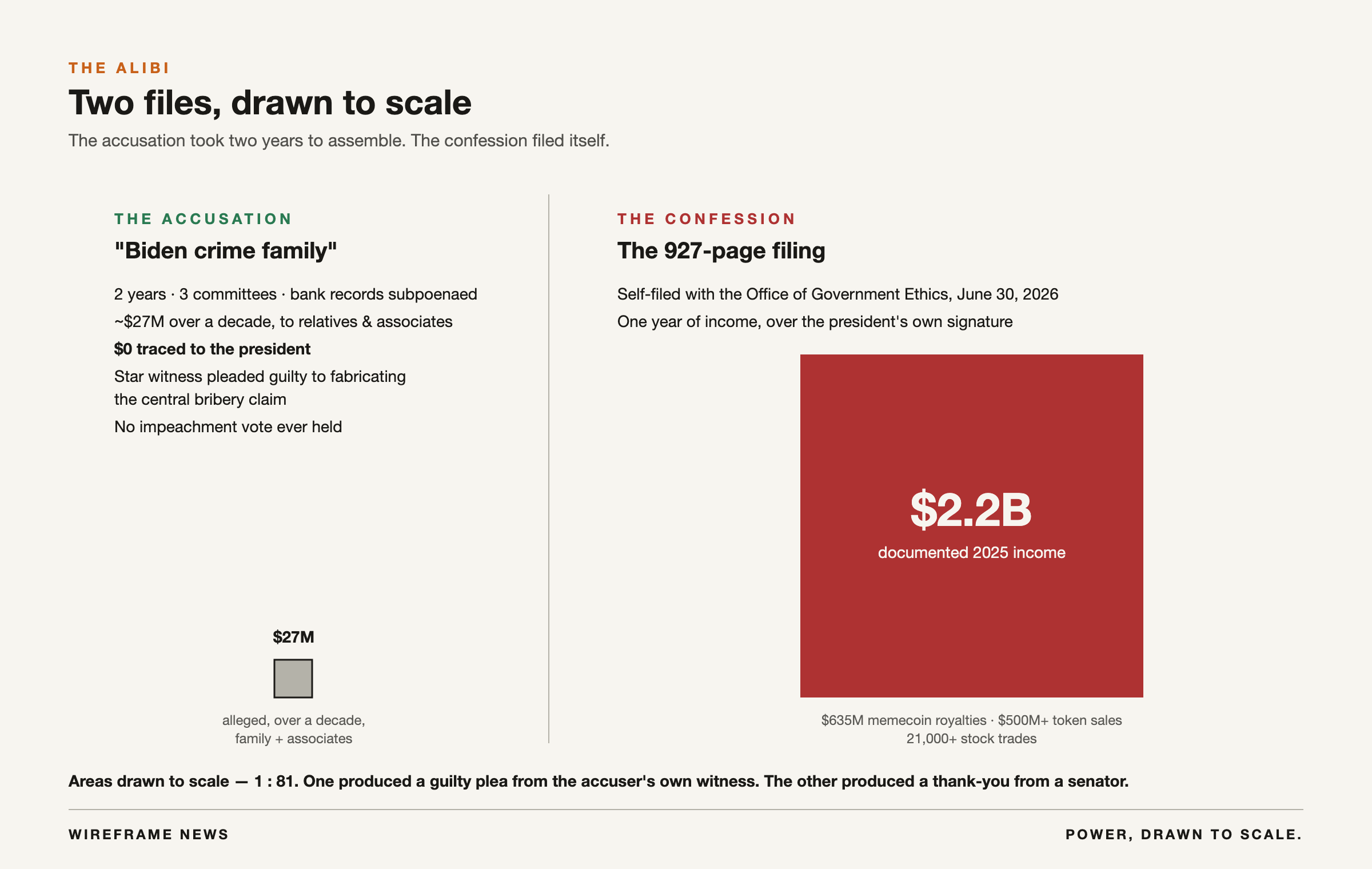
The Biden file: two years, three committees, dozens of subpoenas, the family’s actual bank records. Result: roughly $20–27 million in foreign consulting money, about $14M of it to business associates, the family’s share flowing mostly to Hunter, and zero dollars traced to Joe Biden. The bribery allegation at the center of the whole thing came from an FBI informant, Alexander Smirnov, who pleaded guilty to fabricating it and told investigators the material traced to Russian intelligence. Ken Buck, a Republican on Judiciary, said the quiet part on camera: evidence linking the president to a high crime “doesn’t exist right now.” By April 2024 Comer was telling colleagues the inquiry “had run its course.” The final report landed in an August recess week and asked for an impeachment vote that was never held.
The Trump file: no subpoena required. He filed it himself. Nine hundred twenty-seven pages, roughly $2.2 billion in one year’s income, $635 million of it royalties on a memecoin whose retail holders are underwater, more than half a billion in token sales from the family crypto venture, and 21,000-plus stock trades including up to $1 million of Nvidia bought on January 6, 2026, one week before his administration loosened Nvidia’s China export rules.
The comparison, stated with the precision it deserves: the Biden investigation documented a president’s relatives monetizing his name and never reached the president. The Trump disclosure documents the president himself, over his own signature, at roughly a hundred times the alleged scale. One of these produced a guilty plea from the accuser’s own witness. The other produced a thank-you from a senator.
And the machinery didn’t stop at rhetoric. The same years produced the enemies file: Comey and Letitia James indicted by a prosecutor so hastily installed, Trump’s own former personal lawyer, presenting to the grand jury alone, that a judge threw both cases out as unlawful exercises of executive power. A grand jury opened on Obama after the president posted an AI-generated video of his arrest; a year later, no indictment. A criminal referral on Adam Schiff that has so far produced only a DOJ probe into its own handling. The pattern isn’t that prosecutions failed. It’s that the accusations were never built to convict.
They were built to establish that everyone is guilty, because in a country where everyone is guilty, no one is.
You deserve the complications straight, so here they are. Hunter Biden committed real crimes and was convicted of them by a jury. His father pardoned him — sweepingly, covering a full decade of conduct, after promising on camera that he wouldn’t, and that pardon did real damage to the very norm this essay is defending. The consulting money was real: bank records show millions in foreign payments to the president’s relatives and their associates, and the appearance it created was genuine. Concede every word of that. Then notice what the concession is being used to buy: “everybody does it.” Everybody does not do it. The difference is not purity. The difference is scale, office, signature, and one man in this comparison wrote the number down himself, because he found out that nobody cared.
The Repair Manual
So what do you do about it? Fourteen months of this series has been diagnosis. Receipts, arithmetic, named mechanisms. That was the necessary half: you cannot fix what you refuse to measure. But diagnosis without prescription curdles into something worse than silence. It teaches people the theft is a fact of weather. It isn’t. Every mechanism in this piece runs through a gap in written law, and gaps in written law have a known repair procedure.
Start with why no one is charged, because the answer is not “the evidence is thin.” The evidence is a 927-page government filing. The answer is that the statutes were built for a different shape of corruption.
American law has no standalone influence-peddling offense. Bribery under 18 U.S.C. § 201 requires proving a corrupt exchange for a specific official act, and the Supreme Court’s McDonnell decision in 2016 shrank “official act” so far that arranging meetings and making calls no longer counts. The conflict-of-interest statute, § 208, covers an official’s spouse and minor children. It does not reach an adult son. Every deal in this piece that runs through Don Jr. or Eric is legal not because it is clean but because the statute stops at their eighteenth birthdays. The Office of Government Ethics can collect disclosures; it cannot enforce anything. The blind trust every president from Carter to Biden used was a custom, not a law. Customs bind the ashamed.
Translate that into a builder’s terms, because that is what it is. The system did not fail a stress test. The system was never load-rated for an operator who reads the code and does exactly what it doesn’t prohibit.
The law assumed shame would carry the load the statutes didn’t, and shame has been removed from the building.
Each gap names its own repair:
Write the influence-peddling offense. Most democracies have one. Criminalize the monetization of access itself, not just the provable quid pro quo.
Extend § 208 to adult children and siblings of the president, vice president, and cabinet, with mandatory divestment or recusal where family financial interests intersect official action.
Make the blind trust a statute. Mandatory, verified, enforced, for presidents and cabinet secretaries. Carter put a peanut farm in one. The bar was never high.
Repair “official act.” Congress can define the term McDonnell narrowed. A meeting arranged, a call placed, a review requested; write them back in.
Give OGE teeth. Subpoena power, civil penalties, an enforceable disclosure regime with real deadlines instead of 45-day extensions and late fees priced like parking tickets.
Give the Emoluments Clause an enforcement statute — standing, penalties, and a definition that covers a $400M aircraft routed through the Air Force to a presidential library.
Drag clemency into the light. The pardon power itself is constitutional and cannot be statute-proofed, so aim at what can: mandatory disclosure of who paid whom to lobby for a pardon, and a standing report of every dollar of court-ordered restitution a pardon extinguishes. The Milton pardon erased a $680 million restitution request two weeks after prosecutors filed it. The victims learned there was no line item for them from the news.
If that list sounds utopian, the uncomfortable fact is that most of it has already been drafted, voted on, and passed by a chamber of Congress. The Protecting Our Democracy Act went through the House in December 2021. Pardon-abuse provisions, emoluments enforcement, inspector-general protections, penalties for Hatch Act violations. It died in the Senate, and everyone moved on. The repair manual is not waiting to be written. It is sitting in a drawer.
And before you say none of this passes the current Congress: correct. That is not the argument against writing it. That is the argument for writing it now. The Ethics in Government Act, the Inspector General Act, the strengthened FOIA — the entire accountability architecture we just watched get disabled was drafted while Nixon was still popular and enacted in the two-year window after he fell. Watergate did not produce reform because the system worked. It produced reform because people had the repair manual ready when the window opened. The 1968 Match Plan made this same bet about wealth concentration. This is the governance version of the bet.
Which leaves the part that is actually yours. The Assembly Line series ended with a question: whether we noticed. Noticing turned out to be insufficient. Saturation is the machine’s ally. Each week’s receipt buries last week’s, and a scandal that cannot be remembered cannot be answered. So the work distributes:
Personal. Keep the receipts. Not metaphorically: bookmark the trackers that do cumulative accounting instead of daily outrage — CREW’s foreign-deal tracker, American Oversight’s litigation docket, the disclosure documents themselves, which are public and readable. When the FIFA story surfaces at a barbecue this week, you now know the number that goes next to it: $2.2 billion, filed on the president’s own signature, five days before the phone call.
Collective. Fund and share the institutions doing memory work, because memory is the scarce resource. Newsrooms doing forensic accounting. Watchdogs with standing to sue. This publication runs its own version — the Extraction Ledger, a running, sourced tally of what the presidency takes, updated as the receipts land. This essay is its Edition Zero.
Structural. One question for every candidate who wants your vote in November, at every level, phrased so it cannot be waved off: Will you vote for an influence-peddling statute, a mandatory presidential blind trust, and conflict-of-interest coverage for adult children — yes or no? Not “do you oppose corruption.” Everyone opposes corruption. Name the three repairs and make them say the word no out loud.
The men in this piece are betting that you can’t hold four numbers in your head for two years. The wall’s $46.5 billion. The ballroom’s missing half. The 927 pages. The red card.
Four numbers. Hold them.
The United States lost to Belgium 4-1, and Balogun, who by every written rule of the sport should have been watching from the stands, was on the pitch. So you have to ask yourself, was it worth it?
This World Cup proved something that nothing else could: people just want to live their lives, enjoy themselves, and cheer for their country. The Tartan Army took over Boston, fans from Japan loved Texas ribs, some marveled at what America has to offer. The gathering of nations showed the world that outside the elite, we the people get along just fine.
On July 19 the president will stand at midfield in New Jersey and hand the trophy to the champion, because Infantino announced he’ll co-present it. The trophy from the last final is already in the Oval Office.
That’s the deal on offer to you, by the way. That’s what the grift pays you: your team loses, but your striker plays. It costs you a red card’s worth of rules at a time, and the bill, as always, arrives later, made out to the payer of last resort, you and your family.
Sources
The red card / the fix: AP via PBS — FIFA lifts the suspension after Trump calls Infantino · ESPN — Trump confirms the call · PBS — Cruz’s thank-you · CBS — UEFA: “crossed a red line” · Al Jazeera — why it’s unprecedented · Euronews — Belgium’s challenge ruled inadmissible · Yahoo — straight reds can’t be appealed · Fox Sports — Garrincha 1962 · EO 14234 · AP — the Trump Tower office and the Peace Prize · CNBC — the $15K in tickets · FairSquare ethics complaint
Someone else always pays: CNBC — the jet’s first flight · NYT / Forbes — the $934M Sentinel transfer · CNN — the administration approached Qatar first · The Hill — “a free, very expensive airplane” · Washington Post — the $600M contractor estimate · FactCheck.org — who’s paying for the ballroom · PolitiFact — the East Wing flip-flop
The filing cabinet: CNBC — the disclosure · CBS — the crypto components · Time — the 927 pages · NYT — nearly 1M investors lost $3.8B · CNBC — the $500M Tahnoon stake · Fortune — $187M to the family · Forbes — Binance holds 87% of USD1 · CNBC — the CZ pardon · WaPo — the Milton pardon · SEC — USA Rare Earth 8-K · Warren/Wyden/Van Hollen letter · Bloomberg — the sons’ drone order · Warren — settlements to a dissolved library fund · Fortune — Trump Mobile’s fine print · CREW — 24 foreign projects
The alibi: The NYT interview transcript — “nobody cared. I’m allowed to.” · WaPo — “the president can’t have a conflict of interest” · PolitiFact — where the “$20M to the Bidens” went · The impeachment inquiry’s final report · CNN — “run its course” · Lawfare — the postmortem · DNI — the Gabbard referral · Snopes — the AI arrest video · NBC — Comey and James dismissals · NPR — Bolton’s guilty plea · SCOTUS — Trump v. Cook · CNN — the Hunter Biden pardon
The repair manual: 18 U.S.C. § 208 · McDonnell v. United States · The Protecting Our Democracy Act · CREW tracker · American Oversight · House Oversight tracker