


THE DAILY · FRI SEPTEMBER 11, 2026 · 5 ITEMS
THE FRAME
The Pentagon punishes the AI lab that wouldn’t drop its safety terms, and rewards the one that did. The president’s own party’s election officials go over his head to the Supreme Court. His sons’ investment funds sit inside the same defense budget their father controls. A Harvard Law professor spends forty minutes explaining, on the record, why none of it is clearly illegal. Four tests of the same idea: the rules only bind whoever still believes they apply.

FIG.01 · ABC NEWS · SEP 11
Punished for the Terms It Wouldn’t Drop
WHAT HAPPENED
Trump ordered every federal agency to stop using Anthropic. After a Friday deadline passed, Defense Secretary Pete Hegseth designated the company a national-security “supply chain risk,” a label usually reserved for foreign adversaries. Anthropic had refused to drop two conditions from its Pentagon contract: no fully autonomous weapons making final targeting decisions, no mass domestic surveillance. OpenAI, which agreed to nearly identical protections in its own Pentagon deal, faced no penalty.
WHAT IT MEANS
Anthropic says the Pentagon’s revised contract language would let those safeguards be “disregarded at will,” and calls the designation “legally unsound,” a fight it says it will take to court. Hegseth’s framing inverts the story: “America’s warfighters will never be held hostage by the ideological whims of Big Tech. This decision is final.” Two labs asked for the same guardrails. Only one got punished for insisting on them.
WHY IT MATTERS
Anthropic gets a six-month transition before the designation bites. Watch the court challenge, and whether other contractors read this as a warning to soften their own terms before their next Pentagon renewal.
[war-machine] [ai-safety]
Connects → The Open Skies Doctrine

FIG.02 · WASHINGTON POST · SEP 10
His Own Party Tells the Court No
WHAT HAPPENED
Five Republican secretaries of state, plus Utah’s lieutenant governor, joined more than three dozen election officials asking the Supreme Court to leave in place a district-court order limiting Trump’s mail-ballot rule. The signers include Georgia, Kentucky, Kansas, North Dakota and South Dakota. Judge Indira Talwani’s order lets USPS implement parts of the rule but bars it from rejecting mail that doesn’t comply; a three-judge 1st Circuit panel denied the administration’s bid to stay that order Thursday.
WHAT IT MEANS
The officials take no position on whether the rule is legal. Their objection is administrative: “Ballots have been prepared and proofed. Poll workers and other election officials have been trained on processes,” and “late changes almost always lead to unforeseen consequences.” When the president’s own party’s election administrators say implementation itself is the danger, the rule’s problem stopped being ideological.
WHY IT MATTERS
The Court hasn’t ruled. Watch whether it treats an emergency stay request from the losing side as routine, or notices that the officials asking it to stay out are the ones who’d actually have to run the election.
[rolling-coup]

FIG.03 · YAHOO FINANCE · SEP 11
Invested Where Dad Signs the Checks
WHAT HAPPENED
Investment firms run by Donald Trump Jr. (1789 Capital) and Eric Trump (American Ventures, under Dominari Holdings) hold stakes in defense-tech startups. The Washington Post reports those companies have already landed an estimated $3.1 billion in Pentagon contracts since the administration began, with another $3.1 billion in potential future work identified, and a projected $200 billion more in Pentagon contracts guaranteed down the road with exclusive bidding rights.
WHAT IT MEANS
Nobody has shown the sons had advance knowledge before investing. But the fund managers are the president’s own children. The contracts come from an agency their father runs. One attorney watching the pattern put the concern plainly: if the family “received intel about particular government contracting business prior to investing... there certainly appears to be malfeasance.” The concern is proximity, not proof. And proximity is the whole business model.
WHY IT MATTERS
Democratic lawmakers have already asked the Pentagon’s inspector general to investigate a related $3.2 billion slice of this same portfolio. Watch whether that request becomes an actual probe, or joins the pile the IG’s office hasn’t acted on.
[grift-extraction] [war-machine]
Connects → Payer of Last Resort

FIG.04 · VIDEO · INTERESTING TIMES (NYT OPINION) · SEP 10
“That Does Count As a Kleptocracy”
WHAT HAPPENED
Christopher Caldwell opened the New York Times’s Interesting Times by noting Trump has made more than $2 billion since returning to office. His guest, Harvard Law’s Jack Goldsmith, who ran the Bush-era Office of Legal Counsel, put a harder number on part of it: $1.4 billion disclosed from 2025 alone. Much of it ran through crypto vehicles, Goldsmith said, including World Liberty Financial, where UAE-linked entities bought a 49% stake for what he estimated, without a firm figure, at “$400 or $500 million.”
WHAT IT MEANS
Goldsmith won’t call it illegal. The president is exempt from the conflict-of-interest regime binding every other federal official, and the bribery standard is “very hard to meet.” But asked directly whether the pattern counts as kleptocracy, he doesn’t hedge: “that corner of policy... does count as a kleptocracy.” He also names a receipt. The UAE investment landed in roughly the same window as the administration’s reversal of a Biden-era block on advanced Nvidia chip exports to the UAE. It’s a policy the prior administration held back specifically over China-proliferation risk.
WHY IT MATTERS
Goldsmith’s own diagnosis: the emoluments clause exists exactly for this, Congress hasn’t used it, and the courts haven’t engaged. Watch the next World Liberty Financial disclosure filing, or any congressional subpoena targeting its foreign investor records, whichever comes first.
[crypto-kleptocracy] [rolling-coup]
Watch → on YouTube
FIG.05 · AMBCRYPTO · SEP 11
$1.4 Billion, and a Bill Built Around It
WHAT HAPPENED
Trump made $1.4 billion from crypto last year, more than his entire real estate empire. The figure surfaced as he pushes Congress to pass the Clarity Act, the bill meant to set federal digital-asset rules, by September 15.
WHAT IT MEANS
Senate Banking Committee Democrats say the bill’s ethics language wouldn’t have stopped a single dollar of this year’s profits. “Democrats want the bill to come with real ethics rules that actually address the president’s own crypto holdings, and unless it does, they are not backing it.” Goldsmith’s interview above supplies Trump’s own explanation for the second term’s acceleration: no one punished the first one.
WHY IT MATTERS
Watch the Clarity Act’s next markup for whether an ethics amendment that actually binds Trump’s own holdings survives contact with the industry lobbying for the bill’s passage.
[crypto-kleptocracy] [grift-extraction]
What to Watch
Anthropic’s court challenge — Whether the ‘supply chain risk’ designation survives, or sets the pattern other contractors read as a warning.
The SCOTUS mail-ballot ruling — Whether the Court notices the plaintiffs this time include the president’s own party’s election administrators.
The Pentagon IG’s inbox — Whether the call for an investigation into the Trump sons’ funds becomes an actual probe.
The next WLF disclosure — Whether the UAE investment picture gets independent scrutiny before the next filing.
The Clarity Act’s ethics language — Whether an amendment that actually binds Trump’s holdings survives markup.
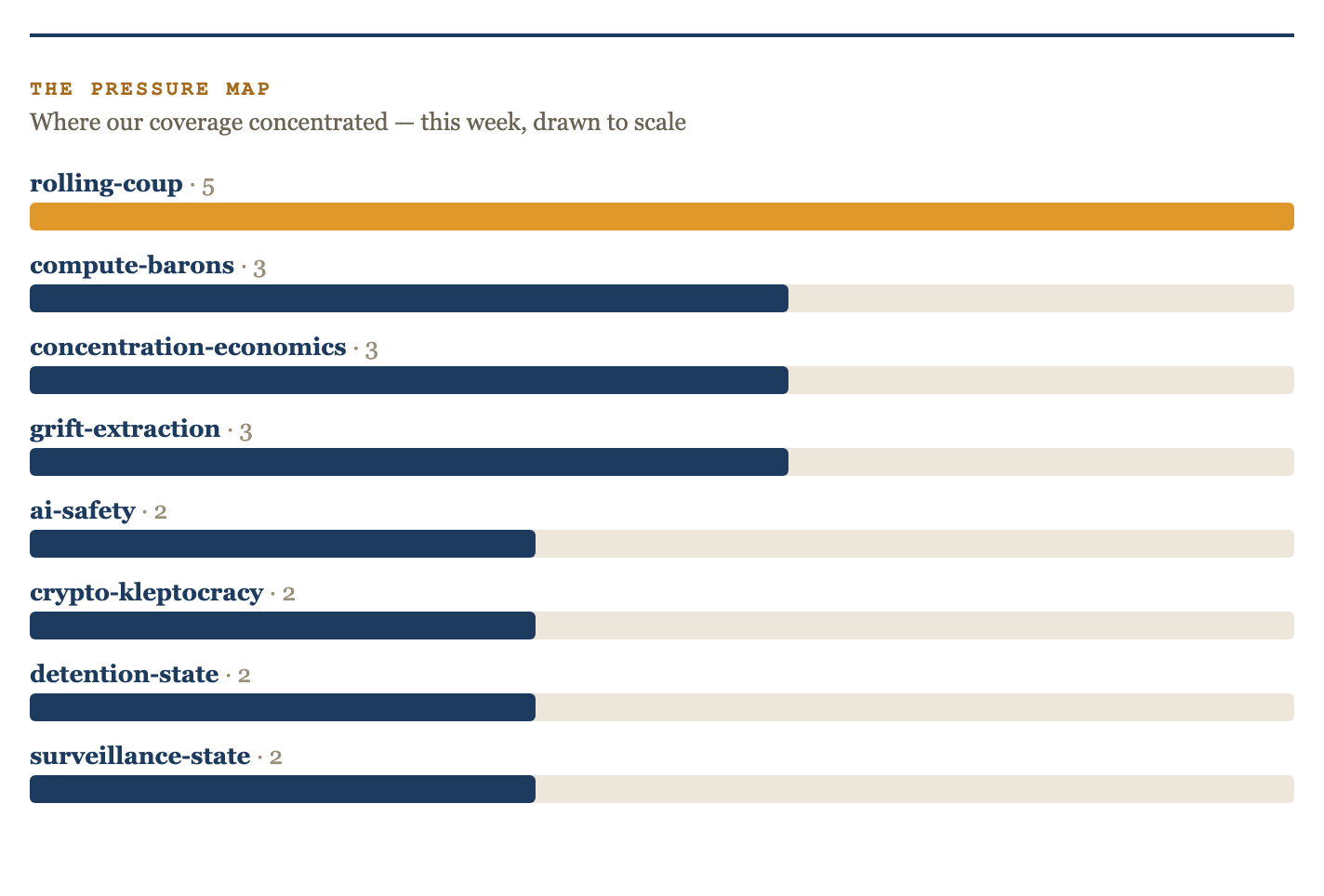
THE PRESSURE MAP — where our coverage concentrated this week, drawn to scale
THE LONG VIEW · FROM THE ARCHIVE — the daily is the fast news; this is the deep one.
Today’s Goldsmith interview and Clarity Act item are this essay’s argument delivered back by a Harvard Law professor and a Senate committee, eight months later.
The Tokenized Presidency, America’s First Blockchain Kleptocracy — The office itself, tokenized — a sitting president monetizing the presidency through crypto vehicles built to launder foreign money into personal wealth.
This is Wireframe News—four different offices, four different mechanisms, and the same discovery each time: the check only holds if the person it’s checking agrees to be checked.