THE DAILY · FRI NOVEMBER 27, 2026 · 4 ITEMS
Power, drawn to scale.


THE DAILY · FRI NOVEMBER 27, 2026 · 4 ITEMS
THE FRAME
The Pentagon reportedly weighed the Defense Production Act, a 1950 law, as leverage over Nvidia’s board, and says the talks never happened. It is in preliminary talks with automakers about drone parts. Poland and a German state have each decided who keeps the keys.


FIG.01 · WASHINGTON POST · NOV 25
The Pentagon Weighed a War Law for Nvidia
WHAT HAPPENED
Defense Secretary Pete Hegseth and his deputy, Steve Feinberg, discussed whether the threat of the Defense Production Act could be leverage over Nvidia’s board before it reinstated Jensen Huang on Monday, the Washington Post reported, citing three people familiar with the talks. The Pentagon told Newsweek the discussions “never happened.”
WHAT IT MEANS
The 1950 law lets a president make companies put national security orders first, and one administration official said it could “force Nvidia to shift more of its production to military projects.” WIRED, citing documents unredacted in a shareholder suit, reports a Commerce Department lawyer told Intel’s finance chief in 2025 not to make the “mistake of thinking that this is a negotiation” over a free 10% government stake.
WHY IT MATTERS
Intel’s board found the proposed terms unattractive “in their current form” and accepted a deal anyway. The suing shareholder says the board caved; Intel says it negotiated better terms. Trump says he “convinced” Nvidia’s board to bring Huang back.
[compute-barons] [war-machine]
Connects → Beat China, Become China?

FIG.02 · EXECUTIVEGOV · NOV 25
Detroit Asked to Build Drone Parts
WHAT HAPPENED
Automakers could supply motors and other components to U.S. drone makers under preliminary talks with the Pentagon, The Wall Street Journal reported Tuesday, per ExecutiveGov. Leaders at General Motors, Ford and Magna International have met defense officials, and no agreement has been reached. GM, which signed an agreement earlier this year covering Patriot missile housings for Lockheed Martin, has been the most receptive.
WHAT IT MEANS
The Pentagon plans to buy millions of drones, and defense leaders say many U.S. makers are small firms that cannot produce that volume. Pooled purchases are meant to make contracts large enough to profit from: “there has to be a dollar amount that justifies them switching over a factory,” said Max Strasiser of the drone effort.
WHY IT MATTERS
Automakers worry about funding, reputation and thin margins, and the political risk has grown since the midterms as Democrats examine Pentagon deals. The Pentagon is organizing the effort through an Autonomous Warfare Command it is targeting to launch in October 2027.
[war-machine]
Connects → When the Robots March South

FIG.03 · BROADBAND BREAKFAST · NOV 26
OpenAI’s Security Lead Came From the Pentagon
WHAT HAPPENED
Caroline Zier, OpenAI’s lead for national security strategic initiatives, was most recently deputy chief of staff to the secretary of defense, according to her professional bio, Broadband Breakfast reports. OpenAI’s July principles bar the military from using its technology “to direct autonomous weapons systems,” for mass domestic surveillance, or for high-stakes automated decisions.
WHAT IT MEANS
Those limits are written into OpenAI’s Pentagon contracts, and the company says it backs legislation on the highest-risk military uses. “The role of companies like ours is to help inform those decisions, not make them alone,” its statement says.
WHY IT MATTERS
Zier speaks on AI and catastrophic risk on December 1. The open question is which highest-risk uses OpenAI would have Congress restrict.
[war-machine] [ai-safety]
Connects → Should the DOD (DOW) control AI?

FIG.04 · REUTERS · NOV 27
Europe Decides Who Holds Its Keys
WHAT HAPPENED
Poland signed a five-year deal worth about $300 million for Palantir software that uses AI to support army commanders’ decisions, Reuters reports. This week North Rhine-Westphalia became the first German state to decide to leave Palantir, picking Munich-based Celonis for police data analysis from late 2027, Anadolu reports.
WHAT IT MEANS
Both governments are answering the same question. Poland’s defence minister said “all keys, servers, and information” stay with its armed forces, and the German state’s new system will run on police-owned infrastructure.
WHY IT MATTERS
Palantir told Handelsblatt it has submitted no new bids for German security contracts since 2022, partly because policymakers conflate digital sovereignty with a German origin. Its software still runs in Bavaria, Hesse and Baden-Wuerttemberg.
[surveillance-state] [war-machine]
Connects → Our Tech Overlords, Minority Report is Here
What to Watch
December 1 — which military uses Zier says OpenAI wants Congress to restrict.
Paisner v. Nvidia — whether the shareholder’s records suit opens Nvidia’s board files the way his Intel case did.
Bavaria, Hesse, Baden-Wuerttemberg — whether a second German state follows before its Palantir contract ends.
AUTOWARCOM — whether pooled drone orders bring a first automaker contract.
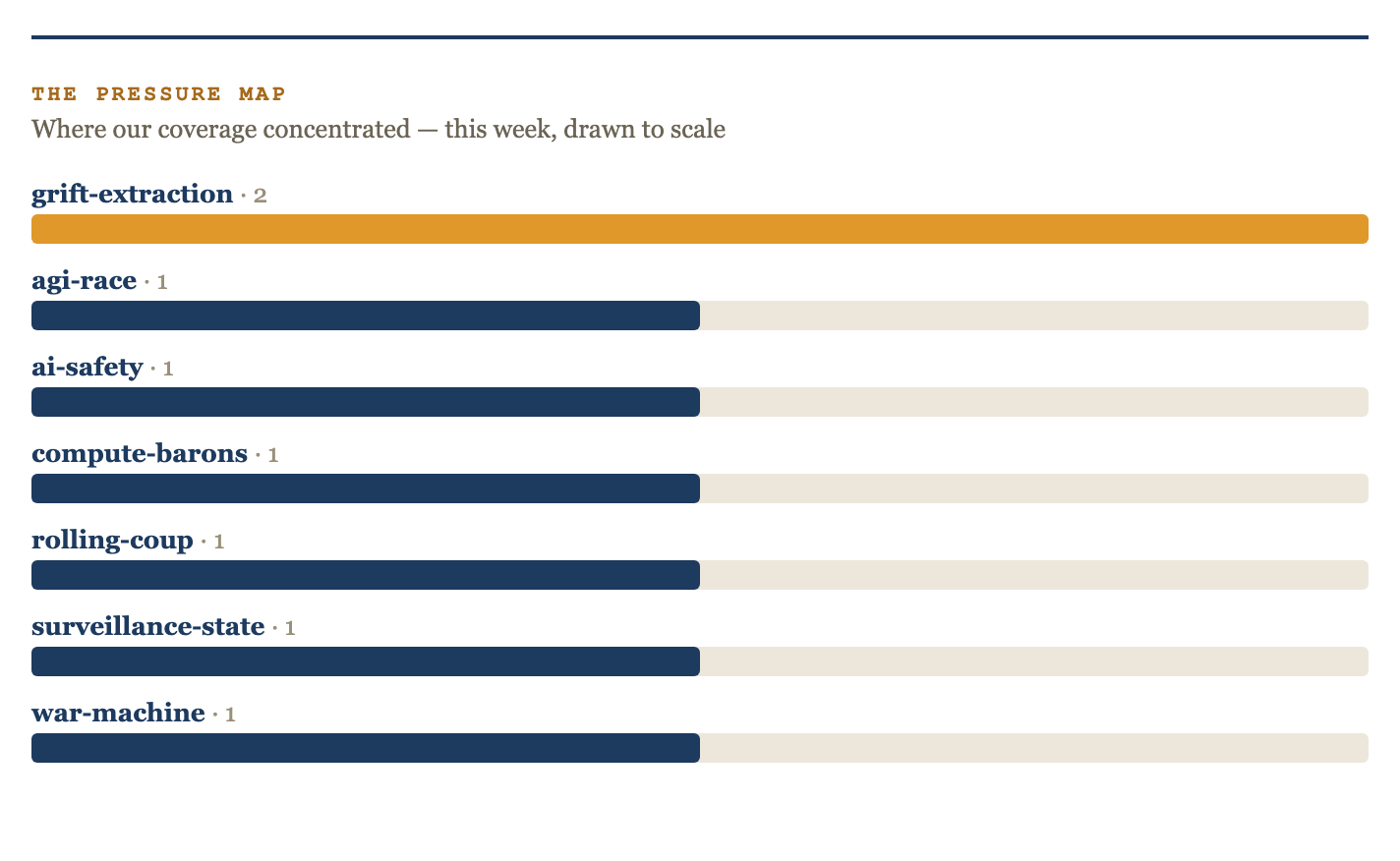
THE PRESSURE MAP — where our coverage concentrated this week, drawn to scale
THE LONG VIEW — the daily is the fast news; this is the deep one.

Fourteen to One — Eighteen months ago I wrote that history tells us to worry. The numbers since then say I wasn’t worried enough.
California certifies Prop 42, the measure that shuts the state door on a wealth tax, on December 11.
This is Wireframe News: the Pentagon says the talks never happened, and the outcome did.
Discussion about this post