Fourteen to One
Eighteen months ago I wrote that history tells us to worry. The numbers since then say I wasn’t worried enough.

On Thursday, November 19, Anthropic’s shares started trading on the Nasdaq under the ticker ANT. They had priced the night before at $83. They opened at $111.50 and closed the day at $97.17. The day before, the company had raised $81.3 billion, the largest initial public offering on record by proceeds.
That day Steven Rattner, who ran President Obama’s auto task force, posted a chart. Two bars. On the left, the stakes held by Anthropic’s founders and employees at that day’s close: about 5,300 people, $433 billion. On the right, the combined net worth of the bottom third of American households: about 45 million families, $432 billion.


One company’s staff, on one good day of trading, was worth more than the combined wealth of the bottom third of American households.
On Friday the stock fell 8.5 percent, to about $89, and the left bar dropped below the right one again. That’s the part that stayed with me. The comparison could flip back and forth on a day’s trading because the two numbers are now close enough to flip. A few thousand people and 45 million households are fighting over the same rounding error.
The week before, the New York Fed put out its quarterly report on what American households owe: $19.1 trillion, up $334 billion in three months, with 5 percent of it in some stage of delinquency.
Before the French Revolution
In May 2025 I wrote a four-part series on the Gilded Age and what it took to get out of it. The first part ended with a question for anyone cheering on a “New Gilded Age”:
“So are you in the top 10%? If not, why support this? And if you are in the top 10%, history tells us to worry, so let’s fix it before we have a French Revolution.”
The second part made an argument about Elon Musk’s companies and all the public money that built them:
“If the U.S. government had acted like a venture capital firm when it funded Elon Musk’s companies, taxpayers would be sitting on trillions in equity instead of watching the excessive returns flow to one man and his inner circle.”
Eighteen months later, part of that came true, and not in the way I meant. The federal government now holds equity in around forty companies, from Intel to a 40 percent stake in Anduril’s new shipyard. The returns still don’t reach the public in any form you could point to, and we’ll get to who does hold them. And Musk became the first trillionaire in recorded history the day SpaceX went public in June.
So it’s fair to ask whether we fixed it.
Fourteen to one
We didn’t. The cleanest way to see it is the Federal Reserve’s own measure of who owns what, the Distributional Financial Accounts. It’s one series, kept the same way every quarter since 1989, so there’s no switching sources to make a point.
When I wrote the Gilded Age series, the latest numbers were from the end of 2024. The top 1 percent of households held 30.9 percent of the nation’s wealth. The bottom half, about 67 million households, held 2.4 percent.
The latest numbers, for the second quarter of 2026: the top 1 percent holds 32.5 percent. That’s the highest share since the Fed’s series began in 1989. The bottom half holds 2.3 percent.
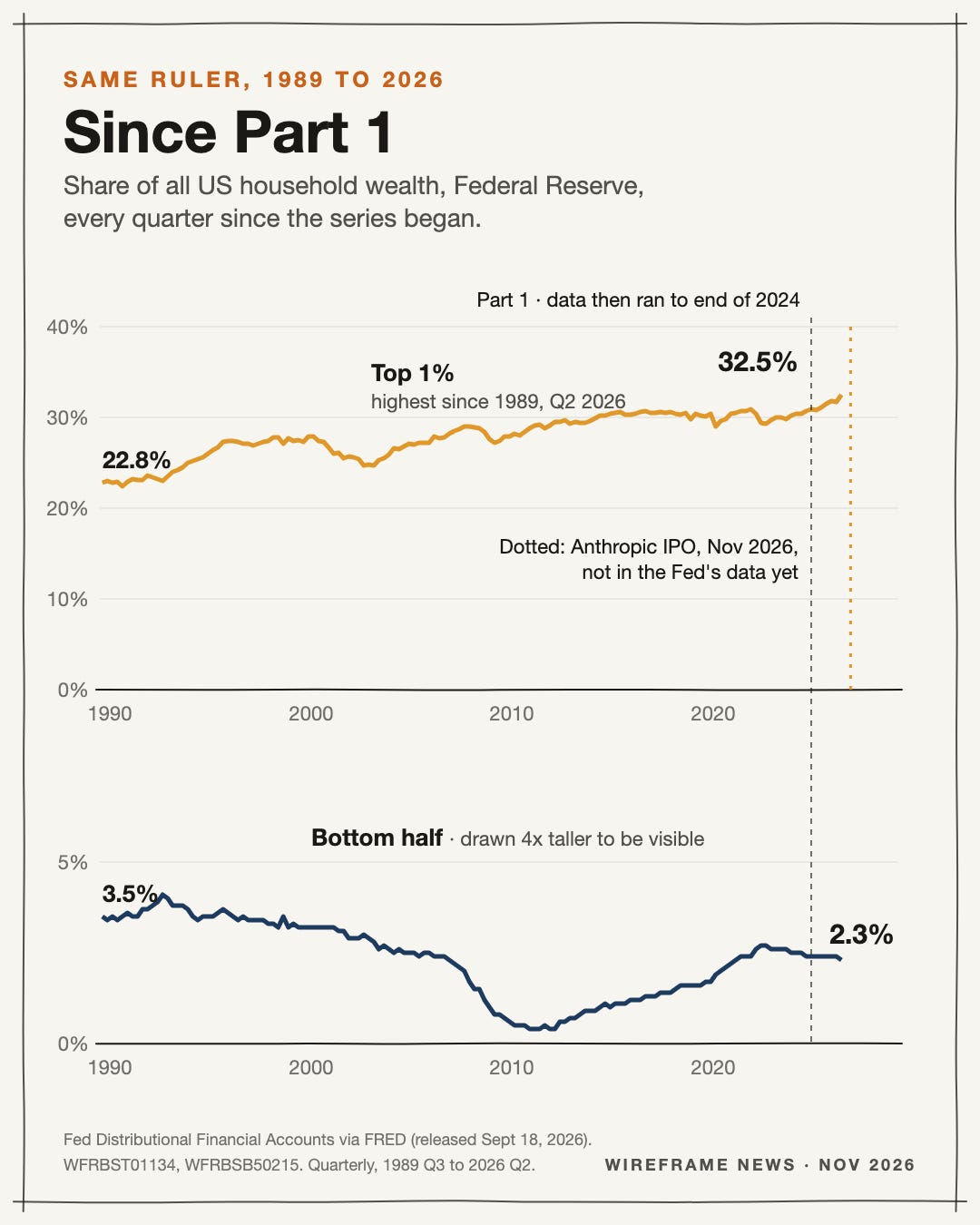
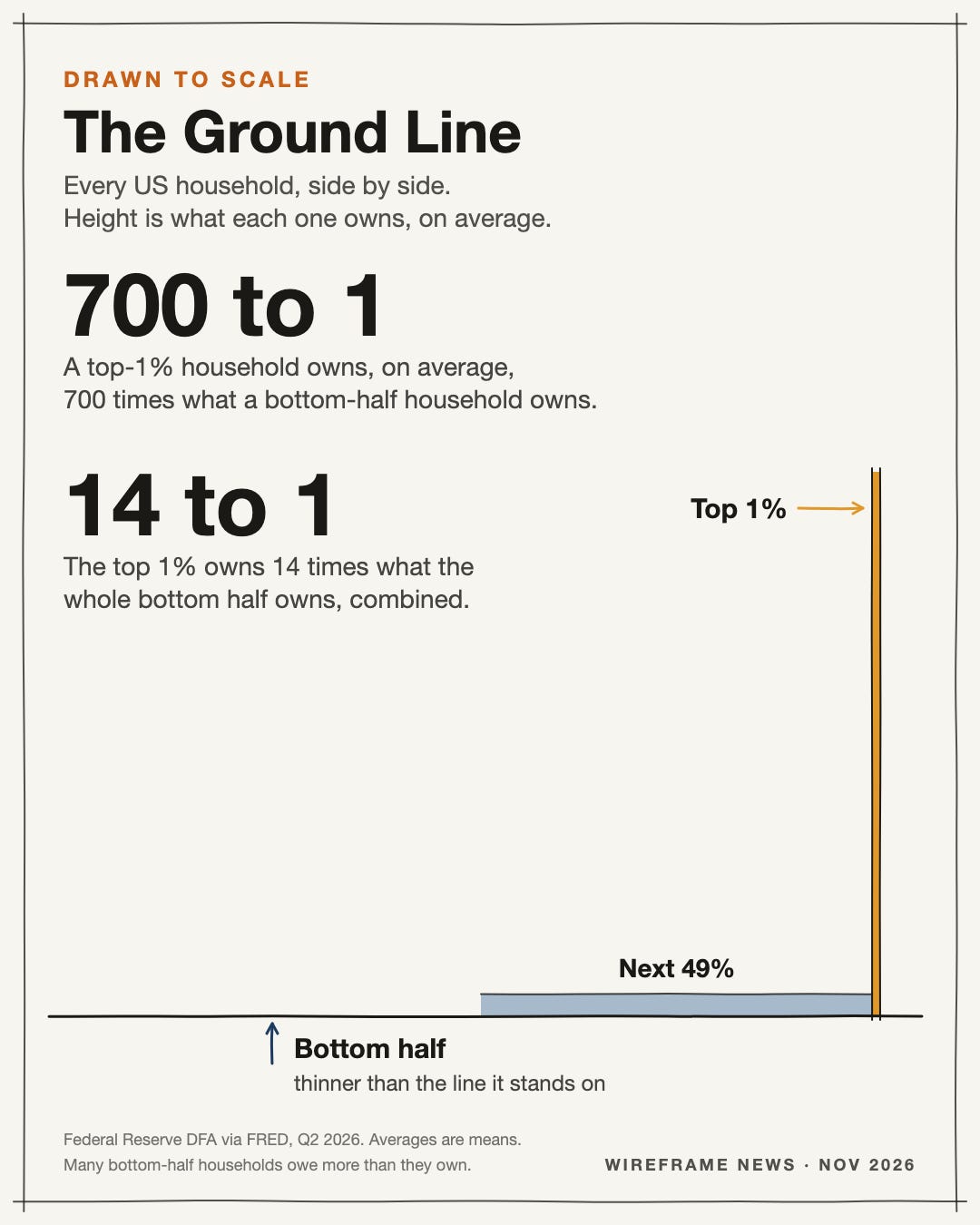
In the second part of that series I put it as a ratio: the top 1 percent controlled 10 to 20 times more wealth than the entire bottom half combined. On the Fed’s numbers it was about 12.6 to one at the end of 2024. Now it’s 14.1 to one.
For every dollar the bottom half of America gained in the last eighteen months, the top 1 percent gained twenty-nine.
Think of it like a pay raise. Both groups got one. The bottom half’s wealth went from $3.9 trillion to $4.3 trillion, about 10 percent. The top 1 percent went from $49.3 trillion to $60.3 trillion, about 22 percent, and they started from a base more than twelve times larger. A raise of the same percentage would have widened the gap. They got more than double the percentage.
And none of that includes the week I opened with. The Fed’s latest quarter ends in June. The Anthropic offering, the at least 400 early employees Fortune, citing CNBC, counts as worth more than $100 million each, the $163 billion on the co-founders’ line of Rattner’s chart, all of it lands in numbers the Fed hasn’t published yet. The record we just set is the one from before the largest IPO in history.
The bottom of the scale
The top of the chart gets the headlines. The bottom is where the strain shows up first.
In October paychecks rose 0.4 percent and prices rose 0.4 percent, so the average worker’s real hourly pay didn’t move. In September it was down 0.7 percent from a year earlier. And more of what people owe slipped into delinquency this quarter than last.
The Federal Reserve’s own Financial Stability Report, out November 13, asked the market contacts it surveys what worries them most. Eighty-seven percent named artificial intelligence, more than any other risk. The country’s largest banks, the report says, have “close to $1 trillion of exposure” to large tech companies, data center developers, special financing vehicles for advanced computing, private credit and utilities. The boom at the top is now on the books of the banks everyone else uses.
And where people got a direct vote on it, they said no. On election night there were 41 data center measures on ballots in 10 states. By the next day, with most results in, the industry had won one, in Harwood, North Dakota. That isn’t a vote against technology. It’s people who are told the boom is good for them noticing the power bill, the water and the land, and the stock going to someone else.
What happens when it gets this wide
Here is the hard part of this essay, because history doesn’t hand us a comforting answer.
Walter Scheidel, a Stanford historian, looked across recorded history at the times a big gap between rich and poor actually closed. In The Great Leveler he kept finding the same four causes over and over, his “four horsemen”: “mass mobilization or state warfare, transformative revolution, state collapse and plague.” Total war. Revolution. Collapse. Pandemic. The gap closed because something broke, and a lot of people died in the breaking. He doesn’t think the usual fixes are enough. He told Stanford: “Something truly innovative and original may have to happen in order to create lasting change.”
Peter Turchin, who models the rise and fall of societies with historical data, looked at the United States in 2010 and didn’t like what he saw. “Frankly, the results for the USA scared me,” he wrote. He forecast that the decade to 2020 “would likely be a period of growing instability in the United States and Western Europe.” We lived that decade.
I don’t want to oversell this. Rich democracies don’t usually explode. When Stephan Haggard and Robert Kaufman tested whether fights over inequality drove democracies to rise or fall, they found it explained under a third of the democratic collapses they studied. What the newer research does find is quieter and, to me, worse. Susan Stokes and Eli Rau at the University of Chicago looked at democracies around the world and found that inequality is “one of the strongest predictors” of democratic erosion, including in wealthy countries. The country doesn’t snap. It bends, toward whoever holds the money, one election and one court and one exemption at a time.
Think of it like a pressure cooker. Every one works the same way. The pressure builds, and there’s a small valve on the lid that lets it out a little at a time. If the valve is working you barely notice it. If someone tapes it shut, the pressure doesn’t go away. It waits for the weakest point in the lid.
There are exceptions. Economic historians have found that wealth gaps narrowed in Finland in the late 1800s and incomes evened out in Norway before World War I, without a war or a revolution to do it. Our own Progressive Era built the tools, the income tax, the estate tax and the Federal Reserve, and it’s worth being honest that the gap itself didn’t close until the Depression and the war. The lesson isn’t that the gap always snaps. It’s that the tools have to be built before they’re needed.
Why this one is different
The original Gilded Age had its railroad barons and its oil trust, and they were powerful. They still answered to a government that was bigger than any of them.
That’s not as clear today. Anthropic went public worth more than a trillion dollars, whichever way you count the shares. That’s more than Taiwan produces in a year. As of this morning Forbes puts Elon Musk at $811.7 billion, more than the whole annual economy of Argentina, Israel or Sweden. Comparing a fortune to a year of a country’s output isn’t exact, but it gives you the scale.
The power is what matters, not the size. In The Charter I went through what happens when the state can’t function without the companies it depends on: a reported Starlink price fight in the middle of a war, a speed cap that cut off Ukraine’s faster drones while Musk pointed at the president and the president said it wasn’t him, a 40 percent public stake in a defense company’s new shipyard with no published terms. I won’t retell those here. The new part is that SpaceX and Anthropic now trade on public markets, and the people who hold their stock have more money than most countries produce in a year.
Anthropic’s own chief executive saw this coming. In January Dario Amodei wrote that in a world where AI is taking over the economy and “single individuals hold appreciable fractions of the GDP,” innovation isn’t the problem. “The thing to worry about is a level of wealth concentration that will break society.” Then he brought up the Gilded Age and Rockefeller himself. When the man whose company just made the bar in Rattner’s chart is warning about the bar, it’s worth listening.
The valves we’re closing
In 1912 a House subcommittee, named for its chairman Arsène Pujo, set out to investigate what the papers called the “money trust,” the handful of New York bankers who controlled the country’s credit. In December 1912, J.P. Morgan himself sat in front of it. When the committee’s lawyer asked whether credit wasn’t based mainly on money or property, Morgan said: “No, sir; the first thing is character.” What came out of those hearings helped build public support for the Federal Reserve. The National Archives says Congress created it “to lessen the control of the Money Trust over the nation’s money supply.”
That’s how the last Gilded Age started to bend. Congress made the money testify.
On November 20, two days after Anthropic priced the largest IPO on record, the president signed Executive Order 14438. It requires every federal contractor to “notify the White House and the contracting agencies of any pending or future congressional request respecting the contractors’ communications or work with the executive branch,” and to follow White House and agency instructions on withholding anything they say is covered by executive privilege. If a company doesn’t comply, agencies must consider canceling its contracts or barring it from new ones. By one estimate there are about 100,000 of these companies. The order itself accuses “certain congressional leaders” of “harassing private companies.” Jamie Raskin called the order “totally unprecedented and blatantly unlawful.”
The timing isn’t subtle. The new Congress, with both chambers flipped, gets seated on January 3. As I wrote in Not Yet, that date changes who can ask questions under oath. The order reads like an answer to that date.
Oversight is one valve. Taxation is another. In California this month voters were asked to approve a one-time 5 percent tax on billionaires. The opponents raised $378.4 million. The supporters raised $33.5 million. It lost, 52 to 48. On the same ballot, voters approved Proposition 42, which bars new taxes on financial assets. Final certification is due December 11.
The opponents didn’t spend anything close to what they would have paid. The state’s own analysts said it probably would raise tens of billions of dollars; the economists behind it put the figure near $100 billion over five years. The campaign against it cost $378.4 million. That’s somewhere between a third of a cent and two cents on the dollar, depending on whose estimate you believe, spent on a campaign instead of paid to the state. Influence is cheaper than taxes, and they know the exchange rate.
The third valve is the one Part 2 asked for. The government does own pieces of private companies now, dozens of them. But those stakes sit with agencies inside the executive branch, with no public fund, terms that are often undisclosed or partial, and no single office answering to Congress for them. And the president’s own accounts trade in the same names. His September disclosure shows 751 trades, including Nvidia, Palantir and SpaceX, around the same weeks those companies were getting federal contracts. The White House says independent managers make every decision, and CNBC found no evidence he directed them. The managers may be independent. The conflict isn’t.
How the money gets around the tax, and why people still fear one
I covered this in the Gilded Age series with Musk, and it’s worth walking through again because it explains almost everything above.
It’s called buy, borrow, die. You buy something that grows, stock in a company you founded. As long as you don’t sell it, the gain isn’t income, so it isn’t taxed. When you need money, you borrow against the stock, and a loan isn’t income either. When you die, a rule called “step-up in basis” resets the value for your heirs as if the gain never happened, so it’s never taxed as income. By the Joint Committee on Taxation’s estimate, that one rule costs the Treasury about $73 billion in 2026.
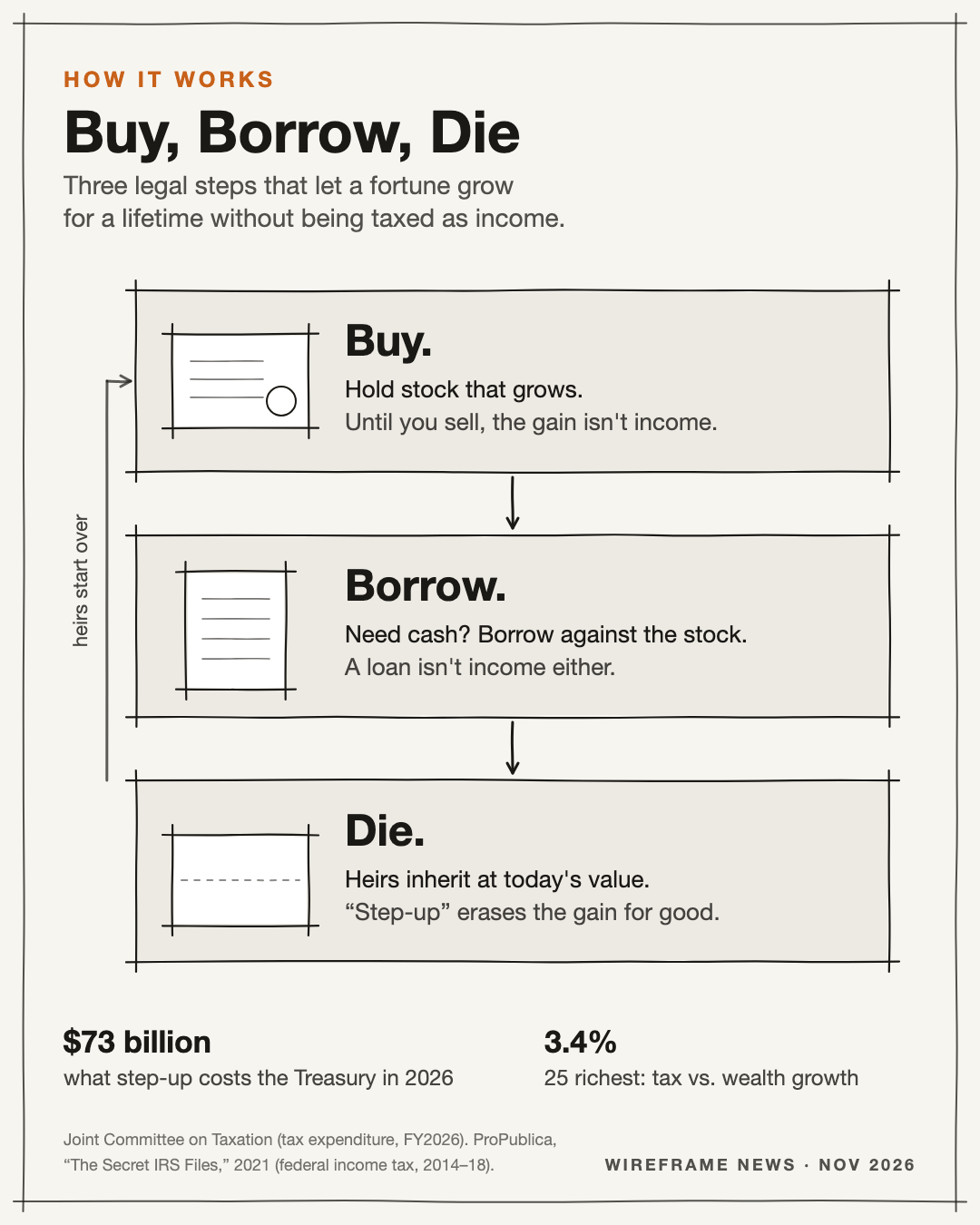
That’s how you end up where a 2025 study by Emmanuel Saez, Gabriel Zucman and two colleagues found us. Counting every tax they pay, the 400 richest Americans paid about 24 percent of their economic income in 2018 to 2020. The population as a whole paid about 30 percent. People earning very high salaries paid 45 percent. Critics, among them the economist David Splinter, argue the real figure is closer to 38 percent once family wealth spread across many tax returns is counted. On the study’s own numbers, the richest Americans pay a lower total tax rate than the country as a whole.
So why don’t people vote to change it? It isn’t because they like billionaires. A January Pew survey found 61 percent of Americans are bothered “a lot” that some wealthy people don’t pay their fair share. It’s fear, and it’s a reasonable fear.
When Stanford business school researchers surveyed Americans in 2019, 65 percent supported a tax on fortunes of $50 million or more. Then they told people it might hurt the economy or cost jobs, and support dropped to 26 percent. Only a quarter trusted the government to spend tax money effectively. And six in ten Americans told Pew this year they already pay more than their fair share themselves. When you already feel squeezed, any new tax sounds like it’s coming for you next. That’s the fear the California campaign spent $378 million on. One of its strategists called the tax, after it lost, “a reckless experiment conducted on our state’s economy.”
The fear deserves an answer, not a lecture. Norway raised its wealth tax in the early 2020s, and some commentators said the rich were fleeing. A study published last month counted at most about 100 people who left because of it, found no real exodus of founders or inventors, and found that the tax’s revenue still grew by about 71 percent over those years. And people can be persuaded by who actually pays. In one well-known experiment, telling people how few estates pay the estate tax doubled support for it.
And when Americans are asked the plain question, with the numbers in front of them, they aren’t afraid at all. The University of Maryland’s Program for Public Consultation asked about an annual federal tax of 2 percent on wealth over $50 million and 3 percent over $1 billion, nationally and in about 20,000 interviews across battleground states and districts. Nationally, about eight in ten were in favor. That included 88 percent of Democrats and 72 percent of Republicans. No other tax change they tested scored higher nationally.
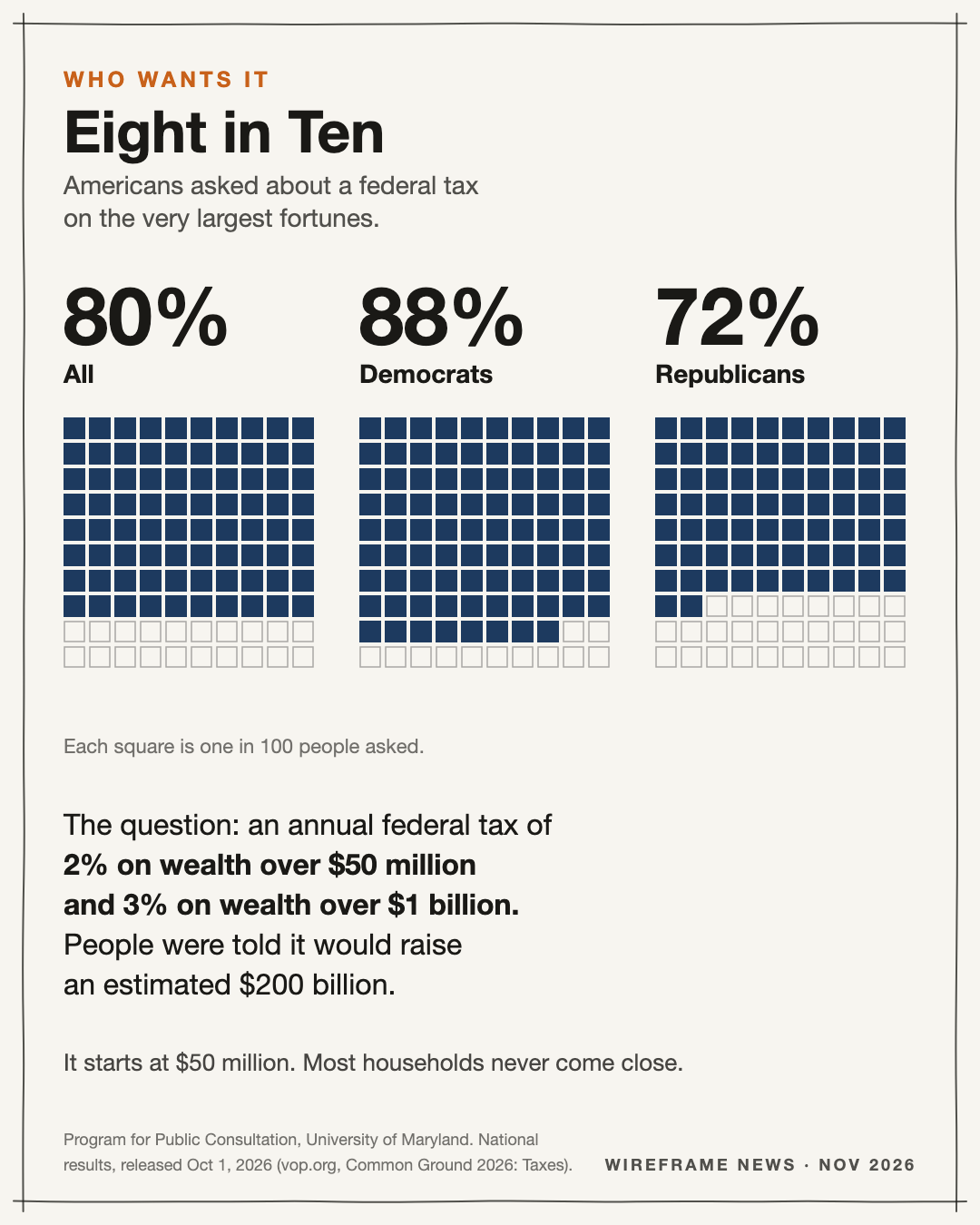
Closing the loopholes one at a time is the right long-term fix, and it’s slow. Step-up in basis has survived repeated proposals to end it, including one in 2021. California just closed its own state-level door. If the loopholes can’t be fixed quickly, a federal floor on the largest fortunes is the valve we can build now, and most of the country already wants it.
What we can do
None of this needs a revolution. It needs the valves put back on the lid while there’s still time to do it calmly.
Yourself. Know the numbers, because the fear runs on not knowing them. The tax that polls at eight in ten starts at $50 million of wealth. If someone tells you it’s coming for your house or your 401(k), ask them how many of their neighbors are worth $50 million. Look up where your own household sits in the Fed’s wealth data. (federalreserve.gov/releases/z1/dataviz/dfa) Most people find they’re in the bottom half or the middle. The bottom half gained one dollar for every twenty-nine the top 1 percent gained.
Together. The fights that are winning are local. Forty of 41 data center measures went against the industry on election night. Ask your local officials who pays for the power and the water about any project that comes with a tax break: what does the community get back, in writing. And the new Congress gets seated January 3. Tell your representative you expect its oversight committees to use their subpoenas, executive order or no executive order.
Structurally.
A federal floor on the largest fortunes. An annual 2 percent on wealth over $50 million and 3 percent over $1 billion is the version the University of Maryland tested, and it’s the same rate structure as the Ultra-Millionaire Tax Act Elizabeth Warren introduced in March. It’s the valve that works while the loopholes stay open.
Close buy, borrow, die. End step-up in basis for very large estates. Those were the fixes in the Gilded Age series, and the 1968 Match Plan in Part 4 still lays out the rest.
Make the public’s stake public. If the government is going to own pieces of companies, the shares belong in a fund held in trust for the public, voted under rules Congress writes, and reported to Congress, not to the White House. That’s the venture-capital idea from Part 2, done the way it should have been.
Protect the oversight. Congress, not the White House, decides what a contractor owes a subpoena. That needs a law that says so, before the courts are left to sort it out one company at a time. The Repair Manual has the rest of the anti-corruption list, and What Corporate Responsibility Actually Looks Like has the version for companies.
On Thursday the bell rang on Anthropic and, for one day, a few thousand people were worth more than 45 million households combined. On Friday the stock dipped and the chart flipped back. In the spring the Fed will publish year-end numbers that include all of it.
Eighteen months ago I ended a piece by telling the top 10 percent that history says to worry. The numbers say it’s worse now than when I wrote that, and the people with the most to lose are spending less than two cents on the dollar to keep it that way.
The places that came through a gap like this without a war or a revolution weren’t just lucky. They had the tools in place first. We still can. The pressure isn’t going anywhere, and neither is the lid.
Sources
The week: Renaissance Capital, pricing · Al Jazeera, Nov 19 · Steven Rattner on X, Nov 19 · Mother Jones · Fortune, Nov 19· New York Fed, household debt Q3 2026
The gap: Federal Reserve Distributional Financial Accounts via FRED: top 1% share · bottom 50% share · top 1% level · bottom 50% level · DFA explorer
The bottom of the scale: BLS real earnings, October · BLS, September year over year · Federal Reserve Financial Stability Report, Nov 13 · CNBC, data center ballot measures · Scientific American
History: Scheidel, The Great Leveler (LSE review) · Scheidel at Stanford · Turchin, his 2020 forecast · Haggard & Kaufman, APSR 2012 · Stokes & Rau, University of Chicago · Economic History Association
Why this one is different: Forbes, Elon Musk · Dario Amodei, The Adolescence of Technology
The valves: National Archives, the Money Trust · J.P. Morgan’s Pujo testimony (SEC Historical Society) · Executive Order 14438, Nov 20 · ABC News · CBS News · MS NOW · CNN · LAist, Prop 40 result · Legislative Analyst, Prop 40 · Galle, Gamage, Saez & Shanske, revenue estimate · KQED, Prop 42 results · Cato, the federal equity portfolio · CNBC, the president’s September trades
Taxes and what people think: Joint Committee on Taxation via CRFB · Balkir, Saez, Yagan & Zucman, NBER 34170 · Cato, the critique · Pew Research Center, 2026 · Stanford GSB, 2019 tax survey · Ring, Norway, NBER 35854 · Kuziemko et al., NBER 20625 · Program for Public Consultation, Common Ground 2026: Taxes · CBS News, the Ultra-Millionaire Tax Act
Earlier pieces: Why We Shouldn’t Want a New Gilded Age, Parts 1, 2, 3, 4 · The Charter · Not Yet · Payer of Last Resort · What Corporate Responsibility Actually Looks Like
Discussion about this post