

WIREFRAME · THE SPEED OF LIGHT · PART 1 OF 4
There has always been something that helped new technology and the will of one person to be kept in check, the masses. They created a brake that helped us slow things down and build responses. People needed to be convinced that the will or the tech was in their favor, they needed to feel it before they would agree to it.
That convincing took time, but over the ages that time has gotten shorter and shorter. First it was by word, then text, then air waves, then a TV signal. The internet came with the promise of connecting us all, true it did, but social media made it a place where facts went to die, where outrage became a currency.
Now add AI on top of it. With AI all the brakes we had to keep things in check go out the window and into the hands of very few. We have seen this with social media, now we will see it on steroids with AI. One CEO could, in turn, hold the power not only of a nation, but the world.
In 1917, the American people were not ready for WWI. So they needed to be convinced, persuaded. Congress declared war that April, but a declaration does not fight a war, and the country was still reluctant. Someone had to spend the next year and a half building the case with the American people. George Creel’s Committee on Public Information built a machine of humans to do that convincing. 75,000 people called the Four Minute Men, ordinary people, spoke for four minutes between reels at movie houses around the nation. Their job, to change the minds of millions.
Over 18 months they delivered 7.5 million speeches, reaching some 300 million times in a nation of 103 million. Every American was talked into the war several times over. Speech by speech, they kept a wary country behind a war it had never wanted. The bottleneck was not the weapons, but the people who would bear the brunt of it. With their lives, their wealth, their livelihoods they would join the movement. They felt compelled because they were wearing our country’s pride. A nation stood behind them.
That convincing is our first brake to the will of a small group of people. It’s the oldest, most stubborn brake.
For every new technology, the plow, the printing press, the engine, the bomb. They all arrived with a shock that took time to absorb. There are three brakes that we use to keep things from moving too quickly.
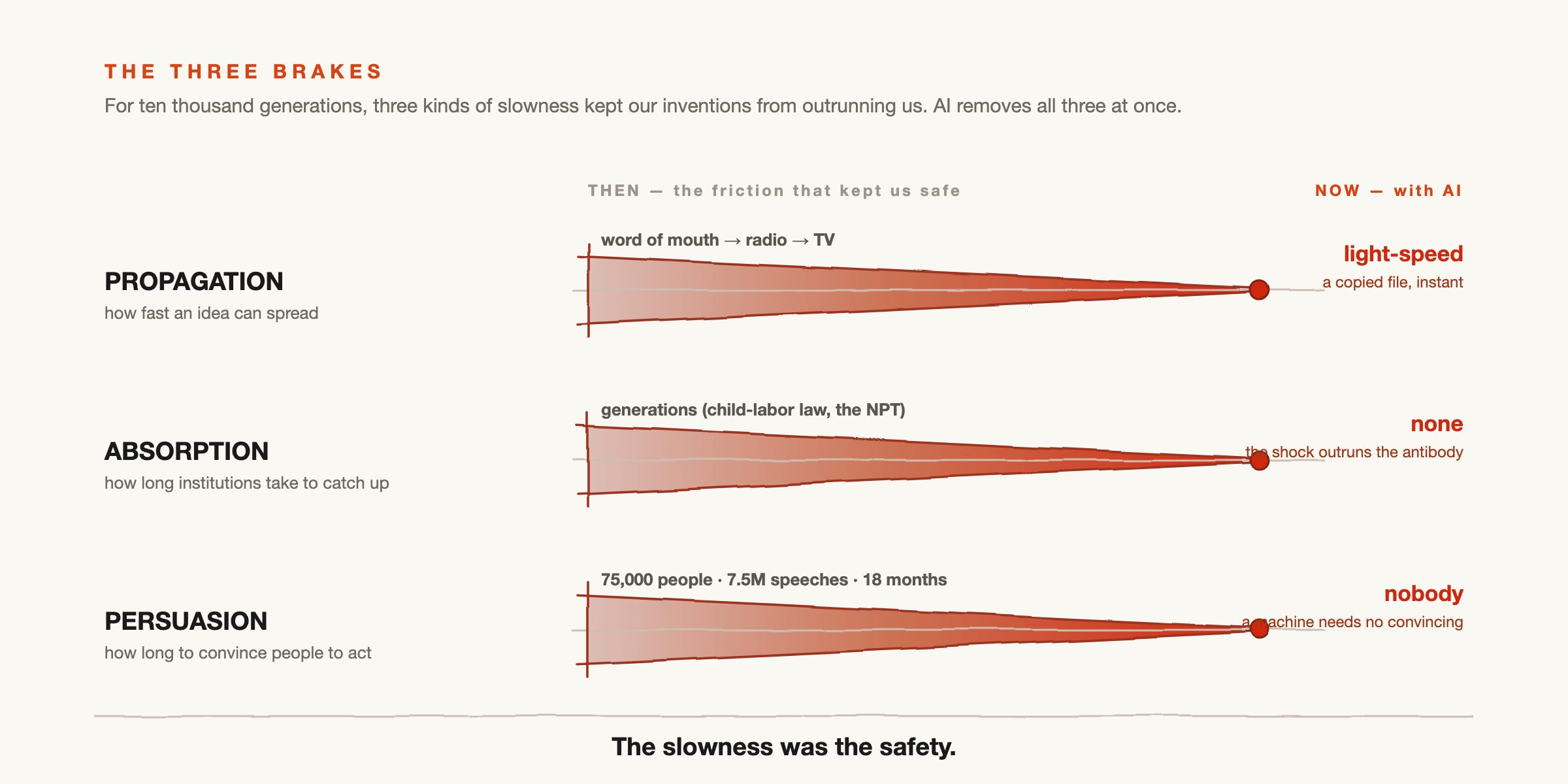
Propagation, absorption and persuasion. Those are the only brakes a society has to help control actions being taken on them. Let’s walk them since most assume it was our wisdom that prevented bad things from happening, but really, the slowness of the delivery system was the safety.
Propagation
From word of mouth to the printing press was the first big leap. Each new technology accelerates that process. Radio could broadcast a voice for thousands of miles instantly being heard in living rooms across the nation.
Then TV came, putting the faces of those in front of us. Families would gather around the box and watch as our leaders would talk to us about the world, their view of it and what they were doing or planned on doing. We connected to them from those black and white images.
Now in an instant, information travels without any editor, presented as facts, that once it’s out there, there is no pulling it back. The work has reversed, now the work is convincing people what they have already seen or read isn’t accurate. The speed of that has removed persuasion from the need of our leaders, speeding up their will. Now we find out after the fact, rather than being part of the decision. Like other aspects of technology, we have given up our civil duty of holding power to account out of convenience.
Absorption
How long it takes a person, a nation, to absorb the information was our other brake. It was the immune system that our society needed to create laws, use courts, build unions, and work with other nations to write treaties. These steps are never fast, they in some cases take decades. Child-labor being removed from the factory took almost that child worker’s lifetime. Nuclear treaties took another generation after the first bomb drop. They all arrived to level out the damage, level out the wealth.
Persuasion
Of the three, this last one is the deepest, because it was the one no king could buy or build their way around.
It used to take a lot more to push someone to agree with you, especially if their lives were on the line. We like to think everyone just joined up, but in reality they needed to be convinced too, they had to believe the cause was too great. The time it took was another brake, time for people to poke holes in it, ask the right questions, think about the impacts and what the future would look like. Leaders knowing they worked for the people, not the other way around, so they needed to take that time to persuade us.
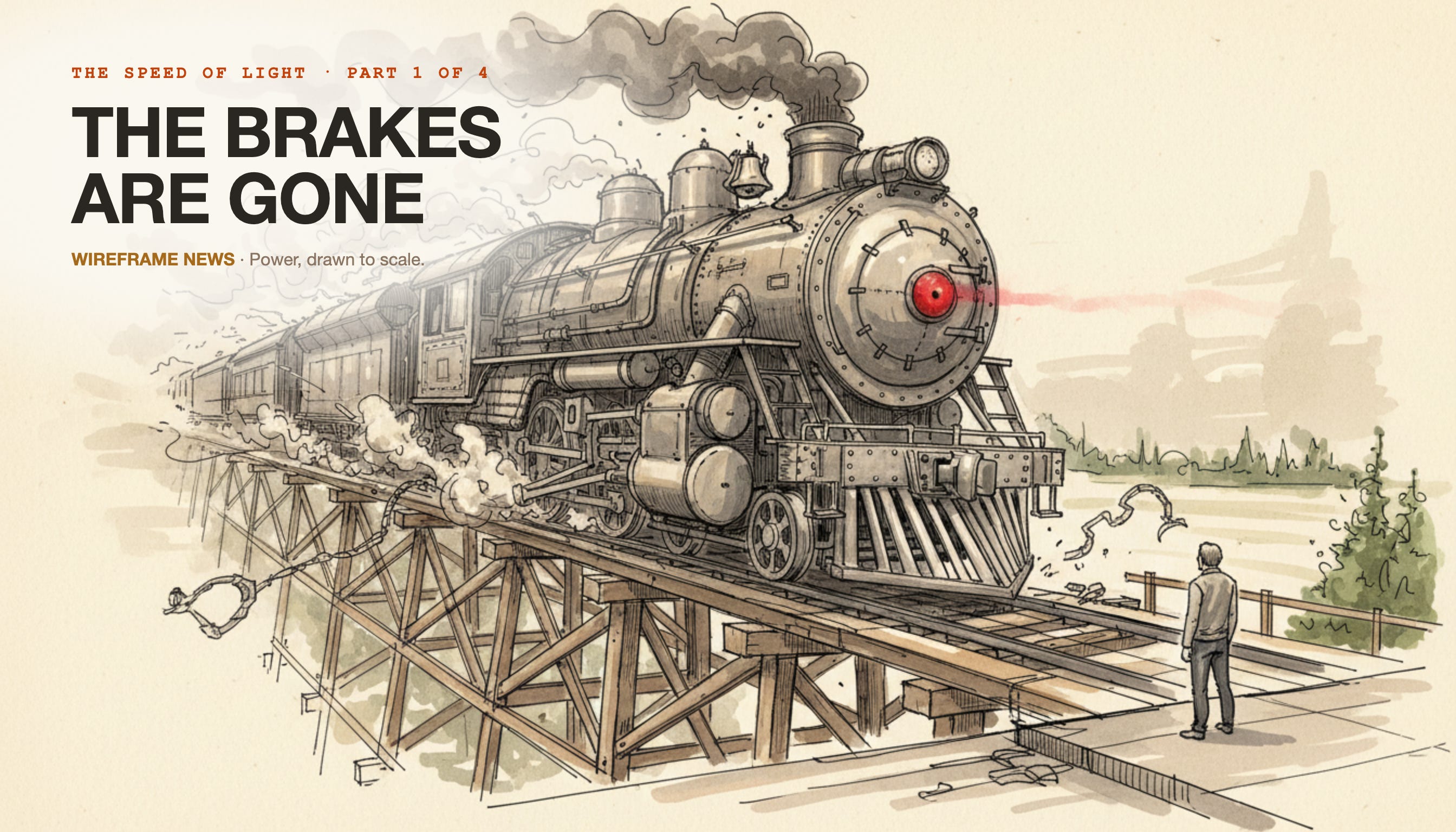
These three steps were not virtues, they were friction. Friction that has always kept the train on its tracks. You could lay a telegraph line to increase the spread, pass a law to force absorption, but you could not skip the convincing.
This was the strongest brake, mass action needed mass consent. A war needed soldiers who would march and die. A factory needed workers who’d show up and use their labor to fund their lives. Even conscription only worked while enough enforcers agreed to drag the rest along, and remove those who wouldn’t.
No ruler could buy their way around it. The fear of counter-movements: the general strike, the soldier lowering his rifle, a mutiny, anarchy, was itself the check on power. The time it took to convince was the strongest of the checks. Until now.
Now we seem to be letting a small handful of people feel they no longer need our blessing, they get to act on our will without our consent. For ten thousand generations, doing something enormous to the world meant first persuading a great many people it was worth doing. The requirement was exhausting, and undemocratic regimes spent fortunes faking their way around it.
Every atrocity of the past has a bottleneck, a friction point, it was the masses’ ability to refuse.
The speed of light
AI, combined with social media, takes these brakes to zero. Agents don’t have beliefs, they have no reluctance, they are already conscripted, they just have to have goals. Point them at a goal, and a million of them at once coordinate, they don’t need to be convinced. They need no time to absorb, be persuaded. All at once they will move at the hands of a small few. The masses don’t even get a say.
The control moves from the masses, collapsing down from the nation to whoever holds the off-switch. There is no need to get our consent, the nation’s people are not part of the equation.
Power now can be projected without the need of the people. These autonomous systems just act without debate. The persuasion brake doesn’t disappear, it just concentrates into the boardroom. Your vote means nothing, your voice does not matter in the decision-making process.
There is a small window left for us to raise our voices, but only if we all see the issue. Too many seem to feel better by keeping their heads in the sand rather than looking up and seeing the small number of hands controlling our fate.
The Map
Leopold Aschenbrenner mapped it plainly. He describes the drone swarms and roboarmies to come, a military that no longer needs the mass of humans who once had to be convinced to fight. Whoever controls it, he writes, “will quite possibly have enough power to seize control from pre-superintelligence forces,” and in a world of private labs racing to build it, individual CEOs “would have the power to literally coup the US government.”
There will be no one to persuade, no one to convince in the public. The public, already blind to the power AI wields, will only have a sense that something feels off. The loss of facts, the loss of common connection, and the fading belief that we the people have a say in our fate.
What happens to a civilization when it builds the first machine that runs faster than all three brakes at once? You can feel it already, the ping-pong of our leaders vying for control of the system. They are thinking not of us, but only of staying above those below them.
Tyranny needed people to enforce its will, and that is what’s being quietly dismantled. Not with a discussion with the public, but with a product.
And most of us won’t see it, because we’ll be looking at the chatbot in our hands and missing what’s happening behind it. That machine isn’t coming. It’s already here, and it’s already writing the world you live in. It even helped me write this.
That machine exists now. Let me show you where it already is.
This is Wireframe News—for ten thousand generations our slowness was the only real check on power, and we just built the machine that ends all three at once.
WHAT’S NEXT
Part 2 — The Substrate Woke Up. The machine that runs faster than all three brakes isn’t coming. It’s here, and it has already started writing the culture you live in. Subscribe and it lands in your inbox.
KEEP READING
The Timeline You Are On — the whole map this series walks one station at a time.
Gods or Ashes — the race that set this whole timeline in motion.
SOURCES
Committee on Public Information & the Four Minute Men (1917–1918) — Creel’s tally: 75,000 volunteers, >7.5M four-minute speeches, ~300M reached, in a nation of 103M.
Leopold Aschenbrenner, Situational Awareness: The Decade Ahead (2024) — “drone swarms and roboarmies,” whoever controls superintelligence “will quite possibly have enough power to seize control from pre-superintelligence forces,” and “individual CEOs would have the power to literally coup the US government.”
WIREFRAME NEWS · Power, drawn to scale. · wireframenews.com · ↳ reading the diagrams