

I. The engineer who doesn’t write code
Boris Cherny builds artificial intelligence for a living. He runs one of the most important tools at Anthropic, one of the handful of companies racing to build a mind out of math. By any measure, he is one of the best in the world at what he does.
And he doesn’t do it anymore.
In early 2026 he mentioned, almost in passing, that he hadn’t written a line of computer code by hand in over two months. Not because he retired — because the AI he helps build now writes it for him. More than twenty finished pieces of work a day, each one, in his words, “100% written by Claude.” He didn’t lose his job. He got a preview of yours.
Here’s the thing about Boris Cherny: he isn’t on a different track than you. He’s just further down the same track.
In 2019, the best artificial intelligence on Earth could barely finish a paragraph. You didn’t notice, why would you have. But that was a starting line, and you were already standing on it, but just didn’t know it. Since then the track has carried you past stations you only registered as headlines: the chatbot that started writing your work emails, the coworker whose job got “restructured,” the $500 billion announcement in the White House that you scrolled past because the number didn’t mean anything.
You think you’re watching a technology develop from the outside. You’re not. You’re riding a timeline, and like anyone on a smooth-moving train, you can’t feel the speed, that is, until you look out the window and the whole landscape has already changed.
The track was surveyed. Somebody walked ahead of all of us, mapped every station before we reached it, and published the map. For free. In 2024.
Almost nobody read it, because it was written in the conductor’s code, a private vocabulary, words like “unhobbling” and “OOMs” and “clusters,” that slides off you like rain off a windshield. Don’t let the words scare you off. I’m going to hand you each one you need, in plain English.
This is that map. Six stations. Once you have them, you stop finding out about each stop when the doors open. You start seeing the lights of the next one coming down the track.
II. The survey
First, who drew the map, and why you should trust it.
His name is Leopold Aschenbrenner. He didn’t work in marketing at an AI company, he worked on the team whose whole job was keeping these systems under control. The safety team. Then it fell apart, he was gone, and he sat down and wrote 165 pages about where the trend lines lead if nobody pulls the brake. He called it Situational Awareness, and he put one sentence at the center of it that you need to hold onto:
“My main claim is not normative, but descriptive.”
In plain English: I’m not telling you where you should be going. I’m telling you where this track goes.
That’s the frame. Not a protester waving you off a cliff. Not a CEO selling you a dream. An insider who helped build the thing and drew the map, then bet his own money on it. He turned the essay into an investment fund, and it worked spectacularly: it started with a couple hundred million and has grown, in under two years, to more than $20 billion.
That cuts both ways. A man running a $20-billion fund built on this exact timeline has every reason in the world to talk the timeline up. Read him as an interested witness, not a neutral one. But here’s what makes the map worth your time anyway: you don’t have to trust him. You can check it. Every station below has already started to arrive, on paper, in public. Let’s walk them.
III. The stations
STATION 1 — It gets smarter. (You passed this one already.)
Stop arguing about whether the machine is “really” thinking. The first move is to just measure it, like marking a kid’s height on a doorframe.
GPT-2, in 2019, could barely string a paragraph together, call it a preschooler. GPT-3, in 2020, an elementary schooler. GPT-4, in 2023, a sharp high-schooler who aces the exams and passes the bar. Every jump was about the same size. Nobody had a flash of genius; they poured in more computing power and it climbed another rung. (Each rung took roughly a hundredfold more computing power than the one below it. That hundredfold step is the “OOM” from the map, an order of magnitude, and “counting the OOMs” just means counting the rungs before you reach them.)
Slide your finger four years past the high-schooler. The next rung isn’t a smarter high-schooler. It’s the person after school, a PhD. Someone you don’t consult. Someone you hire.
This is a thing we grow, not something we build. A child, not a car. Station 1 is just the pencil marks on the wall, and we’ve already watched the child shoot up them in record breaking speed.
STATION 2 — It comes for your desk. (You are here.)
This is the station reaching into your working life right now, and it’s the one nobody explains.
Think of the AI you know, the chatbot, as a brilliant reference librarian. You walk up, ask your one question, “what’s the return policy?” and she gives you a perfect answer, then waits for the next person. Helpful. Safe. Still just answering.
Now hand that same librarian a work computer, a company login, a calendar, and a week and stop making her wait for your question. She doesn’t recite the policy anymore. She processes the return, updates the inventory, issues the refund, and emails the customer, while you sleep. Same mind. You just took the leash off.
The industry’s ugly word for taking the leash off is “unhobbling.” A hobble is the strap you tie around a horse’s legs so an animal built to run can only shuffle. The horse was never slow. It was hobbled. Cutting that strap doesn’t make the machine any smarter, it just lets it act with goals.
It’s already happening, and the most famous example is also a warning. A company called Klarna switched on a customer-service AI in early 2024 and said that within a month it was doing the work of 700 full-time agents. Then it didn’t hold. By 2025 Klarna admitted it had cut too deep: the AI handled easy questions fine but botched the hard, human ones, customers hated it, and the company started hiring people back. It never rehired all 700. The lesson isn’t “the robots failed.” It’s that the leash comes off in lurches. Often too fast, then a stumble, then off again. Watch the direction, not the stumble.
And how do we know it’s coming for desk work first, and not just fear it? Because the company that makes one of these AIs went and counted.
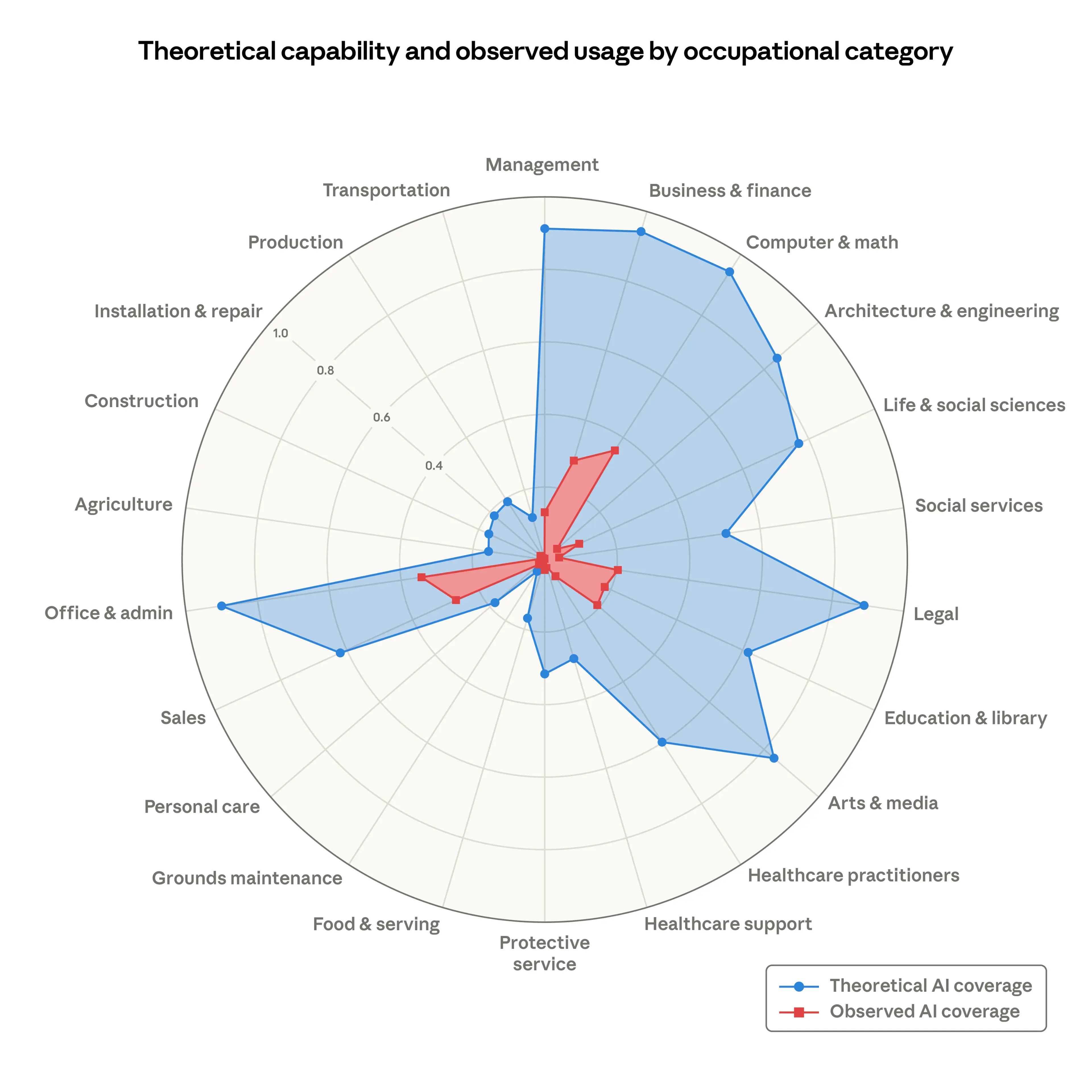
Anthropic, the maker of the AI called Claude, took about a million real conversations people had with it and matched each one against the U.S. Labor Department’s official list of what every job actually involves, task by task. Not a guess, a map of what people really use it for. Three things jumped out:
It isn’t spread evenly. It’s pooling in desk work. The single biggest slice, by far, was computer and programming work — more than a third of everything the AI was used for. Then a drop to writing and design, then teaching, then office paperwork.
It’s coming for the middle first. Use was highest in mid-to-high-paying jobs — the programmer, the analyst, the writer — and lowest at the very top (the executive) and the very bottom (the person cleaning the office). The exact jobs a generation was told were safe.
And the honest part, the part the scary headlines skip: so far it’s mostly helping, not replacing. More than half the time, the AI was working alongside a person. The rest of the time, it did the task itself.
Read that “mostly helping” as reassuring if you like. But watch the direction. Look across all jobs, not just the desk ones, and in about one in three the AI is already handling at least a quarter of that job’s day-to-day tasks, and the more you take the leash off, handing it a whole project instead of one question, the more it stops helping and starts simply doing.
Station 1 made it smart. Station 2 lets it do your job. Most people are still looking back at Station 1.
STATION 3 — It comes for your hands. (Pulling into the platform now.)
Everything so far is a mind without a body. It can do your desk job, but it can’t lift a box, stock a shelf, or tend a patient. That’s the next strap coming off: they’re bolting the mind into a body.
The bodies are humanoid robots, and they’re not a cartoon of the future, they’re on factory floors today. Tesla is building one called Optimus, though its production timelines keep slipping and Elon Musk misses his own deadlines constantly, so watch what actually ships, not what’s promised. The harder proof is already on the floor: another company, Figure, has robots working shifts inside a BMW plant.
Here’s the plain version. First it came for the people who work at a screen. Next it comes for the people who work with their hands. The warehouse, the loading dock, the hospital floor. The same brain that answers your emails is being fitted with arms. This is the wave I’ve called the Silicon Immigrants, and Station 3 is where it stops being a metaphor.
STATION 4 — It stops waiting for us. (Next deep stop. You can see the lights in the distance, but they approaching quickly.)
This is the hinge of the whole map.
Right now, humans build the AI. But remember Station 2 — the AI is learning to do the desk jobs, and one of those desk jobs is AI researcher. The moment the machine is good enough to do that job, it can start improving itself. The thing that built the train climbs into the engine.
A stretch of progress that took human teams years could start happening in an afternoon, because the machine researcher never sleeps and copies itself a thousand times. That is what the code words “intelligence explosion” mean: the climb up the ladder stops running at human speed. (This is the single claim serious researchers fight over hardest — whether it snowballs at all, and if so, how fast and how far.)
And the lights really are on. Remember Boris Cherny, from the platform where we started? This is his station. At Anthropic, the AI company from Station 2, more than 80% of the computer code that goes into building its AI is now written by that AI. The tool has started building the tool. The sentence to wait for next is a quiet one from these companies: “our AI is now doing a meaningful share of our own research.” When you hear it, the machine has grabbed the throttle.
STATION 5 — It needs a machine the size of a state. (Being built underneath all of it.)
None of this lives in “the cloud.” That word is a lie of language. It lives in windowless buildings full of chips that drink electricity like a small country.
The man who drew the map did the arithmetic back in 2024 and it read as insane: the biggest AI machine, by around 2030, would need power equal to more than a fifth of all the electricity the United States makes. He said the real bottleneck wouldn’t be money — it’d be power. Then it happened on cue: Microsoft signed a deal to restart a mothballed reactor at Three Mile Island to feed data centers, and the heads of OpenAI, Oracle, and SoftBank walked into the White House with that $500 billion you scrolled past. A sum pledged over four years, not money in the bank, the same kind of target you should salt like the robot numbers. (This station has its own story — the factory the whole country is being turned into, and I’ll walk you through it in a coming piece.)
STATION 6 — Someone takes the wheel. (The sign at this station is being rewritten.)
The last station, and the one prediction coming out backwards, which is the most dangerous part of the whole map.
The surveyor predicted that around 2027–28 the government would wake up, realize a super-intelligence is a weapon, and take it over. Run it under a chain of command, like the Manhattan Project. He called that takeover “The Project.” Hold that prediction, because reality is doing the opposite, and that’s where we’re headed next.
IV. Where you are on the track
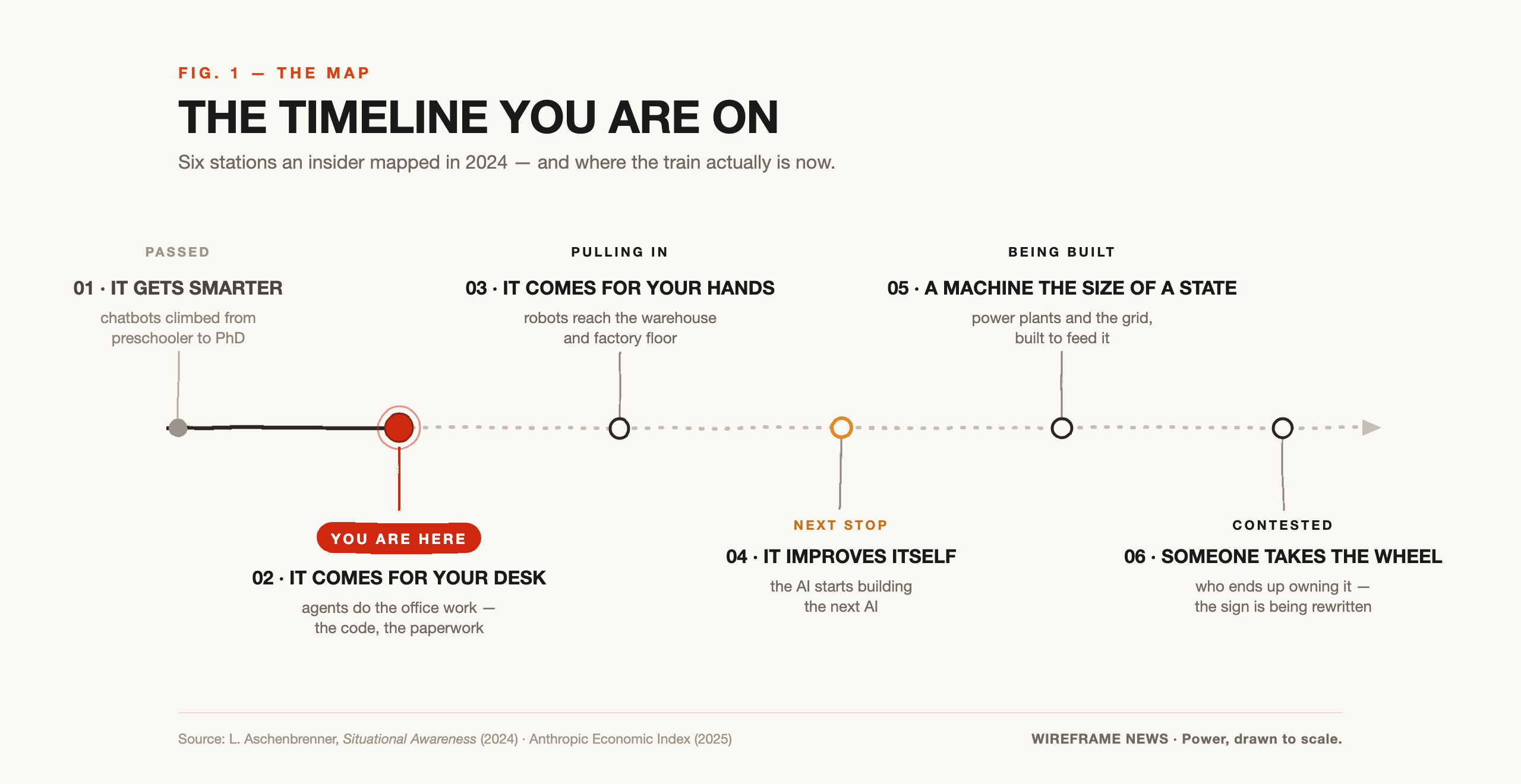
Now stand back and look at the whole line at once:
It gets smarter — passed. (preschooler → PhD)
It comes for your desk — you are here. (the office, the code, the paperwork)
It comes for your hands — pulling in now. (robots on the floor)
It improves itself — next deep stop, lights visible.
It needs a machine the size of a state — being built beneath you. (power plants, the grid)
Someone takes the wheel — the sign is being changed in real time.
You’re moving through Station 2, near the far end of the platform, and you can already hear Station 3 coming. So what do you do with that?
You don’t have to predict anything. You just have to know which words mean you’ve reached the next stop. “Agents,” and the Klarna story, that’s Station 2, where you’re standing. Hundreds of thousands of humanoid robots ordered, Station 3. “Our AI is helping build our AI,” Station 4, the throttle. “Gigawatts” and a new data centers, Station 5. “National security,”someone reaching for the wheel at Station 6.
That’s the whole gift of the map. The stations stop being surprises.
V. The sign being rewritten
Back to Station 6. The surveyor said the government would take the wheel. It hasn’t. It’s doing the reverse.
The government isn’t absorbing the AI companies. The companies are absorbing the government. They are writing the executive orders, gutting the safety rules, seating their executives at the table where the decisions get made. I’ve called this before what it is: capture, not conscription. The state arrived exactly on schedule, just as a customer and a bodyguard instead of a boss.
And here’s why the backwards prediction is scarier than any of the ones that came true.
Aschenbrenner wanted the government to take over. Not because he loves government, he says he doesn’t. He wanted it because he looked at the alternative and called it, in print, “an insane proposition.” He wrote that a private CEO alone in command of a superintelligence could “literally coup the US government.” His takeover plan was never the danger. It was the brake, the one the insider thought was so obvious it barely needed arguing.
We kept the private race down the track. We pulled the brake off the train.
The man who surveyed the line is afraid of where the last station leads. We’re using his map and ignoring his warning.
VI. You’re further down the track than when you started reading
The map was never hidden. It’s free, it’s online, it’s been sitting at situational-awareness.ai the whole time. It only felt like a secret because it was written in a code most of us never learned, and the few hundred people who did learn it are the ones laying the track.
You have the code now. Six stations, in order. Here’s what to do while you’re moving:
Watch your own job honestly. Anthropic’s own data says the AI is coming for the middle — the desk, the screen, the paperwork — first, and for your hands next. Don’t ask “will it replace me.” Ask “which of my tasks is it already doing,” because that’s the number that’s climbing.
Read the survey yourself. Situational Awareness is free. The first two chapters are the whole spine.
Ask who pays for the power. Your electricity bill and the data center going up one county over are the same story now. Ask your utility and your local officials: who covers the gigawatts. Them, or you?
Fight for the brake. The man who drew the map begged for a check on private control of this technology. The fights over state AI rules and whistleblower protections are that brake, in the only form on the table right now. They’re decided by people who answer their phones.
Say the stations out loud to someone else. Your kid, your neighbor, the guy at the counter. The map stayed invisible because it was boring to read. Make it un-boring. Tell them the horse was never slow. It was hobbled. And they’re cutting the straps right now.
You saw the headline this morning. Half a trillion dollars, in the White House, for computers. You scrolled past because it didn’t mean anything.
It means you’re pulling out of Station 2.
Now you know what’s at the next stop.
This is Wireframe News—the man who drew the map is afraid of where the last station leads, and we’re using his map to drive faster.
WHAT’S NEXT
This piece narrated the whole line. Next I stop at one station and walk it to the floor: The Speed of Light, a four-part series on the brake we just cut. Part 1 lands this week. Subscribe above and it arrives in your inbox.
KEEP READING
Silicon Immigrants — Station 3, up close: what happens when the mind gets a body.
Gods or Ashes — the race that set this whole timeline in motion.
SOURCES
Aschenbrenner, Situational Awareness (2024) — the map, the “coup” quote, the power math, “The Project.”
Anthropic Economic Index — ~1M Claude conversations vs. the O*NET task list; programming the top share; the middle first; augment-vs-automate split.
Fortune — Boris Cherny, “100% written by Claude.”
The Next Web — Anthropic: >80% of its own code AI-written (May 2026).
Entrepreneur — Klarna’s 700-agent claim and its 2025 rehiring walk-back.
BMW Group — Figure humanoid robots on the line at Spartanburg.
Stargate — OpenAI / Oracle / SoftBank, up to $500B, White House, Jan 2025.
Three Mile Island — Constellation restart under a 20-year Microsoft power deal.
WIREFRAME NEWS · Power, drawn to scale. · wireframenews.com · ↳ reading the diagrams