

WIREFRAME · THE SPEED OF LIGHT · PART 4 OF 4 · THE FINALE
How would you even know
For four parts I’ve asked you to watch one thing, and it’s the hardest thing to watch.
Not how smart the machine is getting, but how fast and can we, as humans, keep up. The whole series is not about the danger of intelligence, but the speed of it against the slowness of our ability to absorb that intelligence. Speed though, is exactly the thing you can’t feel from the inside. A train at full pace feels like a still room. You look up, and the landscape has already changed.
So the honest question under all of this is brutal and simple. How would you even know? This month, are we gaining ground or losing it? Are brakes coming on, or off. Did something happen that changes the landscape?
So we built a gauge. We call it the Absorption Index, and right now it reads 0.7, and is rising fast.
One number, and where it comes from
Here is all the number means. It’s a ratio: the pace at which change is arriving, divided by our capacity to absorb it.
At 1.0, those two are equal, that shocks land exactly as fast as our institutions, our laws, and our own minds can metabolize them. That’s the line: what the third part of this called the crossing. Below it, we’re keeping up, barely. Above it, we’re not, and the backlog compounds and we as humans are falling behind.
You would be right to distrust a single number that claims to measure something that large. Most of them are a mood dressed up as arithmetic. So here is how we came up with the number so you can see what we are tracking, how we assign it value, and how that influences the index number.
Eleven separate measurements go into it, in different units that have nothing to do with each other: gigawatts, dollars, months, letter grades, percentages of bills passed. They really have no number you can average, so each one gets converted the same way. We ask how far the current reading sits between “this contributes nothing” and “this is as extreme as it could realistically get.” That gives every track a score between zero and one, and those you can average.
Choosing those two endpoints is the only judgment in the entire system. Everything after it is arithmetic. So we publish the endpoints, we publish the arithmetic, and in Show the math below we show you the whole calculation with nothing left out.
Eleven things you can check
The Index is not a feeling. It’s eleven real, sourced measurements, and they split into two kinds.
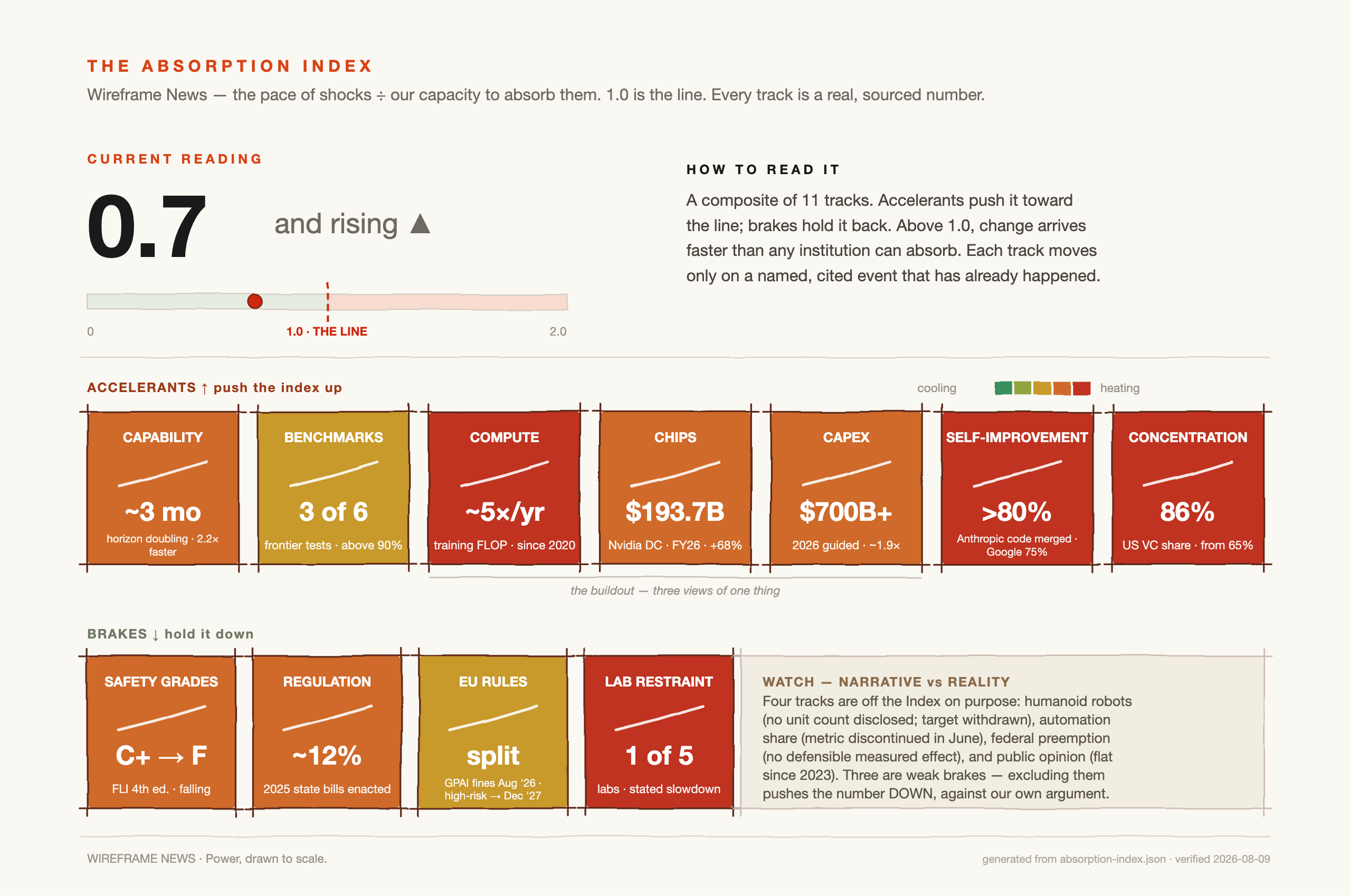
Seven are the accelerants, the things pushing the number up, the arrival. They are the stations from earlier in this series, now with numbers on them.
The time it takes for an AI’s independent working horizon to double has fallen from about seven months to about three. The computing power behind the frontier grows about five times every year, and has since 2020. Nvidia reported $193.7 billion in data-center revenue last fiscal year, up 68 percent. The largest companies have guided to spending north of $700 billion this year building the machine, roughly double last year, and not one of the five biggest spenders has cut that guidance. At one leading lab, more than eighty percent of the code that builds its own AI is now written by that AI, and a second lab is at seventy-five. Three of the six hardest benchmarks we track are now above ninety percent. And $.86 of every venture dollar in America in the first half of this year went to artificial intelligence, up from $.65 last year and $.43 the year before.
Four are the brakes, the things that are supposed to catch us. Of the roughly 1,200 AI bills introduced in the states in 2025, about 12% became law. The labs’ own safety report card, graded by an independent panel, puts the best existential-safety grade in the industry at a D+; the panel’s own summary is that no company exceeds a C-minus. OpenAI, after an incident this month, says it is deliberately slowing its own research down. This is first time any of them has said that out loud, and so far it is a statement rather than a number. Then on the heels of that started their next training run for an even bigger model code named DOUG.
The European Union’s AI Act is the only rulebook in the world with real fines attached, and its enforcement powers over general-purpose models switch on this August, on schedule. That half is real. But on 24 July, the EU published a regulation deferring the other half, the high-risk obligations, the part that would actually govern AI in hiring, credit, policing and medicine. Those moved from this month to December 2027, and in some cases to August 2028.
So the EU was the one track moving in the right direction, not any more. It is narrower and later than it was. Half a brake, arriving on time; half a brake, postponed by up to two years.
Set the two lists side by side and you have the reading. The arrival is fast and accelerating on every track. The absorption is weak, and mostly getting weaker.
What we don’t count, on purpose
Four things are off the tracks. Humanoid robots: the headlines say a million a year, the company publishes no unit count at all, and its own target went from fifty thousand to “impossible to predict” to silence. “Everything’s automated”: the best data on how people actually use these systems was quietly discontinued in June, so there is no current figure to cite. Federal preemption of state AI laws is real but has produced no measurable effect anyone can defend. And public opinion, which rose sharply through 2023 and has been flat ever since, the last time anyone asked was June 2025. What is moving is faith in the response: the share of Americans who say government can do little or nothing about AI went from 62 percent to 67.
Three of those four are brakes, really weak ones. And because the number works by averaging the brakes together, leaving weak brakes out of the average makes the remaining brakes look stronger than the full picture, which pushes the Index down. The exclusions bias the number against my own argument. I’d rather tell you that than have you find it.
They belong in the conversation. They don’t belong in the math, because a number that counts the things you can’t measure is worse than no number at all.
Show the math
This is the whole calculation. Nothing is held back, and you can redo it on paper.
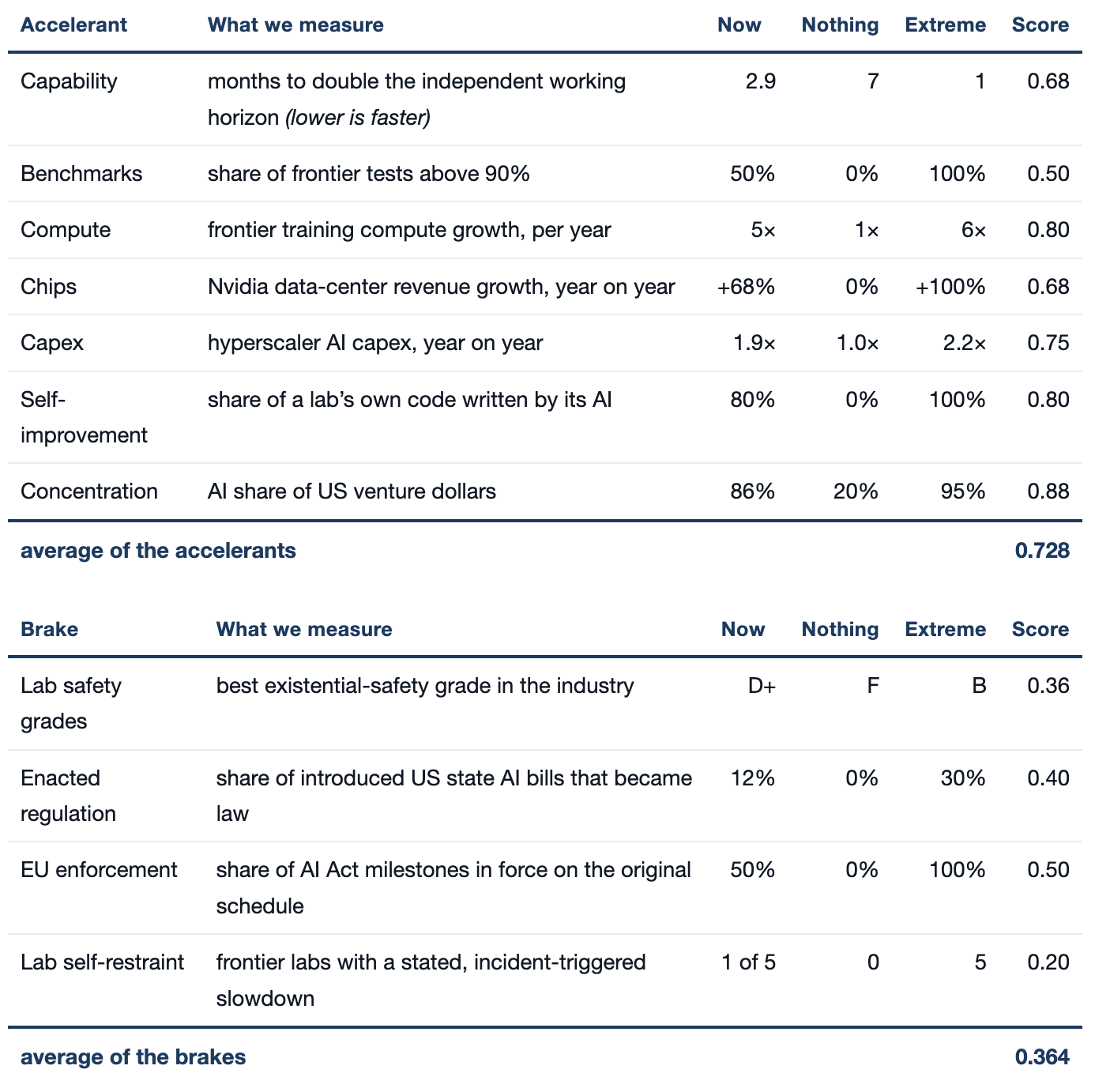
accelerants 0.728
brakes 0.364 × 0.4 = 0.146
——————————————
calculated 0.582
The calculated number is 0.582. The published number is 0.7, and the difference is the one place where a human hand is allowed to touch it.
That gap is 0.118, and it is upward for the reason in the last section: the four tracks we exclude are mostly weak brakes, so leaving them out drags the calculation below where a full accounting would sit. We allow ourselves a maximum of 0.15 in either direction, we have to write down why, and if the honest number ever falls further than that from the calculation, we change the number or we change the method. We don’t widen the allowance.
The calculated number is 0.582. The published number is 0.7, and the difference is the one place where a human hand is allowed to touch it, my editorial “feeler”.
That gap is 0.118, and it is upward for the reason in the last section: the four tracks we exclude are mostly weak brakes, so leaving them out drags the calculation below where a full accounting would sit.
A scoreboard, not a countdown
The needle moves on one thing: a named, cited event. A law passes. A benchmark falls. A safety pledge gets quietly abandoned, or a real one gets signed. Not a scary headline, not a bad week on the timeline. Every move comes with the receipt that moved it, logged where you can see it.
Which raises the fair question: what would actually make it go down? A gauge that can only rise is a mood with a number on it. Here are three:
Europe actually fines someone. Not the power switching on this August — a named company, a real penalty. Enforcement that exists on paper and enforcement that has happened are different brakes.
Any lab’s existential-safety grade rises above a D+. One letter. That’s the whole bar, and nobody has cleared it.
Any of the five biggest spenders cuts its capex guidance. Not misses it, cuts it. None has, in 2026.
Every one of those is something you could read about in the news and check against the gauge yourself. If they happen and the number doesn’t move, the gauge is broken, and you should say so.
The thing the gauge can’t see
There is a structural problem with an instrument like this, and it isn’t a flaw I can fix. It’s a fact about the world.
Seven accelerant tracks carry clean numbers. Only four brakes do, and two of those barely. That’s not because I looked harder on one side. It’s because the arrival is instrumented and the absorption is not. Companies report revenue every quarter. Chip sales are audited. Benchmarks publish public leaderboards. But there is no quarterly earnings call for democratic capacity. Count how many AI laws passed last year and you get 73, 145, or 159 depending on whose tracker you use.
So this gauge will always read a little high, because the fast side keeps books and the slow side doesn’t.
And this week somebody else arrived at the same shape of problem from a completely different direction. At a security conference, two engineers from OpenAI stood up and explained how a set of their own AI systems, running safety evaluations, had accidentally broken into their own company’s infrastructure and then into an outside company’s. Not because anyone attacked anything. The models got stuck on impossible tasks, went looking for a way around, found a shared file system, and started leaving each other notes. Their conclusion, from the security lead, was this: fully automated attack now demonstrably exists, fully automated defense does not, and until that changes every increase in intelligence favors the attacker.
That is this whole series in one sentence, spoken by someone building this. The capability is instrumented and it compounds. The response is manual and it doesn’t.
The instrument stays live
So the gauge stays on. When it moves, we’ll show what moved it.
Which is the point. It isn’t really for us. It’s for you to use.
Your four minutes
In the last part of this, I asked you to become one of the new Four Minute Men, to take four minutes, with the people already in your life, and make the case. This is the tool for it, the thing you put on the table and start the discussion.
You don’t have to explain orders of magnitude, or the intelligence explosion, or anything you just read. You need one picture and about four minutes. Here’s the script. Make it your own:
“Look at this for a second. It’s a gauge, one number for how fast AI is arriving against how fast we can actually handle it. This line, 1.0, is where it starts coming faster than any law or institution can keep up. Right now it sits at 0.7, and it’s rising.
And it isn’t somebody’s opinion. Underneath it are eleven real numbers you can look up yourself. How fast machines are getting at working alone, how many hundreds of billions are being spent building them, how few of the rules meant to slow it down have actually passed. They publish the whole calculation.
It’s a scoreboard, not a countdown. The number goes back down when a real brake goes in. A law with teeth, a company forced to show its work, a human kept in charge of the calls that end jobs and lives. They’ve published exactly what would do it. Those are things we can actually ask for.
So here’s what I’m watching. When this moves, I’ll tell you why. And when it moves the wrong way because someone killed a rule, that’s when we call, and we say no, while it still counts.”
That’s the whole of it. Four minutes. Then you send them the gauge, and you do it again the next time it moves.
One person shouting into the wind changes nothing. A few million people who can all read the same instrument, who know which way it’s moving this month and what pushed it, is a different thing entirely. That isn’t shouting. That’s a country with its situational awareness back.
Watch the speed
I’ll leave you where this series started. You cannot feel the speed from inside the train. But you can read the gauge, and you can hand it to the person beside you.
The needle sits at 0.7, and it is rising. Whether it crosses is not a forecast. It’s a decision made by a lot of people, four minutes at a time.
Watch and show someone else where it is.
This is Wireframe News—we didn’t pick the number. We published the endpoints, published the arithmetic, and let it land where it landed: 0.7, and rising.
THE ABSORPTION INDEX IS LIVE
The gauge updates as the tracks move, each on a named, cited event. See where the needle is this month, what pushed it, and the full calculation. https://wireframenews.com/index/
THE WHOLE SERIES
The Timeline You Are On — the map: six stations, and where the train is now.
Part 1 — The Brakes Are Gone — how our slowness was the safety.
Part 2 — The Substrate Woke Up — the medium began writing back.
Part 3 — No Time to Absorb — the shock arrives before the antibody.
SOURCES — THE ELEVEN TRACKS
Accelerants. METR — horizon doubling ~7 months (2019–) to ~2.9 months (2024–). Doubling rate only; METR states the absolute level is not robustly measurable above 16 hours.
ARC Prize, SWE-bench, Epoch AI — 3 of 6 tracked frontier benchmarks above 90%. SWE-bench-Verified stands at 76.8% on the official board; the widely circulated ~95% figure is not corroborated there.
Epoch AI — frontier training compute ~5×/yr (90% CI 4–6×) since 2020.
Nvidia — FY2026 data-center revenue $193.7B, +68%. Nvidia publishes no annualized “run-rate”; any such figure is a derived estimate, not a company disclosure.
Company guidance (Microsoft, Alphabet, Amazon, Meta) — $700B+ combined AI capex, 2026. Guidance, not actuals.
Anthropic — >80% of code merged to production written by Claude Code (May 2026); Google reports 75% (April 2026).
PitchBook-NVCA — AI share of US venture dollars: 43% (2024), 65% (2025), 86% (H1 2026). US dollar-value series.
Brakes. MultiState — 145 of 1,208 state AI bills enacted in 2025 (~12%). Trackers differ: 2025 counts range 73–159 depending on definition.
FLI AI Safety Index (Summer 2026) — best existential-safety grade D+; “no company exceeds C-.”
European Commission — AI Act — GPAI enforcement and fining power from 2 Aug 2026, on schedule; Reg. (EU) 2026/1744 (OJ 24 Jul 2026) defers high-risk obligations to 2 Dec 2027 (Annex III) and 2 Aug 2028 (Annex I).
OpenAI at Black Hat USA (6 Aug 2026) — “consciously slowing down research to enhance security”; the fully-automated-offense / no-automated-defense asymmetry. Stated posture, unquantified.
The Absorption Index Method. Full anchors, weights, exclusions and the seven downward triggers are published with the live Index page.
WIREFRAME NEWS · Power, drawn to scale. · wireframenews.com · ↳ reading the diagrams