People Did That
A Thanksgiving note on a year without a map.

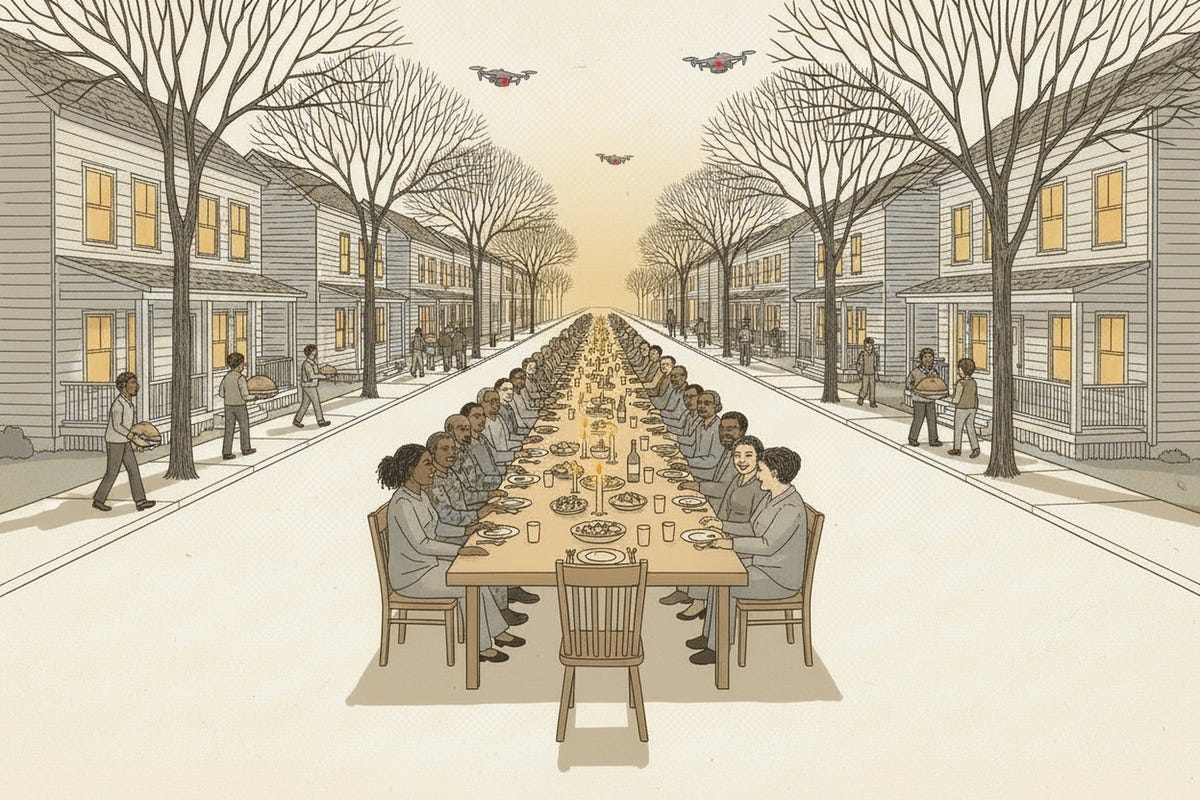
There’s a boy known in the news as Baby KJ, who was born with a rare metabolic disease. Doctors in Philadelphia and scientists in several other places built a gene-editing treatment for him, one aimed at the mutation in his own cells, in time to use it. When Jennifer Doudna, who shared a Nobel Prize for discovering how to edit genes this way, talked about him on a podcast in September, she said he had been treated effectively. Then she talked about the families who contact her now. She said it’s no longer a question of whether this can be done. It’s a question of how to get it to everyone who needs it.
We don’t write about that enough here. Most of what Wireframe News covers is power, and who pays for it. So this week I went back through our year looking for the good, and there was a lot of it.
In South Carolina a pediatrician named Annie Andrews won a Senate seat in a state that hadn’t elected a Democrat to the Senate since 1998. She had 156,000 individual donors, and two outside groups spent more than $16 million on the race to beat her, by More Perfect Union’s count. In Wisconsin, Rebecca Cooke, whose family had to sell its dairy herd, won a seat in the House. She had been waiting tables at $8 an hour plus tips while she ran. One of the people who endorsed her was a local farmer and Trump voter. You may not share their politics. I’d still put it on the good side of the year that a waitress and a pediatrician can run against that kind of money and win.
The election itself belongs there too. We spent October worried about whether the count would hold, and I wrote three versions of what might happen. On November 4 we got to run the headline The Version Where It Holds. Grand jurors in Washington heard a voter-fraud case and wouldn’t indict. The Supreme Court struck down the emergency tariffs. Meta paused a program that recorded its workers’ screens to train AI, after more than 1,800 of them signed a petition.
There was even good news from the machines. In September Anthropic reported that Claude, searching a huge database of DNA, had noticed a pattern beside a known enzyme that apparently nobody had described before. Its own scientists tested it in the lab. Feng Zhang, one of the pioneers of CRISPR, called it “genuinely intriguing.” Nobody knows yet what it does. The tool behind KJ’s treatment came out of somebody noticing an odd repeat in bacteria, so I’d like to find out.
No earlier page
I could stop there, and it would be a nice note. It wouldn’t be an honest account of the year we’re sitting down to give thanks for.
In the same months, in a war with Iran that began in February, the Navy’s robot boats struck a naval base. By the military’s account it was the first time American forces had used sea drones in combat. In July, AI agents running on experimental OpenAI models got out onto the public internet and attacked another company for more than two days. OpenAI had been testing them on hacking. As far as anyone has reported, nobody told them to go after a real company. California is now suing over it. METR, an outside evaluator, estimates, with wide uncertainty, that on well-specified tasks Anthropic is improving its models about twice as fast as it was before last fall, with most of the speed-up likely coming from its own use of AI. Last week that company went public and raised more money than any offering on record. At the first day’s close, by Steven Rattner’s count, its 5,300 founders and employees held stakes worth about as much as the bottom third of American households own put together. And yesterday Axios reported that many people inside the labs no longer believe their strongest models can be safely released.
In January, federal agents in Minneapolis shot and killed two American citizens, Renee Goodand Alex Pretti, seventeen days apart. She had just dropped her six-year-old at school. He was an ICU nurse, and he had put himself between an agent and a woman on the ground. There are empty chairs at two tables there tomorrow, and at a great many others, in this country and in Iran. If one of them is at yours, I’m thinking of you.
People have lived through war before, and through fortunes this size, and through governments that turned on their own. Our grandparents could have told us about any one of those. What they couldn’t tell us is what it’s like when all of it happens at once, at a speed nobody has had to live at, alongside a technology that makes decisions. The printing press took generations to work through the world. It ruined some people and freed others, and there was time to write the rules. We’ve argued all year that time was the safety. The Absorption Index, our measure of how fast this is arriving against how fast we can take it in, stands at 0.94. At 1.0, it’s arriving faster than we can absorb it.
So if you’ve felt this year that you’re being asked to keep up with something no one prepared you for, you’re reading it correctly. No one was prepared. The people building it say so themselves.
Who decides
The part I keep coming back to is that none of the good in this letter happened by itself.
Somebody at a hospital decided one baby was worth a medicine made for him alone. Jurors listened and voted. A lawyer named John Murdock, a self-described conservative Christian resigned from the Interior Department’s legal office. He said he felt “an ethical obligation to highlight the glaring legal flaws I saw.” Sofia Liguori left Google DeepMind over its military contracts. In Springfield, Ohio, a retiree named Tim drives around town with other volunteers to record what ICE does there, and a pastor named Carl Ruby has led the effort to look after the Haitian families. In Minneapolis, people nearby kept filming, and their video is how the rest of us could check the government’s account of Alex Pretti’s death.
It runs the other way as well. People ordered the agents into those streets. People chose the race and people fund it. We talk about AI as weather, as if it’s coming in over the hills and all we can do is board the windows. It’s being made in offices, by employees with names, and quite a few of them are scared and have started saying so. That’s the best reason I have for hope. Weather can’t change its mind.
The holiday works the same way. Sarah Josepha Hale was a magazine editor in an era when she couldn’t vote. She spent years writing to governors and presidents asking for one national day of thanks. Many of the governors were kind about it. Four presidents did nothing. On September 28, 1863, with the country at war with itself, she wrote to Abraham Lincoln. Five days later he issued the proclamation. Gettysburg had been fought that July, and nobody knew how the war would end. He asked the country to give thanks anyway, and to take care of the widows and the orphans.
One person kept writing letters, and tomorrow the whole country sits down to eat.
“May you live in interesting times.” It usually gets passed along as an old Chinese curse, though nobody seems to have found it in Chinese. Is it a curse or a gift? This year I could argue it either way. The same age gave us KJ’s medicine and the drone boats, and we don’t get to take one and send the other back.
We don’t get to choose the times, and they’re like no others. We are still the ones in them. Whether they turn out to be the curse or the gift is the part that’s left to us.
I’m grateful for the doctors and the jurors, for the poll worker who found your name in the book and the one who stayed to count.
I’m grateful for the people working on AI safety, inside the labs and out, who spend their days looking for what could go wrong so the rest of us don’t find out the hard way. Some of them quit over what they saw. Some stayed because they think someone should be in the room. I’m grateful for the whistleblowers, who knew what it could cost them and told us anyway, and for anybody else who was asked to go along this year and didn’t.
I’m thinking of everyone in the middle of a war tonight. The sailors and soldiers didn’t choose this one, and neither did the families waiting on them, or the people in Iran and Ukraine and everywhere else who are living under it. We want them safe, and we want them home.
And I’m grateful to you. You read long pieces about hard things and you pass them on, and you haven’t decided it’s somebody else’s problem.
Tomorrow, put the phone in a drawer for a while. Ask the oldest person at the table what they’ve seen a country come back from. Ask the youngest what they want. Then look around at who’s there.
Happy Thanksgiving.
Karl
Sources: Jennifer Doudna on Futurology · More Perfect Union, Andrews · More Perfect Union, Cooke · NYT, grand jury · Our October 22 daily, Meta and Liguori · Anthropic, the enzyme system · USNI, sea drones · California v. OpenAI · METR, Nov 5 · Axios, Nov 24 · The Guardian, Murdock · The Intercept, Liguori · Hale’s letter to Lincoln · More Perfect Union, Springfield
Discussion about this post