

On Thursday, October 8, in Marble Hill, a neighborhood that is politically part of Manhattan but sits geographically in the Bronx, a plainclothes federal agent, an ICE agent according to DHS, shot a man in the neck. His name is Oscar Bergal. He is 28. His five-year-old son was in the back seat of his car, according to a relative cited by Fox 5.
The boy was not hurt. NYPD Commissioner Jessica Tisch said at least one agent fired seven rounds and that one struck Bergal in the neck, below the left ear. Marcos Charles, who heads ICE’s enforcement and removal operations, said Bergal was “struck by one of the bullets or fragments superficially in the neck,” and that he “weaponized his vehicle and proceeded to accelerate going toward other officers.” A deli worker told CBS New York a different story: she said the car was driving away from the ICE agents. The NYPD says its officers were not at the scene and its cameras did not capture the shooting itself, and no video of it has been released. The next day, Homeland Security Secretary Markwayne Mullin acknowledged the agents did not know the boy was in the car, and blamed Bergal for endangering him. Governor Hochul said she urged the president and Mullin to halt ICE enforcement operations in New York.
I start there because it is the smallest story in this series, and because you don’t need an explainer for it. A man is bleeding, a kid is in the car, and by the next day a governor, a mayor and a cabinet secretary were arguing over it.
Now put the rest of that week next to it. The Pentagon announced that a firing-squad execution will be livestreamed. The president posted that 125 million people voted in India’s “Presidential Election” on Sunday, October 4, a vote India did not hold, and used it to call American elections corrupt. He promised every adult citizen $5,000 if Republicans win the House and the Senate in November. The Labor Department reported that employers added 29,000 jobs in September and revised July down to a loss. Pew reported that 30 percent of Americans approve of him and 68 percent disapprove.
I want to ask one question of all of it: How much do you need to see to know your government has decided it does not need you?
The question a lady asked
In September 1787, as the Constitutional Convention broke up, James McHenry of Maryland wrote in his journal that a lady, whom he identified in a note as Mrs. Powel of Philadelphia, put a question to Benjamin Franklin: “Well Doctor what have we got a republic or a monarchy.” The answer, in McHenry’s hand: “A republic replied the Doctor if you can keep it.”
Franklin didn’t say a republic and you’re safe. He said if. The people who wrote the thing were afraid of one danger above the others, they had just fought a war over it, and they left us a checklist. It is the second half of the Declaration, the long list of what a king does. In this series I’m going to hold it up against this month, line by line.
This is an opinion series. Where I report, I cite. Where I speculate, I say so. And in every part I’ll put the administration’s best case in its own words, because if I can’t beat the strongest version of what they say, I haven’t earned the argument.
Six parts, built around what voters say matters. In a Pew survey taken September 28 to October 4, registered voters called these “very important” to their vote: the economy, 84 percent. The future of democracy, 73. Health care, 68. Immigration, 59. Violent crime, 52. Artificial intelligence, 44. Part 1, here, is democracy and consent. Part 2 is justice, the press and the party around the president. Part 3 is immigration. Part 4 is the economy and health. Part 5 is the army and the companies, which is where I think the biggest story is hiding. Part 6 is the election itself.
What they wrote
The Constitution opens with three words that don’t belong to any president: “We the People of the United States, in Order to form a more perfect Union, establish Justice, insure domestic Tranquility, provide for the common defence, promote the general Welfare, and secure the Blessings of Liberty to ourselves and our Posterity.” The Declaration says governments get “their just powers from the consent of the governed.”
I am not saying the president is George III. He was elected. A king, in the Declaration’s sense, is not a crown. A king is a way of deciding. It is the arrangement in which one man’s will becomes the answer to every question: who judges, who enforces, who is armed, who gets paid, who is listened to. The crown is incidental. A king without a court is just a man, so there is a second feature to look for: the people around him who have learned to ask what he wants. We’ll get to them.
The founders were not saints. The men who wrote the first of those sentences owned human beings, and the distance between the words and the practice has been the whole argument of American history. That distance is why the words are worth anything. They are the thing you measure yourself against. So measure.
The consent of the governed
Start with a pronoun, because it’s the cheapest test there is.
I counted everything Trump wrote in his own words on Truth Social from September 1 through October 9: 275 posts and about 27,000 words, with reposts, shared headlines and other people’s text set aside. The simple version of what I expected to find doesn’t survive the count. He says “we,” “our” and “us” about as often as “I,” “me” and “my”: about 16 times per thousand words against 18.
A count like that means nothing on its own, and the comparison his supporters reach for is Obama and Biden. Their tweets were mostly written by staff, so posts can’t settle it. Speeches can. I took every spoken remark the three of them gave in the same five weeks of a midterm year, September 1 to October 9, from the full transcripts: Obama in 2010, 67 remarks; Biden in 2022, 58; Trump this year, 87. Trump does say “I” more, about 34 times per thousand words, against 28 for Biden and 21 for Obama. Obama said “we” more than half again as often as “I.” But at campaign events, Biden said “I” just as often as Trump does.
So the ratio isn’t the story. The story is who the pronoun belongs to.
In those same transcripts, Obama said “the American people” 54 times and Biden 60. Trump said it 11 times, in more words than either. Per word, that is less than a seventh as often as either of them. On Truth Social it appears 7 times, and nearly every time the people are on the receiving end of something. They “elected me to deliver.” The $5,000 “will happen because the People of our Country deserve it.” The people are a constituency to be served, or a victim to be avenged on a rival’s behalf.
“Our” is the possessive of an owner. The word that follows it most often in his posts is “Country,” about 50 times, then “Great,” and further down “Border,” “Military,” “Economy.” And when he says “we,” it is mostly a scoreboard: “We are building that capacity HERE.” “We have the BEST FINANCIAL NUMBERS EVER.” That is the “we” of a lineup announced from the booth.
In those framings, “we” feels like a smaller group, a group around the president vs the whole of the nation.
Then there is the name. 225 of the 275 posts, more than four in five, end with his name and title in the third person, “President DONALD J. TRUMP” or “President DJT.” In the same five weeks of 2018, on Twitter, he signed one tweet out of 360 that way. Out loud this year he says his own name several times as often as Obama or Biden said theirs, counting the things he has named after himself. He writes about himself the way a broadcaster writes about a franchise: “When PRESIDENT DONALD J. TRUMP has 50,000 people, they make it sound like nobody showed up!”
Some of the “I” is just the office speaking. “I am pleased to announce the nomination of...” is a president doing the job, and nominations are his to make. The test is whether the “I” stays inside the powers the Constitution gave it. Here are the places where it doesn’t seem to, verbatim.
On September 14, about Iran: “I will determine whether or not the U.S.A. will choose to engage.” On October 8: “we will not be attacking Iran at any time prior to the Midterm Elections to be held in the United States on November 3rd.” A war schedule, posted on a social network and set by an election date. On October 7, in a post saying he had just spoken with Tom Tiffany, who “has my Complete and Total Endorsement” for governor of Wisconsin: “I told Tom that I will be approving 17.9 Million Dollars for the Severe Storms and Tornadoes that Wisconsin has experienced,” and ends “I LOVE YOU ALL!” Disaster aid is the public’s money. Here it arrives as something a president told a candidate he would do for the candidate vs for the people of the state. I am not claiming a trade. I am showing you who the post says is giving and to whom by their own account.
On October 9, at 2:46 in the afternoon: “I have just concluded a highly successful discussion with President Vladimir Putin, of Russia, wherein it was agreed that Russia will immediately supply over 300,000 Tons of Diesel Fuel to the American and Global Marketplace.” The same day, the Treasury licensed the purchase of Russian diesel, “including importation into the United States,” through April 7, 2027. Three weeks earlier he had signed the Lindsey O. Graham Sanctioning Russia and Iran Act. That law lets a president waive its sanctions, but only with “a certification in writing that the issuance of the waiver is in the national interests of the United States” and “a report explaining the basis for the certification.” I could find no report that he filed one. The license cites Treasury’s own regulations, not the act, and a 2022 law still says Russian energy products “shall be banned from importation into the United States.” Whether the license squares with that law is an open question. His reason is a real one, diesel prices for “our Great Farmers, Ranchers, and Truckers.” England’s Bill of Rights of 1689 named what kings used to do and outlawed it: “the pretended power of suspending the laws or the execution of laws by regal authority without consent of Parliament.” Congress built a door into its sanctions and told the president how to open it. As far as anyone has reported, he didn’t use the door.
And on September 28: “MAGA, pretend I am on the ballot.” On October 4: “I AM ON THE BALLOT!” He is not on the ballot in November. A president who is not on the ballot has made the midterms a referendum on himself, and told his voters that is what they are voting on.
There is an old line that there is no “I” in team. A republic is an argument about that line, and the Constitution settles it in its first three words. “We the People,” it says, before any branch, any power, any president. A government of one has its own first words: I will determine whether or not the U.S.A. will choose to engage.
A shared picture of what happened
Consent depends on everybody looking at the same facts, so look at the picture. That Sunday night, October 4, at 11:32, the president wrote: “125 Million People voted today in the first round of India’s Presidential Election.” He said the results came the same day, while in Detroit, Philadelphia and California they “take weeks to Rig, I mean, calculate.” And then: “Voting in America is CORRUPT!!!” India held no such election. Its president is chosen by an electoral college. The post is not a gaffe about geography. It is a premise, the corruption of American voting, resting on a fact that doesn’t exist.
On Tuesday, October 6, he wrote that it was “a miracle that I won, the last by a landslide, three Presidential Races.” He lost 2020. A post he published two days earlier, quoting the pollster Dick Morris, put his 2024 share of the popular vote at 49.8 percent. I call this the Weather Report: a daily broadcast from a country that doesn’t quite exist, delivered with total confidence, to people who live in the one that does. When the president tells you an election you’ve never heard of proves yours is rigged, he isn’t confused about India. He is building the permission slip.
What the permission slip is for
At a Senate hearing on September 15, Roll Call reported, FBI Director Kash Patel declined multiple times to commit to keeping agents away from polling places. Asked about the bureau’s election role, he said, “We will always follow the law and the guidelines.” Federal law, 18 U.S.C. § 592, makes it a crime for a federal officer to bring or keep “troops or armed men” at a place where an election is held, unless needed to repel armed enemies of the United States. Whether it reaches FBI or ICE agents is contested. On September 1, Mullin said ICE would be at polling places only “if there is a threat to that polling place or we’re serving a warrant on someone that we have been actively tracking down.” The Justice Department has sued 30 states and the District of Columbia for their voter rolls. Democracy Docket, an advocacy outlet that tracks the cases, counts the dismissal in Georgia on September 30 as the department’s 26th loss. The department plans a record roughly 1,000 poll monitors, CBS reported, against 714 in 2024 and 289 in the 2022 midterms, according to an unnamed Justice Department official.
On September 14, the Supreme Court refused to stay a judge’s injunction against a Postal Service rule on mail ballots, saying the government was “unlikely to succeed on the merits,” with Alito and Thomas dissenting. Justice Kavanaugh, concurring, wrote that state and local officials did not have enough time to put the rule in place before the elections, while finding “at least a fair prospect” that it falls within the Postal Service’s statutory authority.
And the president has said what he’d do if the vote goes badly. Asked in an interview Time published on October 1 whether he was preparing for what might happen if he doesn’t hold the House, he said: “They’ll probably go after me and I’ll go after them.” Four days later, on October 5, he posted: “If Republicans win the House of Representatives and the Senate in the 2026 Midterm Elections, I’m going to give all Adult Citizens in the United States of America, $5,000.” I’ll leave the statutes to the lawyers.
The shape is plain: a promise of money, tied to a party’s victory, from the president.
The case they make
Here is their argument, in their words, and it is a real one. At a rally in Vandalia, Ohio, on October 3, the president told the crowd, “If you do that, we’re gonna win and we’re gonna win big,” per the Roll Call Factbase transcript. The next morning he posted that the polls have always missed his voters: “The Polls have ALWAYS underestimated MAGA.” That has happened before, and it is a fair reason not to treat any poll as a forecast.
The current polls we have don’t help him. Pew has his approval at 30 percent, 68 percent disapprove, and among validated 2024 Trump voters approval has fallen from 95 percent at the start of his term to 67. Registered voters prefer Democrats for the House, 44 to 36, with 15 percent unsure. A national lead is not a majority of seats, and I’ll come back to why in Part 2. But a president who is not on the ballot and a promise of $5,000 are what a campaign looks like when it is worried about its numbers.
What to do tonight
Check your voter registration at your state’s election site, and check it for everyone in your household. Many states’ deadlines have passed. In Georgia, early voting runs October 13 to 30. Texas registration closed October 5, and early voting there runs October 19 to 30. Deadlines differ by state, so use your own state’s official election site, not an aggregator. If you are registered, find your county’s poll-worker sign-up page. The person at the table is the part of the system that holds.
Back to the car
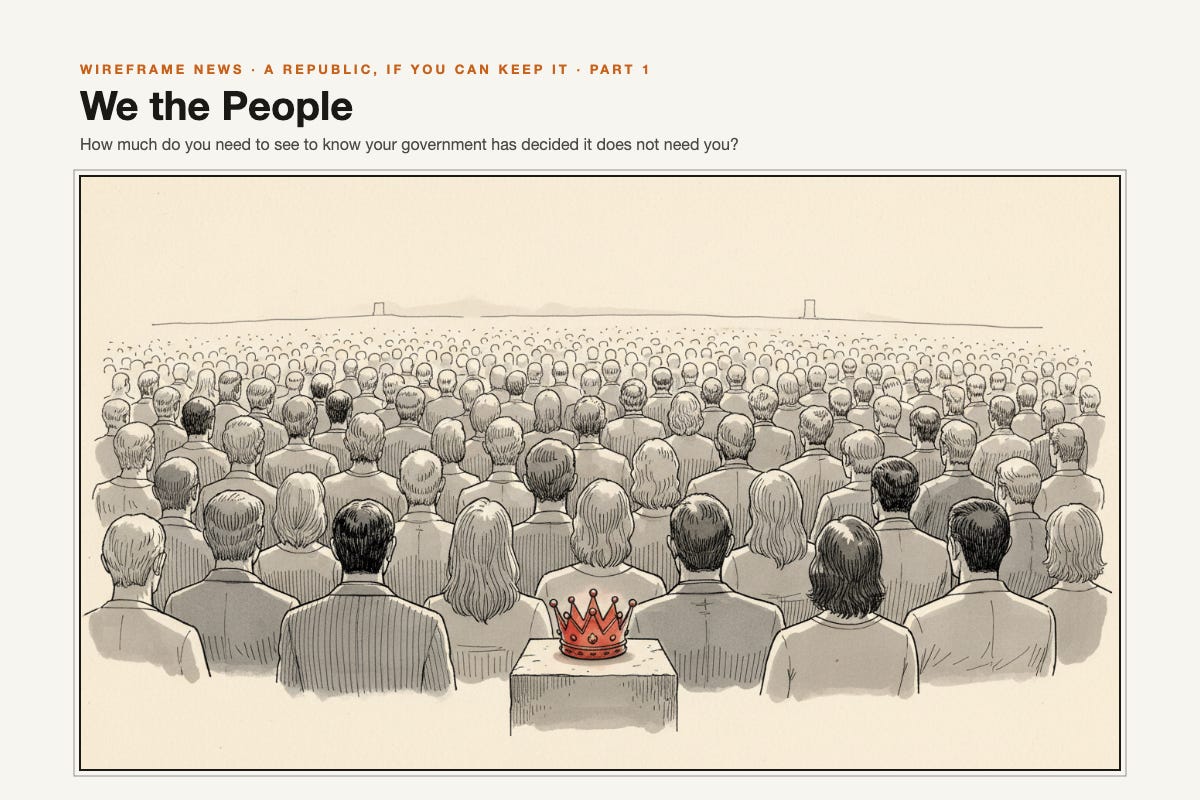
The child in the back seat in Marble Hill is five. The one thing everyone agrees on is that he was there. A republic starts with the word “We,” and ends, if it ends, with the day a government stops needing you as part of that “We”.
Next, Part 2: the courts, the press, and the people around the throne.
Sources
The shooting: CBS New York · NBC News · amNY · Fox 5 NY · CNN (Hochul) · Gov. Hochul, Oct 9 transcript
The week: Pentagon livestream (PBS) · BLS jobs report · Pew: approval · Pew: issues
Founding documents: McHenry’s journal (Library of Congress) · Declaration · Constitution · English Bill of Rights, 1689
His posts (Truth Social archive): Iran, Sept 14 · Iran, Oct 8 · Wisconsin, Oct 7 · Russian diesel, Oct 9 · “Pretend I am on the ballot,” Sept 28 · “I AM ON THE BALLOT,” Oct 4 · India, Oct 4 · “Three Presidential Races,” Oct 6 · $5,000, Oct 5
The pronoun count: Truth Social archive · Trump Twitter Archive · American Presidency Project (Obama, Biden) · Roll Call Factbase (Trump) · counts and method on request
Russian diesel: OFAC General License 135 · Graham Sanctioning Russia and Iran Act (text) · Ending Importation of Russian Oil Act, 2022 · AP via OPB (Zelensky)
Elections: Brazil first round (CartaCapital) · India’s president, last elected 2022 · Patel hearing (Roll Call) · 18 U.S.C. § 592 · Mullin on ICE at polls (The Hill) · Georgia voter-roll dismissal (Democracy Docket) · DOJ poll monitors (CBS) · Supreme Court, USPS v. California · Marist poll and USPS figures (NPR, via KUOW) · Time interview · Vandalia rally (Factbase)
Voting dates: Georgia early voting · Texas Secretary of State