

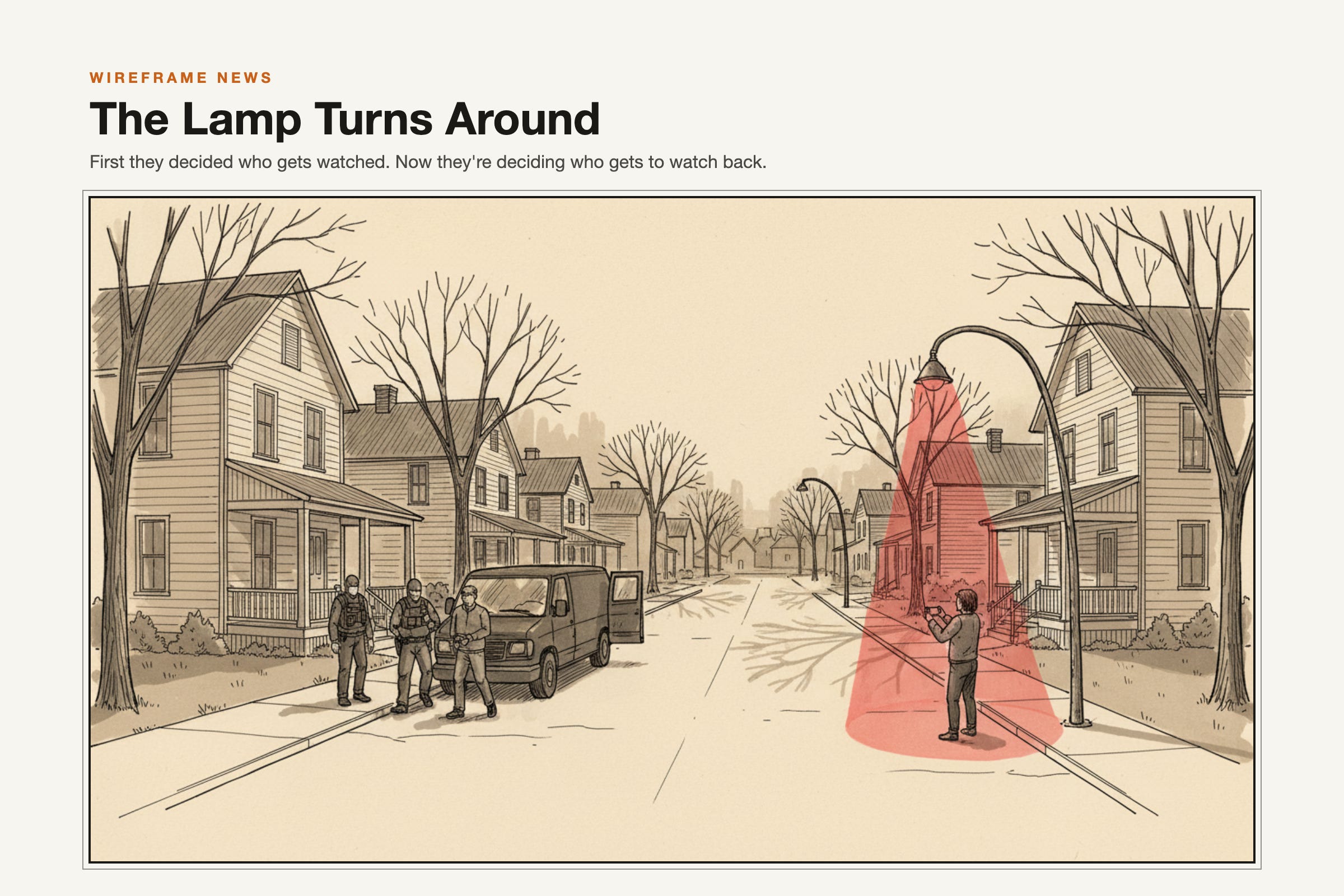
Elinor Hilton started parking a few blocks from her own house this winter. Not because of crime. Because she’d been told, while doing something legal, that agents would “come to her house later that night” if she kept doing it.
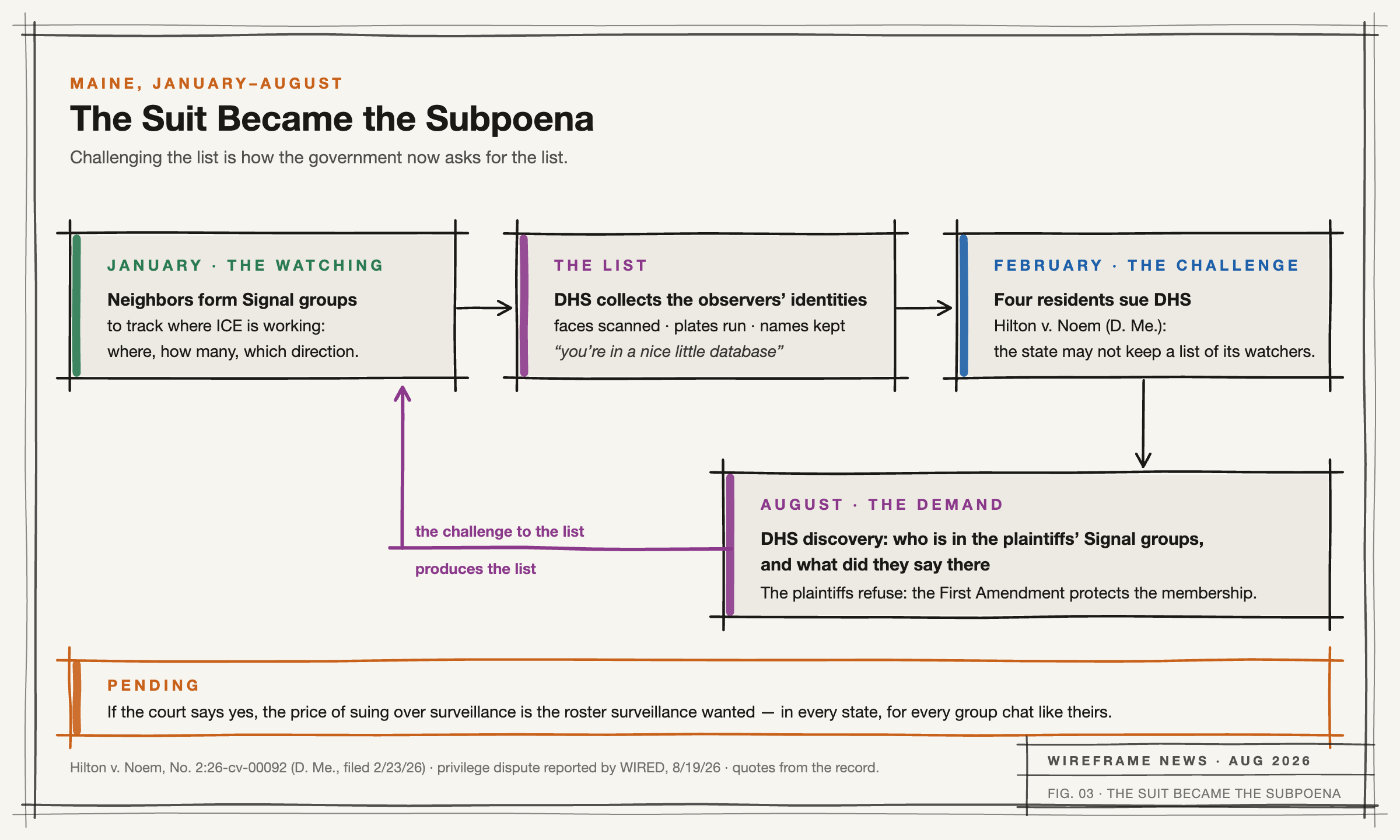
What she kept doing was watching. The deportation operation came to Maine in January. The government called it Operation Catch of the Day, and when agents worked a street, somebody posted it to a neighborhood Signal group: where, how many, which direction they were headed. Whether anyone had gotten a lawyer’s number to the family in time. That’s the whole activity. Watching, and telling each other what you saw.
The warnings came anyway. Colleen Fagan, another Portland observer, says she was told she was now in “a nice little database,” and that the database called her a domestic terrorist. She stopped documenting. In South Portland, Carlyn Williams got a phone call suggesting she encourage her wife not to film anymore, because people who do “might get added to a domestic terrorism watchlist.”
So in February the four of them sued the Department of Homeland Security. Hilton v. Noem, District of Maine. Their claim was narrow: the complaint says DHS has a practice of collecting the identities of people who witness and document its agents, faces scanned, plates run, names kept, and that a list of the government’s observers is not a thing the government gets to keep.
Then DHS answered. In discovery, the government demanded to know who was in the plaintiffs’ Signal groups and what they said there. The plaintiffs refused, claiming the First Amendment protects the membership of an association formed to watch the state. A DHS spokesperson answered that officers face “coordinated campaigns of violence” and that “The First Amendment does not prevent routine discovery into chats that are used to impede and harm federal law enforcement.”
Four people sued to stop the state from building a list of its watchers, and the state’s answer is a formal demand for the list. The suit against surveillance became its instrument. A First Amendment lawyer at FIRE, the Foundation for Individual Rights and Expression, put the stakes plainly: “You shouldn’t have to give up that First Amendment right to expressive association if you need to sue to protect your First Amendment rights.” Judge John A. Woodcock Jr. hasn’t ruled. If he says yes, the price of asking whether the government may enumerate its critics will be the enumeration, and everyone in every group chat like theirs, in every state, will know the price going in.
I wrote in July about the people building the surveillance layer and the bargain underneath it: the rich accept the cameras because they expect to be the watchers, never the watched. That piece was about a belief. This one is about what it looks like when the belief starts getting enforced.
The turned instruments
If Maine were one case, you could file it under aggressive lawyering and move on. It is not one case.
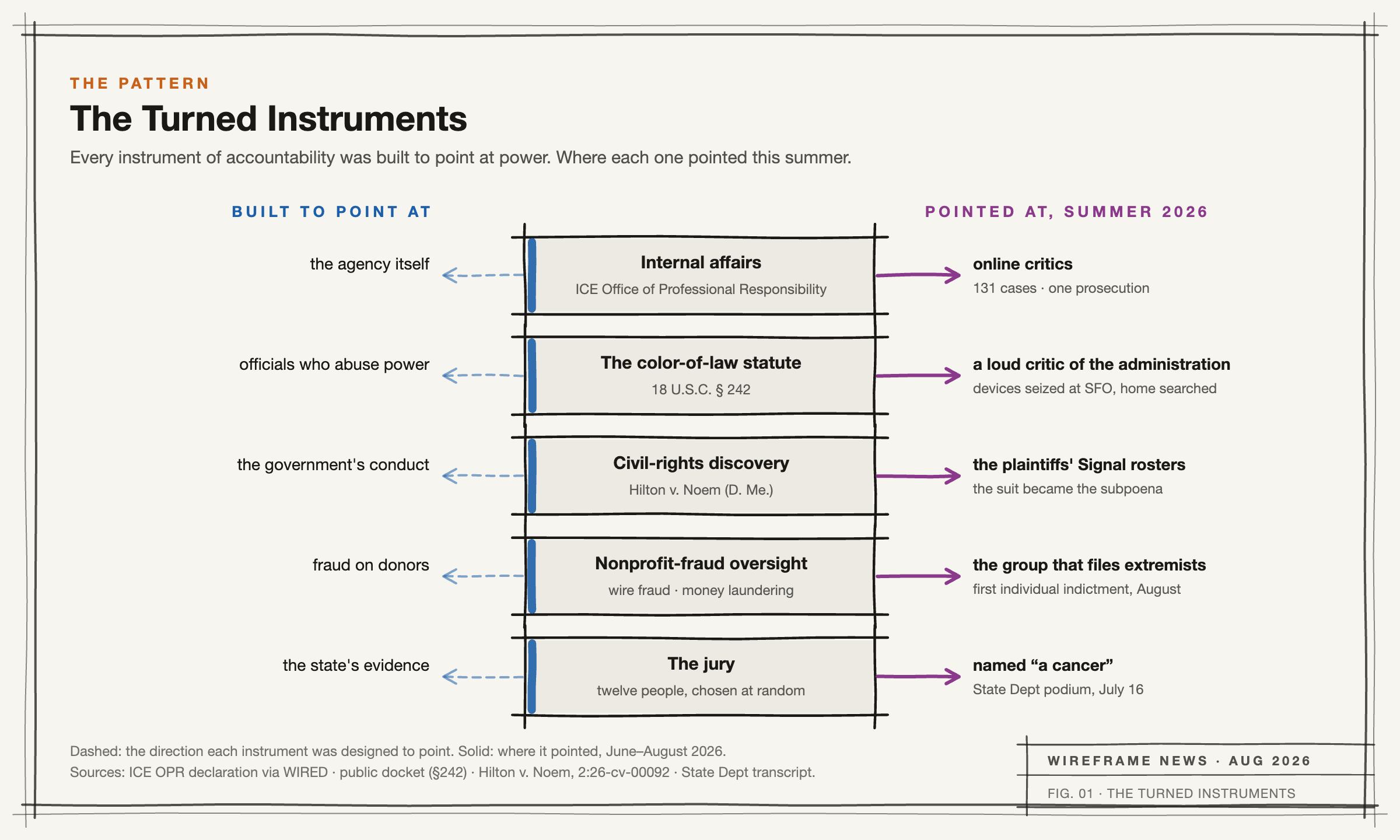
Every instrument of accountability points in a specific direction. Internal affairs points at the agency. The color-of-law statute points at officials who abuse their power. Discovery in a civil-rights case points at the government’s conduct. Nonprofit oversight points at fraud. The jury points at the state’s evidence. Each one is a lamp aimed at power, because power is the thing that needs watching.
Now watch where they’re pointing this summer.
ICE’s Office of Professional Responsibility is the agency’s internal-affairs office. Its job is investigating ICE. An ICE official’s court declaration, surfaced by WIRED, disclosed that OPR opened 131 cases between January 2025 and March 2026 tied to what it calls doxing and threats against ICE staff. WIRED could find exactly one that ever produced a prosecution. The rest is the agency’s self-policing arm, running files on the people who post about the agency.
In Minnesota, prosecutors charged fifteen people who organized against Operation Metro Surge and seized nearly sixteen terabytes of Signal data to do it. At a hearing in July, the prosecutor conceded the haul wasn’t limited to the accused: “There is a large amount of chats that are not specific to these defendants.” How many other people got swept in? Her estimate, on the record: “40, 50, 100 people.” Neighbors. List members. Watchers.
In August, the Justice Department brought the first individual indictment in its case against the Southern Poverty Law Center, the organization whose researchers spent decades keeping files on armed extremist movements. The organization itself pleaded not guilty to eleven counts in April; the new charge names the woman who ran its Intelligence Project, the monitoring arm itself, until 2019. It concerns real money flows, and a court will test it like any other.
Then, last week, FBI agents stopped Eric Swalwell at the San Francisco airport and took his phone and his laptop, and searched his Washington home the next day. Swalwell resigned from Congress in April over misconduct allegations a former aide had made public. The allegations are real, independently reported, serious. What’s strange is the legal vehicle. The public docket identifies the investigation under 18 U.S.C. § 242, deprivation of rights under color of law, the charge you bring against a brutal cop, an official who used the state’s power to strip someone of their rights. It exists to point at abusive officials. Aimed at one of the administration’s loudest critics, it is pointing somewhere else.
If you’ve ever been to a race, you know the marshals: the people at the fence with the flags, whose whole job is watching the track so the stewards can see what happened anywhere on it. A racing series where the stewards started opening investigations into the marshals would not be a safer series. It would be a series that had decided to go blind, on purpose, one corner at a time.
Internal affairs, criminal discovery, the color-of-law statute, nonprofit-fraud enforcement, civil-rights discovery in Maine. Every one of these tools was built to point at power. Count how many are pointing at power now.
The transcript
On July 16, the State Department convened what it called the Ministerial on the Resurgence of Political Terrorism, with delegations from dozens of countries in the room and Stephen Miller at the podium. The transcript is public. It rewards slow reading, because Miller told the room, in his own words, what the turned instruments are for.
On civil liberties:
“One of the hallmarks of left-wing violence and terrorism is its completely pretextual and disingenuous appeal to civil liberties… It is essential that we are wise enough and strong enough to understand that these appeals must fall on deaf ears.”
That is not an argument that any particular claim is weak. It is an instruction, delivered to an international audience, that rights-claims from the labeled class should stop being heard at all. The appeal itself gets reclassified as evidence of the offense.
On the machinery:
NSPM-7 “directs, for the first time in American history, all of our law enforcement and intelligence agencies to work together to disrupt, identify, defund, debank, arrest, and prosecute these political terrorists.”
Read the verbs in order. Defund and debank come before arrest. In Miller’s own sequence, the financial excommunication happens before anyone sees a courtroom.
NSPM-7 is a presidential memo from September 2025, and I introduced it to readers in June, when the first sentences built on it came down: the memo was the architecture, I wrote then, and the sentences were the output. What I wanted readers to understand was never the word “antifa.” It was the memo’s own list of warning indicators for this terrorism: “anti-Americanism, anti-capitalism, and anti-Christianity... extremism on migration, race, and gender; and hostility towards those who hold traditional American views on family, religion, and morality.” It describes tens of millions of ordinary political opinions. A memo that tasks the terrorism task forces, the Treasury, and the IRS against a list like that isn’t describing a criminal organization. It’s describing a constituency.
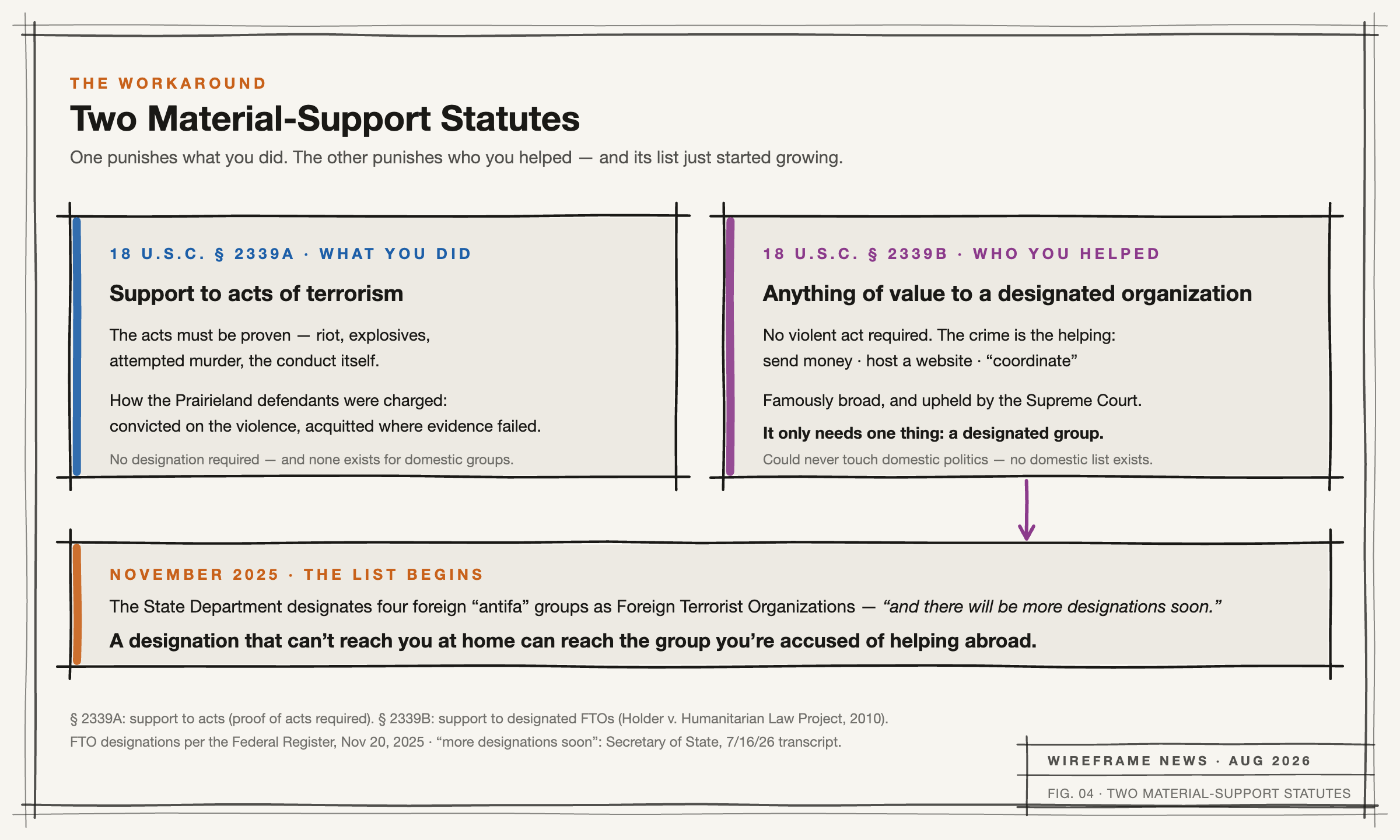
The same event carried the mechanism almost nobody noticed, in a single sentence from Secretary of State Rubio: “Last November, the State Department designated four violent far-left extremist groups as Foreign Terrorist Organizations, and there will be more designations soon.” Why do foreign designations matter for Americans? Because federal law has two material-support statutes, and they work differently. One punishes what you did — support to acts of terrorism, which requires proving the acts. The other punishes who you helped — providing anything of value to a designated organization, no violent act required. That second statute never could touch domestic politics, because there is no way to designate a domestic group. Designating foreign “antifa” chapters changes that. A designation that can’t reach you at home can reach the group you’re accused of helping abroad. Send money, host a website, “coordinate” — the statute’s reach is famously broad, and the Supreme Court has upheld it. “More designations soon” means the list of groups an American can be prosecuted for supporting is now an expanding instrument.
And when Rubio promised to dismantle antifa’s networks “brick by brick,” he was quoting himself. He had used the same phrase three days earlier, announcing the campaign to dismantle the International Criminal Court. The court whose offense is claiming authority to judge American officials. One vocabulary, one week, two targets: a court that could judge power, and a category of people who criticize it. When someone tells you the method twice, believe them.
On juries:
Juries that decline to convict defendants in these cases are practicing “jury nullification,” which shows “how deeply the cancer has begun to infest your society.”
Hold the attribution steady, because this line travels without one: Stephen Miller, the White House homeland security adviser, July 16, 2026, State Department podium, official transcript. The cancer is jurors voting not guilty.
And one more, which I’ll leave without commentary:
“Not one of the people that is demonstrating looks like a normal person. Not one looks normal. They’re all deformed in some way… their outer appearance becomes a manifestation of their inner hatred.”
Two courtrooms, one government
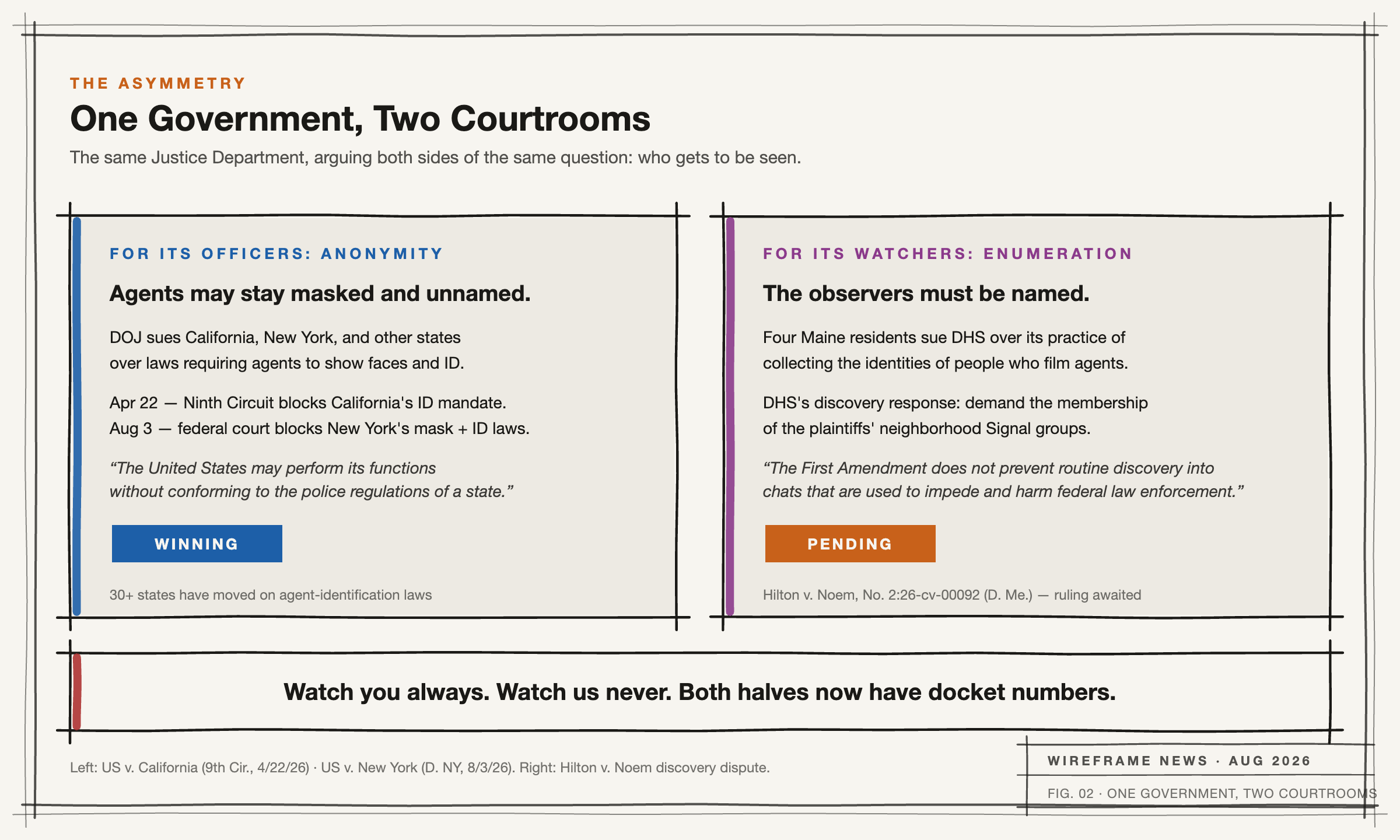
In one set of courtrooms, the Justice Department has sued California, New York, and other states over laws requiring federal agents to show their faces and identify themselves during enforcement operations; more than thirty states have moved on some version. DOJ’s position is that its agents must be allowed to stay masked and anonymous. And it is winning. In April, a Ninth Circuit panel blocked California’s identification mandate. In August, a federal judge blocked New York’s mask and ID laws with a sentence worth keeping: “The United States may perform its functions without conforming to the police regulations of a state.”
In the second courtroom, in Maine, the same department is demanding the names of the people in the group chats that watch those agents.
For its officers: anonymity, argued as a matter of law, and so far prevailing. For Elinor Hilton and her neighbors: enumeration, argued the same way, ruling pending. In July I compressed the bargain into a line, watch you always, watch us never. I meant it as a description of a belief system. I did not expect both halves to acquire docket numbers within the month.
There’s a smaller procurement item that belongs here, because it completes the picture at street level. ICE is buying conductive shock gloves, up to twenty million dollars’ worth, and the civil-liberties objection is not only the device. It’s that a glove leaves no visible trace of its use. Nothing to film, nothing for the record. The mask hides who did it. The glove erases that anything was done. The unwatchability is being engineered end to end.
The July piece opened with Liu Hu, a Chinese journalist who found himself on the blacklist, refused a train ticket, no file, no hearing. It’s worth remembering what he was: a watcher. A man whose work was pointing a lamp at officials. The system that got him wasn’t built to punish traveling. It was built to make watching expensive.
We asked whether “beat China” was becoming “become China.” The Maine docket is a mile marker.
Selection, not innocence
Some of these instruments may be pointed at real conduct. The allegations against Swalwell came from his own former aide and were reported out months before the search. The SPLC case involves documented money moving into shared accounts; a jury may find it was fraud. The argument here is not that every target is innocent. The argument is about which instruments get picked up, and who they get pointed at.
In Minnesota, DHS ran an undercover operation against the people protesting immigration enforcement: infiltrated meetings, joined the Signal chats, compiled attendee names from license plates, issued financial subpoenas to unions and nonprofits under a “domestic terrorist financing” theory. The investigation opened days after Border Patrol agents shot and killed Alex Pretti in Minneapolis, a killing I wrote about in January. The agents are not among the targets. The people who organized about the killing are. The tell is not who was charged. The tell is who wasn’t.
And then there is Prairieland, the case Miller’s cancer line is actually about, which needs telling from the beginning.
On July 4, 2025, an armed group attacked the Prairieland ICE detention center in Alvarado, Texas. Eleven firearms, body armor, trauma kits. An Alvarado police officer was shot in the neck. One defendant, Benjamin Song, was recorded shouting “get to the rifles.” This was not a protest that got out of hand. It was an attack, and a jury convicted nine people for it at trial in March.
What turned those convictions into a template was the charging stack. Prosecutors branded the defendants the “North Texas Antifa Cell” and charged material support for terrorism under a statute written for foreign terrorism, then applied the terrorism sentencing enhancement to every count. In June the sentences came down: one hundred years for Song. Fifty each for five others. And for one married couple, convicted among other counts of conspiracy to conceal documents: thirty years for Daniel Sanchez-Estrada, seventy for his wife, Maricela Rueda. The Times noted the penalties dwarfed those given to January 6 rioters. And in April, this same Justice Department had moved to vacate the January 6 militia leaders’ seditious-conspiracy convictions. One department, ninety days apart: erase the convictions there, century terms here.
Now look at what the courtroom itself refused to do. Antifa membership was never an element of any charge, because no law makes it one. The prosecutor told the jurors the defendants’ beliefs “are not why they’re on trial.” When the government kept saying the word anyway, Judge Mark Pittman asked from the bench: “Whether it’s antifa or the Methodist Women’s Auxiliary of Weatherford, why does it matter?” And the jury did both things juries exist to do. It convicted where the evidence carried, and it acquitted four defendants on the top counts where the evidence didn’t.
The line they held has been held before, and the holding is still law. In 1961, in Scales v. United States, the Supreme Court confronted the McCarthy era’s membership prosecutions and drew the rule that guilt is personal: to punish membership at all, the government must prove active membership, knowledge of illegal aims, and specific intent to further them. The retweet, the donation, the meeting attended; none of it can be the crime. And in 1950 Congress built the machinery this fear always imagines: the Emergency Detention Act, detention on suspicion, party membership as evidence, six camps constructed. They built the camps, and for twenty-one years, they never filled them. In 1971 Congress repealed the act and replaced it with a single sentence that is still the law of the land: “No citizen shall be imprisoned or otherwise detained by the United States except pursuant to an Act of Congress.”
That’s the brake holding at the exact line that matters: conduct punished, ideology never becoming the crime. It held in Minnesota too, where a judge quashed grand-jury subpoenas against state officials as an attempt to “harass and retaliate,” and in Washington, where another judge enjoined DHS’s use of the SAVE database against election officials.
Which brings the cancer line back with its full weight. The jurors Miller condemned are the ones who convicted the shooters and acquitted where the state’s evidence failed, the system doing exactly what it was designed to do. You do not attack the jury box because you are winning in it. The brakes work. That is what makes them targets.
The lamp
Elinor Hilton still isn’t parking in front of her own house. The chats are still running. The motion is still pending. A judge is going to decide, soon, whether suing the government over a list means the government finally gets its list. Whether the courtroom, too, is an instrument that can be turned around. And there’s a version of this roster that will never need a subpoena at all, assembled from the air by cameras that never blink, that’s the next piece.
Last month I ended a piece by saying it was time to break the interrogation lamp, since it isn’t the sun. I’d like to update that. The lamp didn’t break. It turned around. It’s pointed at the marshals now. The group chats, the researchers, the jurors — everyone whose job or instinct is to watch power and say what they saw.
For now, the lamp only works if watching stays survivable, and that’s not abstract. Four things, in ascending order of effort:
Know your rights before you need them. Filming federal agents in public is legal. Know your state’s specifics; save the MigraWatch hotline (1-844-363-1423) before there’s a reason to.
Follow the two dockets. Hilton v. Noem in Maine and the Minnesota 15 are where “who gets to watch” is being decided, and the organizations litigating them run on money. That’s the fix within reach of anyone.
If your state is among the thirty-plus moving on agent-identification laws, that’s a local fight with your name on it.
And when the jury summons comes, serve. The man at the podium called jurors a cancer for a reason. Show up and be one.
These are its companion pieces:
Building the Machine of Mass Detention
Where this thread started: the detention apparatus, built in public, one procurement at a time.
The Molasses Was the Point
Why democratic friction is design, not inefficiency — the argument behind this piece’s brakes: the juries, the judges, the one-sentence law from 1971.
How Did Grey Jacket Know?
The data layer beneath the watching: how a stranger’s jacket color ends up in a federal file, and what pre-crime looks like when it’s operational.
Beat China, Become China?
The predecessor: the people building the surveillance layer, and the bargain underneath it — watch you always, watch us never. This piece is what it looks like when that belief starts getting enforced.
Sources
The Maine case: Hilton v. Noem, No. 2:26-cv-00092 (D. Me.) — case record, Civil Rights Litigation Clearinghouse
WIRED’s reporting on the Signal-group discovery demand, via Reclaim The Net
Biometric Update — the class action and the intimidation record
WIRED, “ICE’s Internal Watchdog Is Now Investigating Online Critics,” via RSN and Court News
The Press Democrat — the Swalwell device seizure and home search
Department of Justice — complaint against New York’s mask and identification laws
Ninth Circuit — opinion blocking California’s agent-identification mandate, April 22, 2026 (PDF)
The August 3 New York ruling, via NEP New York
Shock-glove procurement: AP, August 2026
Prairieland sentencings: KERA News, June 23, 2026
Scales v. United States, 367 U.S. 203 (1961)