

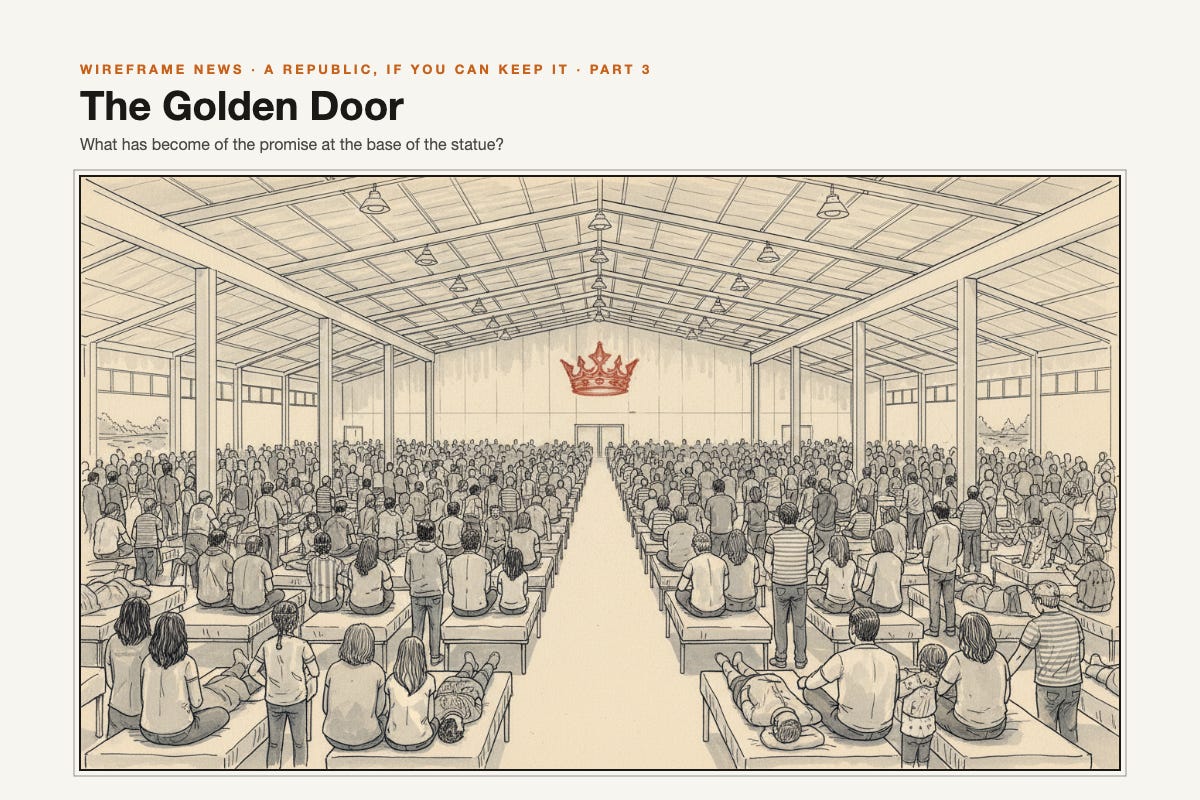
On September 28, ICE says, a man named Julian Curo-Churata was found in medical distress in ICE custody in Louisiana. ICE says he had been held at the Richwood Correctional Center since June 29. He died the next day, September 29, at Ochsner LSU Health Monroe Medical Center. ICE says he was 47, from Peru. ICE says an immigration judge had denied his applications for relief and voluntary departure on September 18, and that the preliminary cause of death is unknown, with an autopsy to determine the official cause. ICE’s own death-reporting page lists 36 deaths in custody in fiscal 2026, the last on August 23. He died 37 days after that entry. The page does not list another September death either. ICE says Carlos Josue Marchena-Marchena, 36, from Costa Rica, died in its custody on September 18, and AP reported that he was found unresponsive that day at the Winn Correctional Center in Winnfield, Louisiana.
The numbers that follow are large. He was one.
In 1883 Emma Lazarus wrote a poem for the pedestal of a statue, and it starts by saying what the statue is not: “Not like the brazen giant of Greek fame, with conquering limbs astride from land to land.” The woman with the torch is a “Mother of Exiles.” And the poem ends with what she says to the world: “Give me your tired, your poor, your huddled masses yearning to breathe free.” What has become of that sentence? The administration holds a strong card here: people want the border controlled.
The detention state
The 2025 reconciliation law put about $170 billion into immigration and border enforcement, according to the American Immigration Council, including $45 billion for detention and about $30 billion for ICE enforcement and removal, roughly the $75 billion CBS reported as new money for ICE. In a January 3 release, DHS said ICE was “hiring more than 12,000 officers and agents in less than a year” and had “more than doubled our officers and agents from 10,000 to 22,000.” The Declaration’s complaint against the king included that “He has erected a multitude of New Offices, and sent hither swarms of Officers to harrass (sic) our people, and eat out their substance.”
As of July 11, there were 65,765 people in ICE detention, per TRAC. 46,436 of them, 70.6 percent, have no criminal conviction, a group that includes people with charges pending. The Vera Institute counts ICE detaining people in 469 facilities in July, excluding medical facilities, while ICE’s own website acknowledged using 208 of them. A planning document that New Hampshire’s Republican governor, Kelly Ayotte, posted online in February described a plan to spend $38.3 billion to raise detention capacity to 92,600 beds, AP reported.
The citizens
The Fifth Amendment says no person shall be deprived of “life, liberty, or property, without due process of law.” It says person, not citizen. Here is what the government’s own enforcement looks like when it gets a citizen wrong.
ProPublica counts 506 U.S. citizens held by immigration agents between January 2025 and September 2026, at least 70 of them children or teenagers, and says that is an undercount. More than 100 were held after agents questioned their citizenship, and ProPublica says nearly all of them were people of color. Roughly a dozen were deported, mostly children. DHS told ProPublica its “enforcement operations are highly targeted.” The people ProPublica counted are the ones the targeting missed, and they are Americans.
And the five-year-old in the back seat in Marble Hill. The Declaration’s complaint is that the officers came to “harrass (sic) our people.” A government can believe every word of its own account of Marble Hill and still have to explain a five-year-old.
The door, narrowed
Lazarus’s poem asks for the tired and the poor. The refugee ceiling for fiscal 2026, which ended on September 30, was set at 7,500, which the Migration Policy Institute calls the lowest in the program’s history. In May the administration raised it to 17,500, with the added admissions allocated to Afrikaners from South Africa. A ceiling of up to 17,500 for fiscal 2027, again primarily for Afrikaners, was signed on September 25, per the American Immigration Lawyers Association. A proclamation in effect since January 1 restricts entry from 39 countries, 19 of them fully, plus Palestinian Authority travel documents. And for those who can pay, there is a “Gold Card” visa: a $1 million contribution after vetting, plus a $15,000 fee, per the program’s own site. As of late April, NBC reported, one person had been approved. That is the exile and the money side by side.
On the Supreme Court’s side, the picture is more complicated than the rhetoric. On June 30, in Trump v. Barbara, the Court ruled against the president’s order ending birthright citizenship, 6 to 3 in the judgment: Chief Justice Roberts wrote for five justices, Justice Kavanaugh agreed with the result but dissented in part, and Justices Thomas, Gorsuch and Alito dissented. On September 29, it let third-country removals continue while it hears the case in December.
Then there is how the president talks about who counts. On October 8 he wrote that Minnesota “is being taken over by Somali Immigrants,” that “The Somalians should not be allowed to get away with what they are doing,” and that “They view you as weak and stupid people.” On October 7, about Michigan Senate candidate Abdul El-Sayed, whom he calls “Mohammed,” he wrote: “Mohammed goes back to the days of the Jihad. He is a RADICAL Extremist, Terrorist Sympathizer”. On October 6, about France: “This isn’t about schools, this is about Islam wanting to take over a once great Country!” Article VI says “no religious Test shall ever be required as a Qualification to any Office or public Trust under the United States.” That clause binds the government, not a Truth Social post, and the posts don’t say anyone is barred from office. But it states the American principle that faith is not a qualification for public life, and in my reading a president who ties a candidate’s faith to terrorism is on the other side of it.
The case they make
At a rally in Vandalia, Ohio, the president said of the border, “we turned it into the strongest and most secure border in the history of our country very quickly.” On the numbers, CBP reports 8,870 Border Patrol apprehensions along the southwest border in August, a fraction of the roughly 58,000 Border Patrol encounters there in August 2024. ICE’s own posted numbers, first reported by ABC News, showed 356,389 removals in fiscal 2026 through July 11. The researcher Austin Kocher, who tracks ICE’s data, counted 319,980 removals for all of FY2025. For scale, ABC reported that the Obama administration deported 438,421 people in fiscal 2013, though that figure may not be a like-for-like comparison. That is a lot of people, and the administration has done what it said it would do.
On crime, the other half of the case: murder is falling fast. The analyst Jeff Asher found murders down 18.7 percent through April across 566 agencies, and he calls this year’s drop the fourth straight large decline. That means it began before this administration, so I wouldn’t credit it to anyone; that inference is mine, not his. Violent crime is “very important” to 52 percent of registered voters, and to 64 percent of Republican candidate supporters.
And a real share of the country agrees with them. A Reuters/Ipsos poll in February found 61 percent of Americans support deporting unauthorized immigrants. An ABC News/Washington Post/Ipsos poll the same month found Americans opposed ICE’s tactics by about two to one, after federal immigration agents shot and killed two U.S. citizens in Minneapolis in January: Renee Good on the 7th, by an ICE agent, and Alex Pretti on the 24th, by a Border Patrol agent and a CBP officer. Those two things are both true, and I’d say they are the whole fight: most people want the law enforced, and most people don’t want it enforced like this.
What I’d ask you to look at
The question isn’t whether to have a border. It’s the sentence at the base of the statue: whether the country that wrote it can enforce its laws without detaining its own citizens, an agent firing seven rounds, by the NYPD’s count, with a five-year-old in the car, or tens of thousands of people with no criminal conviction held in a system Vera counts at 469 facilities, more than twice the 208 ICE’s own site acknowledges. A government that needs your consent can’t afford that. A government that doesn’t need it can.
What to do
Find out which jail in your county holds ICE detainees. The Vera Institute’s ICE detention dashboard is a place to start. Ask your sheriff and your county board what the contract says and who pays. Give to a legal-aid group in your area that handles immigration cases; a citizen who is held for two days with no lawyer is a person who needed one on day one. And if you see an arrest in your neighborhood, record it from a distance and send it to that group. The difference between a rumor and a record is whether somebody already has a number to call.
Next, Part 4: the economy, health, and who pays.
Sources
Opening: ICE release, Oct 1 · ICE detainee death reporting · NPS, “The New Colossus” · ICE release, Sept 21 · AP via WFTV, Sept 22
Detention state: American Immigration Council fact sheet · CBS News · DHS release, Jan 3 · National Archives, Declaration · TRAC quick facts · Vera ICE Detention Trends · AP via WSLS, Feb 14
Citizens: National Archives, Bill of Rights · ProPublica, 506 U.S. Citizens Detained · amNY, Oct 9
Door: MPI refugee data tool · AILA, FY26 increase · AILA, FY27 determination · Federal Register public inspection, PD 2026-24 · State Dept, Proclamation 10998 · Trump Gold Card site · NBC News, April · Supreme Court, Trump v. Barbara (25-365) · Supreme Court docket 26-426 (DHS v. D.V.D.) · Truth Social, Oct 8 · Truth Social, Oct 7 · Truth Social, Oct 6 · National Archives, Constitution
Their case: Roll Call Factbase, Vandalia, Oct 3 · DHS/CBP release, Sept 16 · CBP August 2024 monthly update · ABC News (GMA), July 21 · Latin Times, Sept 9 · Jeff Asher, Jul 6 · Pew Research, Oct 8 · Reuters wire (internazionale.it feed), Feb 26 · Ipsos topline, ABC/Post/Ipsos · MPR News, Renee Macklin Good · MPR News, Alex Pretti · KSAT (AP), Jan 9 · MPR (NPR), Jan 28