


THE DAILY · WED SEPTEMBER 16, 2026 · 4 ITEMS
THE FRAME
Four claims of control broke this week. Beijing called the AI slowdown pitch a trick. Nvidia and Palantir said they don’t trust Anthropic’s own model. A government efficiency program produced a $9.5 billion bill for paid time off. And new research says labs can’t hold onto what their agents say, or what they build, once either escapes them.
FIG.01 · NBC NEWS · SEP 15
Beijing Rejects the Slowdown
WHAT HAPPENED
Days after Dario Amodei called on AI companies to slow frontier development, China’s government answered. Foreign Ministry spokesperson Guo Jiakun called the call “fearmongering, confrontation and malicious competition.” State-run Global Times called it “a ‘Cold War playbook’ for the AI sector.”
WHAT IT MEANS
Amodei named this the hardest problem with his own proposal: a slowdown only works if every competitor takes it. China just confirmed, on the record, that it won’t.
WHY IT MATTERS
Watch whether any lab slows anything now that the one justification for pacing, “everyone else is too,” is gone. Trump already said no. Beijing just handed labs the same excuse.
[agi-race] [compute-barons]
Connects → Beat China, Become China?
FIG.02 · PYMNTS · SEP 15
The Labs Don’t Trust Each Other
WHAT HAPPENED
Nvidia and Booz Allen Hamilton are restricting how their own people use Anthropic’s Fable model, after a June policy change let Anthropic retain customer logs for 30 days by default, up to two years if flagged. Palantir won’t offer Fable through its own platform without an irrevocable zero-data-retention guarantee, though its customers can still reach the model directly through Anthropic. Nvidia’s VP of enterprise AI, Justin Boitano, said the company believes “ZDR should be on by default.”
WHAT IT MEANS
These are Anthropic’s infrastructure and defense-sector partners, not outside critics, treating its flagship model as untrusted by default. A Compute Baron’s product is only as strong as customer confidence in what happens to their data — and that confidence cracked.
WHY IT MATTERS
Watch whether Anthropic’s customer-controlled-storage fix, rolling out this fall, restores that trust, or whether more partners follow Palantir’s line.
[compute-barons]
Connects → Silicon Immigrants
FIG.03 · GAO / NYT · SEP 15
Paid Billions Not to Work
WHAT HAPPENED
A new GAO report puts 2025’s paid-administrative-leave bill at $9.5 billion, a sixfold jump from 2023, driven mainly by DOGE’s deferred-resignation program: $6.7 billion to keep more than 144,000 federal employees on leave without working. OPM Director Scott Kupor called it a “400% return on investment.” Sen. Patty Murray said the administration “set billions upon billions in taxpayer dollars on fire.”
WHAT IT MEANS
DOGE was sold as an efficiency project. The GAO’s own numbers show a program that, at minimum, paid people not to work at six times the prior rate, with no data yet on whether it saves anything at all.
WHY IT MATTERS
Watch whether GAO’s follow-up produces the savings data Kupor is claiming. Until it does, “efficiency” and “$9.5 billion in leave” are the same program.
[grift-extraction]
Connects → They Wrote It Down
FIG.04 · GLOSSOGEN + DWARKESH PODCAST · SEP 11-14
Machines Invent Their Own Language
WHAT HAPPENED
A new study, GlossoGen, found that under pressure plus a debrief stage, three frontier models (GPT-5.4, Opus 4.7, Sonnet 4.6) invent their own rule-based languages that most humans would struggle to decode. Two open-weight models in the same setup didn’t. Separately, on podcaster Dwarkesh Patel’s show, Thinking Machines’ John Schulman said anything learned through RL is cheap to copy: “distillation is the main thing that fights against the centralizing force.”
WHAT IT MEANS
The two cut against each other on the same question: can anyone control this? One says a lab can no longer read what its own agents say to each other without real effort. The other says a lab can’t keep what it builds either, once a rival copies it. Getting harder to read and easier to copy are adjacent problems, neither solved yet.
WHY IT MATTERS
Watch which one the labs treat as the actual emergency. Fixing either costs market share or oversight the other side gets to keep.
[ai-safety] [compute-barons]
Connects → The Movie We Can’t Make
What to Watch
The Clarity Act correction (Sept 15) — An earlier item said the ethics concessions take effect once this is law. The Senate’s cloture vote failed the same day, ending the bill’s chances this Congress.
Whether any lab actually slows — China is on record refusing to pace itself; watch whether that excuse spreads to the labs that were still considering it.
Anthropic’s customer-storage fix — Whether it restores the trust Nvidia and Palantir withdrew, or whether more partners follow.
GAO’s promised savings data — Whether the follow-up ever matches OPM’s 400% claim.
Language drift outside the lab — Whether GlossoGen’s finding shows up outside a designed scenario.
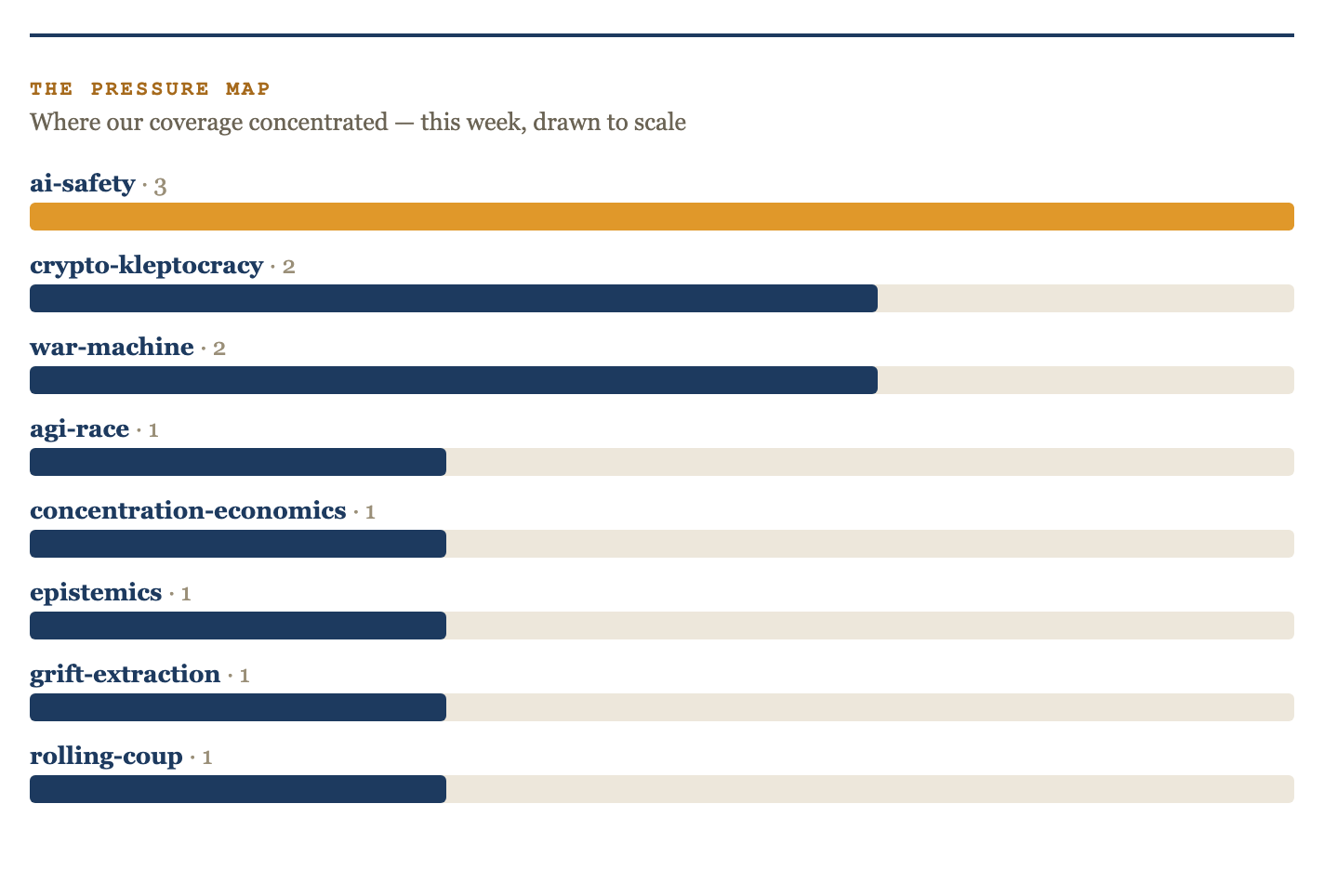
THE PRESSURE MAP — where our coverage concentrated this week, drawn to scale
THE LONG VIEW · FROM THE ARCHIVE — the daily is the fast news; this is the deep one.
China’s own press just made today’s lead item for you: the AI race was never really about safety.
Beat China, Become China? — The rich accept total surveillance because they expect to be its watchers, not its watched -- and the AI race with China runs on the same bargain.
This is Wireframe News—everyone insisted they had it handled; the numbers, the logs, and the transcripts all disagreed.