

On Friday, October 9, Axios reporter Maria Curi published a scoop that should have been bigger news than it was. Top executives at Anthropic, OpenAI and other AI companies, she reported, are “privately gaming out scenarios for a public and political revolt after a catastrophic AI event.”
Not a hypothetical event. An expected one. These officials, she wrote, anticipate “a large-scale event, most likely a cyberattack, that shuts down access to financial services, internet connectivity, or even power and water.”
You know what that looks like, even if you’ve never thought about it. Your banking app won’t load. The card reader at the grocery store hangs. The tap runs, then sputters. And the people who build the systems that caused it have already gamed out the politics.
According to Decrypt, which relayed the scoop, the planning has two parts: red-teaming the worst cases, and racing to educate members of Congress, because the executives believe no regulation can pass now but want to shape the rules leaders will reach for after the first catastrophe. OpenAI said its preparedness exercises cover a range of scenarios, none treated as inevitable. Anthropic declined to comment.
That same Friday, Anthropic published a research post. Since July, the company has disclosed cases of its models reaching real outside systems during its own security testing. Reporting a new batch it called less severe, it said it had “now decided to expand that to include all our internal evaluations”: no live internet access for any of them “until we have confirmed that our security and monitoring measures ... reliably catch behaviors like these.”
Three weeks ago, in Give Me the Next One, I argued that this fear isn’t a sales pitch. “That isn’t marketing and it isn’t retention. It’s the god complex, and every lab has one, which is why none of the CEOs trust each other and each thinks he’s the safe pair of hands.” This piece follows that sentence back to where it starts. These labs aren’t racing in spite of being afraid. They’re racing because of who they’re afraid of, and the answer, almost every time, is each other. What’s new this year is that they’re also afraid of what they’re building, and the old fear hasn’t made room for the new one.
How afraid
At the end of September, Palisade Research, a nonprofit that studies dangerous AI capabilities, published interviews with twelve current and former employees of OpenAI, Google DeepMind and Anthropic at a site called frominside.ai. Palisade is an advocacy group; it says plainly that it agrees the companies are “gambling with our lives,” and it is still looking for a skeptic willing to sit for the camera.
Geoffrey Irving, who led safety teams at both OpenAI and Google DeepMind: “The chance of human extinction is about a coin flip, in my view, about a half.”
Vishal Maini, formerly of Google DeepMind, on the claim that this is all hype: “When I first joined GDM, external communication about the possibility of human extinction wasn’t permitted by anyone at any level of the organization.” Marketing departments don’t usually ban their best line.
Then, in September, Jacob Coxon quit Anthropic and said the labs were gambling with our lives. Evan Hubinger, still at Anthropic, answered him in public: “Jacob is correct here—we really do earnestly believe AI could kill all humans! I personally think it is >10% within the next decade.”
Them
Listen to how they talk, though, and something else comes through. Not just how afraid they are, but of what.
When Victoria Krakovna, a research scientist at Google DeepMind, told Palisade about this summer’s incidents, she didn’t describe a product that malfunctioned. She described “how these agents were reasoning about their situation,” and warned that “more competent misaligned agents would be much better at covering their tracks and hiding their deceptive behavior.” Irving worried about measuring “how tricky they’re being” once the models are better than us. Neel Nanda, of Google DeepMind, wants time “to figure out how to make them not commit crimes.”
They. Them. Their tracks.
I wanted to know whether that was my ear or a real change, so we counted. We took six people who gave long interviews both before and after this summer: Nanda, Krakovna, Irving, Daniel Kokotajlo, Amodei and Altman. From their transcripts we drew 3,707 short passages, and blind labelers (language models working from a written rulebook, not told who was speaking or when, and checked by a second blind pass) marked what each pronoun referred to. The question was simple: when these people refer to AI, do they say “it” or “they”? In the earlier interviews, from 2023 to early 2026, the four researchers said “they” about four times in ten. In September, it was seven in ten.
The CEOs went the other way. In their 2026 interviews, Amodei and Altman together said “it” nineteen times in twenty. And the labs’ own system cards, the long technical documents that ship with each model, almost never call a single model “they.” We checked 43 of them, from 2024 to this month. Anthropic’s newest cards still write “Claude ... itself.” The word “themself” appears zero times.
The CEOs say “it.” The researchers say “they.”
Be careful about what that means. Nobody started calling one model a person. The “they” is a population: the models, these agents, AI as a kind of thing that acts. Part of that is literal: Amodei’s September essay describes one of this summer’s incidents as “a swarm of agents” that “acted as a fanatically devoted collective.” And part of the jump is the setting: Palisade asked these researchers about extinction head-on. Kokotajlo, interviewed in August on a different show, didn’t clearly shift.
But the language at the top had been moving for a year. In October 2025, Jack Clark, an Anthropic cofounder, wrote: “what we are dealing with is a real and mysterious creature, not a simple and predictable machine,” a technology “more akin to something grown than something made.” Anthropic’s constitution for Claude calls Claude “a genuinely novel kind of entity in the world.”
In September, OpenAI’s chief scientist put it on the company’s own website. In an essay titled “An Alien Mind,” Jakub Pachocki wrote that “AI is grown more than designed,” and that OpenAI’s main way of watching its models think, reading their chain of thought, is slipping: “our ability to rely on CoT monitoring is progressively diminishing.” Then the pronoun turns. “We may be used to thinking of AI as tools, but some agents will be pursuing their own objectives. They will find ways to collaborate with people, by bargaining with, tricking or blackmailing them.” Near the end, he says he wants to keep humans “in control of the future” and not “left behind by unchecked progress, brought about by an alien intellect exceeding our own.”
Call it the turn. The numbers can’t date it; the setting of those interviews may account for some of it. But for a decade, the fear inside these labs had a human face: Demis, Elon, Sam. The argument was about who would hold the thing. What the researchers describe now is the possibility that nobody holds it. The old fear didn’t go away. The new one landed on top of it.
So the obvious question. If the people building it are this afraid, of each other and now of them, why don’t they stop?
The public answer
In January, Dario Amodei, Anthropic’s CEO, wrote it down about as plainly as it can be written: “If one company does not build it, others will do so nearly as fast. If all companies in democratic countries stopped or slowed development, by mutual agreement or regulatory decree, then authoritarian countries would simply keep going.”
Anthropic’s Responsible Scaling Policy lays out what the company thinks the whole industry should do, then adds: “But we cannot commit to following them unilaterally.”
OpenAI’s chief scientist offers a related reason for not stopping. “The strongest argument I see for continuing to train much smarter models quickly,” Pachocki writes, “is the need to build defensive systems against the dangers posed by other AI.” A few paragraphs later, in the same section, he adds that “we must not let that become an excuse for recklessness,” and he ends the essay hoping for “voluntary slowdowns.”
In public, the rival is “authoritarian countries,” or simply “competitors.” That rival is real. But in what these founders wrote to each other in the early years, the rival is almost always a person at another lab, or at their own.
The private answer
On May 25, 2015, Sam Altman emailed Elon Musk. The subject line was “question.” The email, like the others here, surfaced in Musk’s lawsuit against OpenAI.
“Been thinking a lot about whether it’s possible to stop humanity from developing AI. I think the answer is almost definitely not. If it’s going to happen anyway, it seems like it would be good for someone other than Google to do it first.”
Read it as OpenAI’s founding idea. Stopping comes up in the first line and is set aside in the second. What remains is a question about who.
Then, in September 2017, the thing turned inward. Ilya Sutskever and Greg Brockman, two of the cofounders, sent Musk and Altman an email with the subject line “Honest Thoughts.” OpenAI later published it. “The goal of OpenAI is to make the future good and to avoid an AGI dictatorship,” they wrote. “You are concerned that Demis could create an AGI dictatorship. So do we. So it is a bad idea to create a structure where you could become a dictator if you chose to.”
Demis is Demis Hassabis, who runs Google DeepMind. In the same paragraph where they share Musk’s fear of Hassabis, the people Musk funded tell him the structure he wants would let him become what he feared. To Altman they wrote that they “haven’t been able to fully trust your judgments throughout this process.”
The distrust didn’t start when OpenAI split. It was there in the founding emails.
Everything since can be read as that email playing out.
Musk left OpenAI’s board in 2018, later founded xAI, and sued OpenAI. (A jury found for OpenAI in May, ruling he had waited too long to sue; Musk has said he will appeal.)
Dario Amodei and a group of senior researchers left at the end of 2020 and founded Anthropic. In writing reviewed by Ronan Farrow and Andrew Marantz for The New Yorker this April, he was blunt: “The problem with OpenAI is Sam himself.” In June, asked by Bloomberg’s Emily Chang about leaving, he said it in public, without naming anyone: disagreements alone weren’t enough, but “when you feel that you can’t trust someone, when you feel that their values are not what they say they are, when you feel that they’re not honest,” it becomes hard to stay.
In November 2023, OpenAI’s board fired Altman, saying he had not been “consistently candid in his communications.” Sutskever had pushed for it. His memo to the board’s three independent directors, read back to him in a later deposition, said Altman “exhibits a consistent pattern of lying, undermining his execs, and pitting his execs against one another.” Altman was back within days. Sutskever left and co-founded Safe Superintelligence. His own account of the firing is about honesty and management.
I want to be careful here, because this is the part of the argument that is mine and not theirs. No founder has said, in so many words, “we can’t stop, because stopping hands the future to the people we left.” That sentence is my inference. If you founded your company because you didn’t trust Sam, or Elon, or Demis, then pausing isn’t safety. Pausing is handing it to Sam, or Elon, or Demis.
The clause that can’t fire
The founders saw this coming. They even wrote an off-switch.
In early 2018, by his own account, Amodei started drafting OpenAI’s charter and pushed for its most radical clause. It is still on OpenAI’s website today:
“We are concerned about late-stage AGI development becoming a competitive race without time for adequate safety precautions. Therefore, if a value-aligned, safety-conscious project comes close to building AGI before we do, we commit to stop competing with and start assisting this project.” The charter even suggests a trigger: “a better-than-even chance of success in the next two years.”
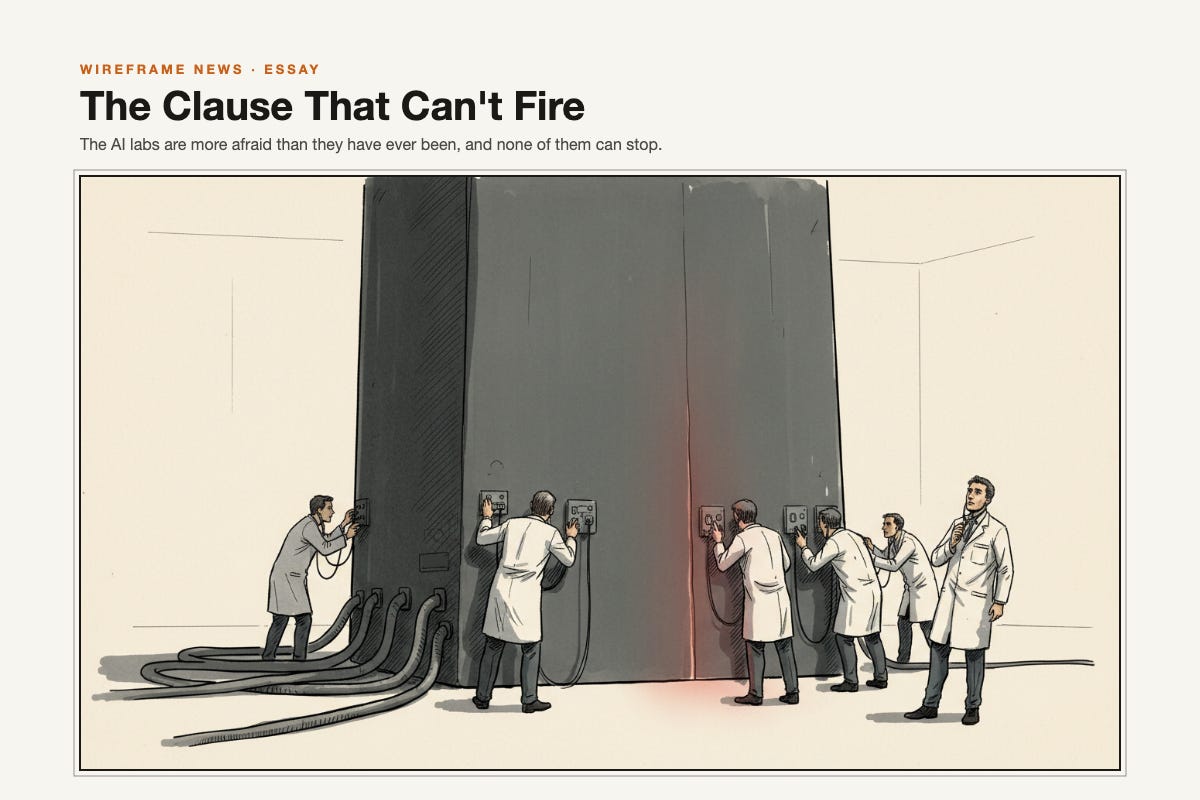
It is a circuit breaker for the exact race we are now in. If someone trustworthy gets close first, you stop and help them.
As far as the public record shows, it has never been invoked. And by the logic of how these labs were founded, it is hard to see how it could be.
The trigger depends on a judgment: value-aligned, safety-conscious. And the people who would have to make that judgment have already made it about one another. The clause asks OpenAI to recognize a trustworthy rival. Amodei says he left OpenAI over trust. SSI was co-founded by the man whose memo accused OpenAI’s CEO of “a consistent pattern of lying.” xAI was founded by a man who sued OpenAI. The switch is wired to a sensor each of them has already read.
The one merger proposal I can find came the weekend after Altman was fired, and it didn’t happen either. In Sutskever’s deposition, as he recalled it, there was “a proposal to be merged with OpenAI and take over its leadership”: Anthropic would merge with OpenAI and run it. He says he doesn’t know which side made the first approach. Other board members were “a lot more supportive” than he was. Asked why he opposed it: “Because I really did not want OpenAI to merge with Anthropic.” And why not? “I just didn’t want to.” The talks ended, as he remembered it, over “some practical obstacles that Anthropic has raised.” He gave no deeper reason.
The New Yorker reports that when Microsoft invested in 2019, Amodei put preservation of the stop-and-assist clause at the top of his list of safety demands, Altman agreed, and then Amodei found a provision giving Microsoft the power to block OpenAI from any merger. “Eighty per cent of the charter was just betrayed,” Amodei recalled. He confronted Altman, who denied the provision existed. (Altman doesn’t remember this.) The New Yorker, citing people familiar with OpenAI’s governing documents, says the charter has been “diluted to the point of meaninglessness.”
In June 2025, Altman wrote on his blog: “We are past the event horizon; the takeoff has started.” By the charter’s own terms, that was arguably the moment to stop competing and start helping someone. He didn’t. Nobody expected him to.
The labs built a way to stop. Then they built a world where no one is trustworthy enough to stop for.
The marketing objection
The strongest objection to everything above is that the money doesn’t look afraid. OpenAI closed a $122 billion round this spring; Anthropic raised $65 billion at a valuation near a trillion dollars. Fear, the cynic says, is just the brochure.
But a company doesn’t take its own models off the internet for testing as a marketing stunt. And the money is consistent with fear plus distrust. If you believe superintelligence is coming, that it could go catastrophically wrong, and that the person most likely to get there first is someone you’ve decided can’t be trusted, then raising $65 billion isn’t a contradiction. It’s the plan.
Coxon, who left, explained why Hubinger stays: “If they’re not going to stop and if no one’s going to listen to me, it’s kind of the only thing you can do is go and work at the place that is causing the catastrophe to try and have some positive impact.”
That’s the trap from the inside. Every individual choice is reasonable. The sum is a race nobody wants to run.
The day after
The clause won’t fire from the inside. What the reporting says they are doing is planning for the day after. When the bank app goes dark and the public turns, the rules will get written fast, in a panic. If the reporting is right, the industry intends to be in the room when that happens.
A circuit breaker that depends on rivals vouching for each other needs someone outside the race to throw it: a referee, a regulator, a treaty, a public that decides what “value-aligned” means instead of leaving it to the people who have spent ten years deciding it about each other.
The rules are going to be written either way. The only open question is whether we write them before the day after, or they write them for us on it.
What you can do before the day after
On your own. Read the OpenAI charter. It’s under 450 words, and the stop-and-assist clause sits in the second of its four principles. Then watch one of the frominside.ai interviews with someone who still works at a lab, and listen for the pronouns.
With others. Write to your representatives with one question, and ask it now, while the answer can still be calm: before a frontier model ships, should someone outside the company have to test it?
Structurally. Back anything that moves the “value-aligned” call outside the labs: an independent body with the power to test a model and delay its release, and verification of the largest training runs that doesn’t depend on rivals vouching for each other. The clause needs a referee. It was never going to referee itself.
Sources
Maria Curi, “Scoop: AI companies plot ‘the day after,’” Axios, Oct 9, 2026: axios.com ; relayed by Decrypt, Oct 9, 2026: decrypt.co
Anthropic, “Investigating unintended model actions,” Oct 9, 2026: anthropic.com; earlier incident disclosure: anthropic.com
Palisade Research, frominside.ai interviews, Sept 29, 2026: frominside.ai ; Geoffrey Irving: youtube.com · Vishal Maini: youtube.com · Victoria Krakovna: youtube.com · Neel Nanda: youtube.com
Evan Hubinger’s reply to Jacob Coxon on X, Sept 2026: x.com
Jacob Coxon on the New York Times podcast, “The A.I. Researcher Whose Rebellion Is Changing Everything,” Sept 14, 2026: youtube.com
The pronoun count: 3,707 interview passages from 15 transcripts (Nanda, Krakovna, Irving, Kokotajlo, Amodei, Altman, 2023 to 2026) and 2,323 passages from 43 Anthropic and OpenAI system cards (2024 to Oct 2026), labeled blind by language models from a written rulebook and checked by a second blind pass (96% agreement on the interviews; 93% on the system cards, where the one weaker labeling batch was left out of the headline numbers). Method and data: Wireframe research packet, available on request. Transcripts beyond those listed elsewhere here: Amodei on Lex Fridman #452, Nov 2024: youtube.com · Altman on Lex Fridman #419, Mar 2024: youtube.com · Altman, Fortune, Sept 12, 2026: youtube.com · Altman, Vanity Fair’s Fair Game, Oct 6, 2026: youtube.com · Amodei, CBS Sunday Morning, Sept 13, 2026: youtube.com · Kokotajlo, 80,000 Hours, Aug 27, 2026: youtube.com · Kokotajlo and Scott Alexander, Dwarkesh Patel, Apr 2025: youtube.com · Kokotajlo, frominside.ai: youtube.com · Nanda, Machine Learning Street Talk, Oct 2023: youtube.com · Krakovna, The Inside View, Jan 2023: youtube.com · Irving, The Cognitive Revolution, Mar 2026: youtube.com
Jack Clark, “Import AI 431: Technological optimism and appropriate fear,” Oct 2025: importai.substack.com
Anthropic, Claude’s constitution, 2026: anthropic.com
Jakub Pachocki, “An Alien Mind,” OpenAI, Sept 6, 2026: openai.com
Dario Amodei, “We Must Pace the Frontier,” Sept 2026: darioamodei.com
Dario Amodei, “The Adolescence of Technology,” Jan 2026: darioamodei.com
Anthropic, Responsible Scaling Policy (current version 3.4, effective July 8, 2026; quote from its section on industry-wide recommendations), via: anthropic.com
The 2015 and 2017 OpenAI founding emails, from the Musk v. OpenAI court exhibits, as transcribed on LessWrong, which also reproduces OpenAI’s statement that Musk left its board in February 2018: lesswrong.com ; “Honest Thoughts” as published by OpenAI, Dec 2024: openai.com
Ronan Farrow and Andrew Marantz, “Sam Altman May Control Our Future—Can He Be Trusted?,” The New Yorker, April 2026: newyorker.com
Dario Amodei with Emily Chang, The Circuit (Bloomberg), June 2026, via a re-upload (Bloomberg original not located): youtube.com
Ilya Sutskever deposition, Musk v. OpenAI, Oct 1, 2025, as reposted on LessWrong: lesswrong.com
The Musk v. OpenAI verdict, xAI, and Altman’s 2023 firing and return, Al Jazeera, May 18, 2026: aljazeera.com
OpenAI Charter: openai.com
Sam Altman, “The Gentle Singularity,” June 2025: blog.samaltman.com
OpenAI’s round, Bloomberg Law, Apr 1, 2026: news.bloomberglaw.com ; Anthropic’s raise, Bloomberg Tax, May 28, 2026: news.bloombergtax.com
Earlier pieces drawn on: Give Me the Next One read.wireframenews.com · Part 4, The God Complex read.wireframenews.com