

On October 6, at a shipyard site at Sparrows Point, Maryland, the president announced what Anduril calls a $6.6 billion investment in building submarines: $3.7 billion from Anduril, a defense startup, and a Navy contract worth up to $2.9 billion. Then he said this: “American taxpayers will receive a 40 percent stake in the new shipyard.”
The stake is in a new Anduril subsidiary set up to run the yard, not in Anduril itself, the company told Defense One. DroneXL found that neither Anduril’s announcement nor Maryland’s mentions government ownership, and the president didn’t say how it works. I found no term sheet. So I can’t tell you whether taxpayers will own a piece of a company, or whether that piece comes with any say in what the company does.
That one sentence fits two stories. In one, the government is taking control of a private defense firm. In the other, the government and the firm are turning into the same thing.
The army
Start with the old worry. Among the Declaration’s complaints, the king “has kept among us, in times of peace, Standing Armies without the Consent of our legislatures.” In 1961 Eisenhower, the general who led the Allied invasion of Europe, used his farewell address to warn: “In the councils of government, we must guard against the acquisition of unwarranted influence, whether sought or unsought, by the military-industrial complex.” And he said who would do the guarding: “Only an alert and knowledgeable citizenry can compel the proper meshing of the huge industrial and military machinery of defense with our peaceful methods and goals.” We were the check.
Now the army we have. On October 5 the Pentagon announced that the president had approved a firing squad for Nidal Hasan, who killed 13 people at Fort Hood in 2009. Defense Secretary Pete Hegseth told Real America’s Voice: “We’ll make sure that people are able to watch it, that it’s public.” On October 8 Pentagon officials said the December 3 execution would be livestreamed, which Al Jazeera called “a first for the United States.” A week later the president called it off: Hasan “will die, as scheduled, by firing squad, but this event will not be streamed.” I’m not defending Hasan. But a government planned to turn a punishment into a broadcast, and got as far as announcing it. A public punishment teaches the crowd what the state can do. That’s my reading, not a finding.
On September 20 the president wrote that he would turn a planned Triumphal Arch near Arlington Memorial Bridge into “a top grade Military Complex/Triumphal Arch,” to hold drones, snipers and “large quantities of sniper ammunition in storage.” On October 2 he posted: “The Great Ballroom and Military Complex being built at the White House. Very exciting!” Two buildings the president calls military complexes. One of them is a ballroom. And the Pentagon plans to keep the National Guard in Washington until January 2029, at a cost of roughly $1.4 billion, AP reported.
Who serves
On September 30 Hegseth announced an Autonomous Warfare Command, to stand up by October 2027 if Congress approves. “We need institutional knowledge and career paths for a new generation of autonomous warfighters,” he said. The Pentagon wants $54.6 billion for autonomous warfare next year, up from $225.9 million this year, though all but $1 billion rides on a special budget bill, so it could be a one-year surge.
Young Americans mostly enlist for the pay, the education benefits and the career, ABC reported. What follows is my worry, not anyone’s plan: no document I read says the Pentagon means to replace recruits, and its request would add 15,000 active-duty soldiers to the Army. But when an institution finds a cheaper way to do a job, it doesn’t fire anyone on day one. It stops growing the expensive part and moves the money. If the drones work, the deal that made service worth it for a kid with no other door, a paycheck, health care, a degree, becomes a deal the military no longer needs to offer. Watch the troop numbers in the next two budget requests.
The Charter
The British East India Company started as a trading company with a charter from the Crown. By 1803 its private army numbered somewhere between 200,000 and 260,000 men, twice the size of the British army, by accounts of the historian William Dalrymple’s book The Anarchy. Parliament spent decades trying to rein it in, and only after the uprising of 1857 did the Crown take India away from it. The Company grew inside the state’s own charter, under the state’s protection, until the state could only deal with it in a crisis.
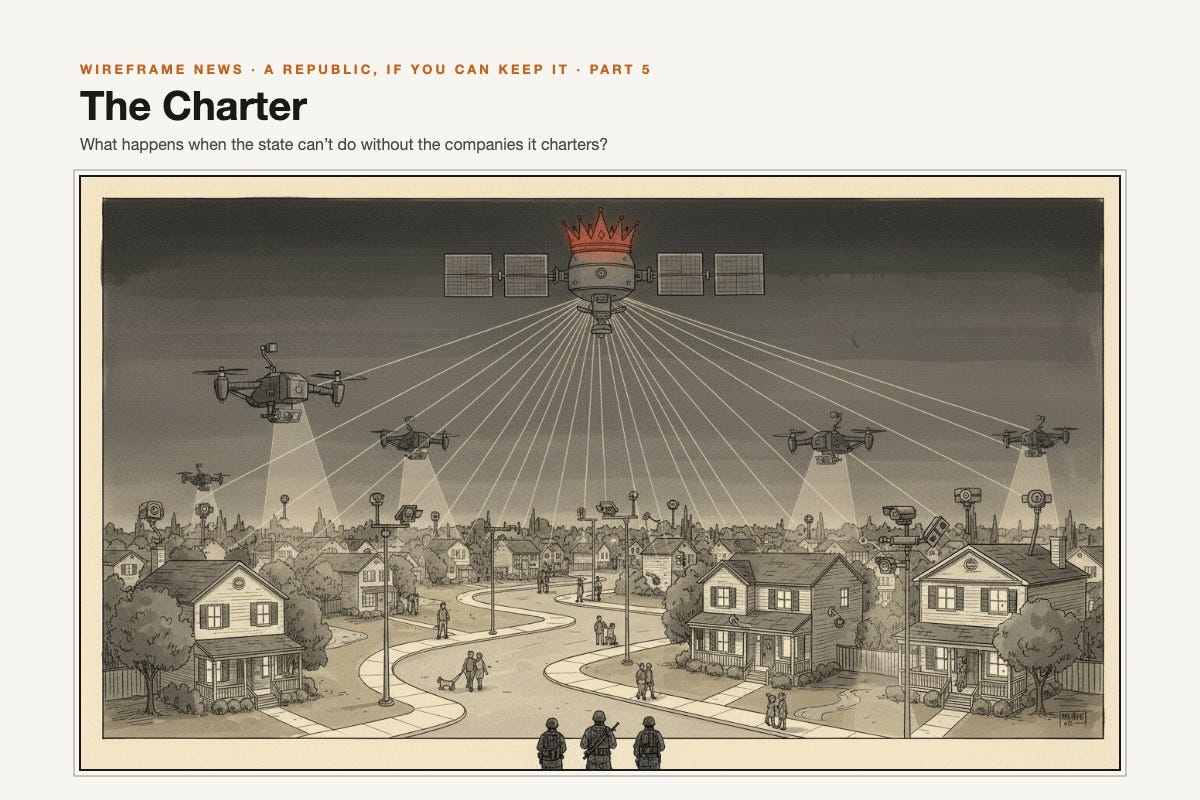
No company today has said it wants an empire. The real question is smaller and stranger: what happens to a government that hands the most dangerous parts of its work to companies it can’t do without?
Start with the size. Amazon, Google, Meta and Microsoft planned to spend $735 to $750 billion this year on buildings and machines, by one analyst’s tally of their summer guidance. Think of it this way: four companies, on their own, are spending about half of what the U.S. military is asking for its entire budget next year. Different money for different jobs, but that is the scale. Meta, the first to report this fall, narrowed its own plan to $135 to $145 billion; Alphabet and Microsoft report tonight. Anthropic raised $65 billion in May at a $965 billion valuation and filed to go public on October 26.
Now the dependence. SpaceX’s own filing says: “We are the primary launch provider for the U.S. government.” It flew 11 of the 12 big national-security launches in 2025, and about a fifth of its revenue came from federal agencies. Palantir got about 42 percent of its second-quarter revenue from U.S. government customers. In May the Pentagon signed eight firms, among them SpaceX, OpenAI and Google, to put AI on its classified networks. Anthropic wasn’t one of them. It was fighting the Pentagon, though Nextgov doesn’t say that was why, and government work was only about 1 percent of its revenue, its IPO filing says. And Hegseth named Musk and Palmer Luckey, Anduril’s founder, to co-lead a Pentagon technology effort called Project Meridian, alongside Newt Gingrich. Both men’s companies are Pentagon contractors.
Now the oversight. On September 14 the president wrote: “The only control or ‘guardrails’ that AI needs is a STRONG AND SMART (High IQ!) PRESIDENT, and the U.S.A. has that, in spades!” The same post said his administration has “tremendous CRIMINAL and REGULATORY power over these companies!” and named “Dario (Anthropic!), who is now pretending to be a ‘perfect little angel’”. Two weeks later, six tech leaders, Anthropic’s Dario Amodei among them, signed an accord with the president: internal controls, outside auditors and an independent committee. AP called it “voluntary.” The president said “I think I’m seeing tremendous self-policing.” Musk called it “just generally grading each other’s homework.”
There is no federal AI law. The Pentagon’s rule on autonomous weapons was due for a rewrite by early September; I found no new version. The strongest check so far is the Federal Trade Commission. On October 14 it sent formal demands to Anthropic and OpenAI for documents on safety incidents, privacy policies and safeguards, CBS News reported, citing Axios, and it has said it plans to compel executives, Anthropic’s among them, to testify. That’s real scrutiny. It runs on the laws the FTC already has, not on any law about AI.
And the money. Three AI-backed political networks have raised more than $300 million this year, TechTimes counts; the largest is a super PAC network backed by OpenAI’s Greg Brockman and Andreessen Horowitz. Anthropic has given $40 million to a group called Public First Action, money it says goes only to education and policy work, for rules that include government checks on companies’ safety claims. Like the others, it is spending to shape the rules for its own industry. On October 8 the president gave national medals for science and technology to Musk, Sergey Brin, Jensen Huang, Lisa Su, Michael Dell and Satya Nadella; all six have given money to Trump or Republican causes, The Next Web reports, citing CNBC.
The lever
If this were only the story of a government too weak to keep up, I’d stop here. It isn’t.
Anthropic’s contract with the Pentagon barred two uses of its AI: mass surveillance of Americans and fully autonomous weapons. The Pentagon wanted those limits replaced with “all lawful use” and set a deadline of February 27. Amodei said he “cannot in good conscience accede to their request.” On the deadline day the president posted that he was directing every federal agency to “IMMEDIATELY CEASE all use of Anthropic’s technology.” The Pentagon then labeled Anthropic a “supply-chain risk,” a tag usually reserved for firms suspected of working for foreign adversaries, which keeps the Pentagon and its contractors from using its products. Think of it as the government’s list of suppliers it can’t trust in a war, used here on an American company over the terms of a contract.
The courts split. A federal judge in California found the Pentagon had illegally punished Anthropic for its views, AP reported, and blocked the other agencies from carrying out the president’s order, according to the company’s IPO filing. On September 25 the appeals court in Washington went the other way, 2 to 1. It upheld the Pentagon’s label and rejected Anthropic’s free-speech claims. The Pentagon, the majority wrote, “reasonably feared” Anthropic might manipulate Claude’s design, and the label “hinges on what Anthropic does, not why Anthropic does it.” Anthropic has asked the full court to hear the case again; I found no ruling as of October 27. The Pentagon’s technology chief, Emil Michael, said: “Warfighters will sleep better knowing that no private company will insert their opinions in the chain of command.”
Read that fairly. A military has to know a tool will do a lawful job when it’s needed, and in a republic, elected officials, not a company, decide how the military uses its tools. I agree with that. The questions are who is using that power, for whom, and whether Congress is in the room. The lesson isn’t that the government is weak. It has a lever, and it knows how to use it. Whether it pulled it against a real risk or against a company for saying no is exactly where the two courts split.
So this isn’t just a state being outgrown. It’s a state taking a hand in who its companies are: a stake in one shipyard, contractors’ owners named to lead a Pentagon technology effort, an accord that leaves the labs to audit themselves, and a blacklist for the lab that refused its terms. A defender sees civilian control and a strong industrial base. I see a government deciding who its companies are, led by a president who says the only guardrail is a president.
What they say
I looked for anyone in this world saying a company could do without the government. I didn’t find it. Peter Thiel wrote in 2009: “I no longer believe that freedom and democracy are compatible.” Marc Andreessen’s 2023 manifesto names “statism” among its enemies, and also says “Technologically weak liberal democracies lose to their autocratic rivals.” Hostile to politics, yes. Against a strong America, no. And Dario Amodei, whose company is in this story, wrote in January that “the next tier of risk is actually AI companies themselves,” while noting that “The main thing they lack is the legitimacy and infrastructure of a state.”
The exit
Everything above is on the record. From here it is my projection.
Start with leverage. In May, Reuters reported that during the Iran war SpaceX pushed the Pentagon to pay far more for Starlink: about $25,000 a month for a higher tier of service, where it had been paying about $5,000 a terminal. Musk called the report “false”; the Pentagon called it “wrong.” Reuters also reported that the Pentagon ultimately agreed to the higher price. One report, denied, so don’t lean on it. But it shows the shape: a company has something the state needs right now, and the state doesn’t hold all the cards.
In October the dependence showed in the open. Overnight into October 14, the Starshield terminals Ukraine’s military relies on, the military version of Starlink, were capped at 100 miles per hour, according to Serhii Beskrestnov, an adviser to Zelensky. Drones flying faster lost their link. “Our armed forces did not receive a warning about these restrictions, and this led to the failure of a number of missions,” he wrote. Who decided? Musk wrote that “any limits on speed or usage are decided by the US military and ultimately POTUS.” Reuters, citing two U.S. officials, reported that the call came from the White House. Trump said on October 16: “Well, I don’t know if it was anybody because it wasn’t me, and I don’t think it was Elon.” A person familiar with the matter told CNN that Trump then called Musk. Trump wouldn’t confirm it: “Whether I called or whether somebody else called, doesn’t make any difference, I guess. The bottom line – he put it back,” he said on October 22. Two days later Ukraine said the speeds were back. When an army’s drones fly on one firm’s satellites, that is what the line between contractor and state looks like up close.
Now suppose it spreads. The same few firms hold the launches, the satellites, the computing power, the data and the money to build the next ones. The state still has tools: in June, Commerce’s export rules led Anthropic to switch off two of its models for every customer until the rules were lifted, its filing says. But mostly it has voluntary accords and a weapons rule nobody has rewritten. In that world a company doesn’t have to declare independence. It only has to be the one thing the state can’t switch off. That’s much closer to the East India Company than to a coup: not a company that walks away, but a state that finds, in a crisis, that it can’t afford to say no.
Will they decide they don’t need us? I doubt it. They need the government for chips and export licenses, and some of them for a big share of their revenue. They are rivals, not a bloc; in May a jury found that Musk’s claims against OpenAI came too late, and the judge adopted the finding. The likelier ending is quieter. The companies don’t leave the government. They inherit it. Who they inherit it from is a question for November.
The case they make
The administration’s case is the race. “WHOEVER WINS AI, WINS!” the president wrote on September 14. At the Vandalia rally he said of data centers: “You can’t just turn them off. They’ll go to China.” It’s a serious argument. China is building these systems too. The case against my reading is that a government afraid of losing to Beijing will do whatever it takes to win, including picking winners.
What to do
Ask your candidates for Congress three things, in public. Will you support binding rules, with real penalties, on the biggest AI models? Will you make the Pentagon rewrite its rule on autonomous weapons in a form Congress can read and vote on? And will you require that any government stake in a defense company, like the 40 percent at Sparrows Point, comes with terms the public can see? AI is “very important” to 44 percent of registered voters, Pew found, more Democrats than Republicans. Your candidates read that number. Read the September 29 accord yourself; it’s short. And if you work in this industry, say out loud which side of the lever you want to be on.
Next, Part 6: the election.
Sources
Opening: Defense One, Anduril submarine shipyard, Oct 7 · Spectrum News, Anduril Arsenal-2, Oct 6 · Fox News, the 40 percent stake, Oct 7
The army: National Archives, Declaration of Independence · National Archives, Eisenhower farewell address, 1961 · AP via PBS, Hasan execution livestream, Oct 8 · Al Jazeera, Hasan firing squad, Oct 6 · Truth Social, Oct 15 · ABC News via WJLA, livestream scrapped, Oct 15 · Truth Social, Sept 20 · Truth Social, Oct 2 · AP via WTOP, Guard deployment cost, Aug 4
Who serves: DefenseScoop, Autonomous Warfare Command, Sept 30 · Breaking Defense, $54.6B drone plan, Apr · ABC via 6abc, why recruits enlist, Aug 17 · Task & Purpose, FY27 end strength
The Charter: Dalrymple, The Anarchy, publisher description · Lowy Interpreter, review of The Anarchy · Platformonomics, hyperscaler capex, Jul 31 · Anthropic S-1, Oct 26 · SpaceX S-1, May 20 · Palantir Q2 2026 8-K, Ex. 99.1 · Nextgov, classified-network AI agreements, May · Military.com, Hegseth at Quantico, Oct 1 · Truth Social, Sept 14 · AP via WUNC, AI accord, Sept 30 · Defense One, the accord, Sept 29 · CBS News, FTC demands, Oct 15 · The Next Web, FTC probe, Sept 30 · TechTimes, AI political money, Oct 9 · Anthropic, Public First Action donation, Jul 21 · The Next Web, national medals, Oct 9
The lever: Truth Social, Feb 27 · Nextgov, Anthropic supply-chain-risk ruling, Sept 28 · D.C. Circuit opinion, No. 26-1049, Sept 25 · Anthropic S-1, litigation section · MLex, Anthropic seeks en banc review, Oct 14 · Lawfare, the rehearing petition · DefenseScoop, former officials back rehearing, Oct 21
What they say: Peter Thiel, Cato Unbound, Apr 13, 2009 · Andreessen, Techno-Optimist Manifesto, Oct 2023 · Dario Amodei, The Adolescence of Technology, Jan 2026
The exit: Reuters via Defense News, Starlink price dispute, May 26 · Kyiv Independent, Starlink restrictions, Oct 14 · Al Jazeera, Starshield, Oct 15 · CNBC, Trump on Starlink, Oct 16 · AP via Stars and Stripes, speeds restored, Oct 24 · AP via News4Jax, speed limits lifted, Oct 24 · Anthropic S-1, export restrictions · The Next Web, Musk v. OpenAI verdict, May 18
The case they make: Truth Social, Sept 14 · Roll Call Factbase, Vandalia rally transcript, Oct 3
What to do: Pew Research Center, midterm issues, Oct 8 · Defense One, the accord, Sept 29 · Defense One, Sparrows Point, Oct 7