

LaDiamond Lopez lives in Phoenix. She is the mother of a three-year-old and a nine-year-old, and in January she lost her SNAP benefits after officials asked for more income and household documentation. “I was approved at the end of May, but now they’re asking me for more documents,” she told the AP. “It’s a panic.”
Her story, as she tells it, is about forms. A request for more documents, and the benefits stop. Approval again at the end of May. Then another request. From January to at least the end of May, a mother of two went without the help.
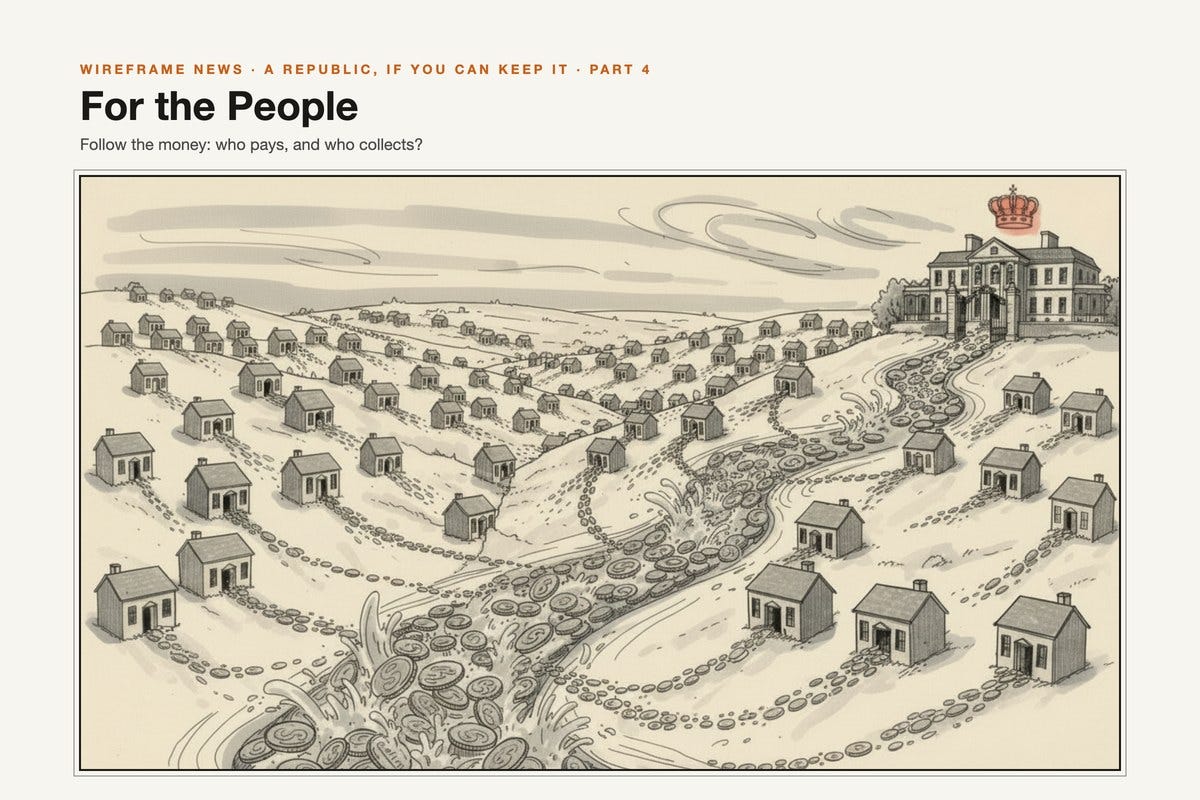
Lincoln closed the Gettysburg Address resolving that “government of the people, by the people, for the people, shall not perish from the earth.” Read it this way: the first two phrases are about who holds power, and the third is about who it’s for. In 2026 that is the economy, which 84 percent of registered voters call very important to their vote, and health care, which 68 percent do. When the government changes the rules on food, coverage and prices, who are the rules for? One way to answer is to follow the money: who pays, and who collects. It is also the plainest way to read your ballot. Every candidate says they are looking out for you. The money shows who is looking out for you and who is looking out for the people at the very top.
The paperwork cut
Lopez is not alone in her letter. SNAP participation fell from 41.8 million people in May 2025 to 36.7 million in May 2026, a drop of about 5.1 million, more than 12 percent, per USDA’s monthly data. In Arizona, the AP reports, the drop over the year to April was 55 percent. More than half of the state’s rolls.
Why they left is contested. Rachel Sheffield of the Heritage Foundation told the AP that if people are leaving because they are working, “that would be a step forward.” Arizona’s own human-services department points somewhere else: its spokesman, Brett Bezio, cites “unprecedented call volumes and administrative hurdles, including additional verification requirements.” Some food banks say demand has risen as the rolls have fallen, and Carolyn Vega of Share Our Strength says they “can’t fill this gap.” I don’t know which of those is bigger. I know Lopez’s kids are three and nine.
Call it the paperwork cut. A rule doesn’t have to say no to take food off a table. It can ask for one more document, and the people who can’t produce it can fall off the rolls. The AP ties requests like the ones Lopez got to how officials check whether people meet new work requirements, so the paperwork and the rules are the same story.
The rules come from the 2025 tax-and-spending law. The Congressional Budget Office estimates it will leave 10 million more Americans without health insurance in 2034. Its projection of who gains and who loses is starker: on average over 2026 to 2034, a household in the poorest tenth loses about $1,200 a year in income and benefits, mostly from cuts to Medicaid and SNAP, while a household in the richest tenth gains about $13,600. Those are projections, not measurements, and as far as I can tell they score the law alone; the letter does not mention tariffs.
Now follow the money the other way. The Tax Policy Center, a joint project of the Urban Institute and Brookings, estimated what the law’s tax provisions are worth this year. The average tax filer in the bottom fifth gets $150. The middle fifth gets $1,780. The top 1 percent gets $75,410, and the top 0.1 percent gets $286,000. The same law raised the amount a person can leave to heirs without estate tax to $15 million, $30 million for a married couple. The law that tightened SNAP’s work requirements also lets a couple pass on $30 million tax-free.
The surcharge and the refund
The tariffs are their own story, and it has a twist.
The Federal Reserve Bank of New York found that nearly 90 percent of the burden of the 2025 tariffs, through November, fell on American firms and consumers. That is the share that landed here, on businesses and shoppers, not on foreign exporters. Then, on February 20, the Supreme Court ruled 6 to 3 that the emergency-powers law the president had used does not authorize tariffs. The Tax Foundation counts about $165 billion collected under the tariffs the Court struck down. That money is going back, to the importers who paid it, not to the households who paid through prices.
Think of it like a fee the city charges a store on every sale. The store passes it on to you at checkout. A court rules the fee illegal. The city refunds the store. Here the refunds go to eligible importers, and in June, Treasury paid out about $49 billion in customs refunds while collecting about $24 billion in customs duties. That month the government paid out twice what it took in from tariffs.
Here is what the refund looked like from inside the biggest store in the country. In the three months ending July 31, Walmart earned $6.4 billion, CNN reported, helped by “a massive $2.9 billion tariff refund, the largest yet reported.” Walmart told investors it would put the money into “price investments,” meaning price cuts. Target received $994 million and said it would not issue refunds to customers but would use the money to lower prices, Fortune reported. Talking Points Memo read the same earnings reports and found that Home Depot, Lowe’s, Target and TJX did not report lowering prices as a result of the cash (Target highlighted price cuts but didn’t tie them to the refund); they booked it as a lower cost of sales, which raises gross profit.
For most of what you paid at checkout, there is no line for you. “There’s no way for consumers to get money from customs,” Rathna Sharad, the head of a logistics company that handles customs paperwork for retailers, told CBS News. The clearest exception shows how the rule works: UPS, FedEx and DHL, which paid duties on packages and billed their customers directly, have committed to send refunds back to the people who paid them.
And companies that couldn’t wait found buyers on Wall Street. Hedge funds bought the rights to importers’ refunds at a discount and collect the full amount when the refund comes through, if it does. In March, NPR reported, those trades were going for about 45 cents on the dollar, according to Wes Harrell of Seaport Global, who connects importers with the funds.
The president has since put new tariffs in place, and at a rally in Vandalia he made a promise: “If the Republicans win, you will each have $5,000 in your pocket.” The Tax Foundation did the math. A $5,000 check to 250 million adults costs $1.25 trillion, and the new tariffs are projected to bring in about $125 billion net in 2027. One year of tariff revenue covers about a tenth of the check. Reuters, covering his Nebraska rally, called the same pledge “legally and financially dubious.”
The farm and the plant
Farmers are getting tariff-era money too. USDA describes its payments as a response to “trade market disruptions and increased production costs.” USDA set aside up to $11 billion for what it calls Farmer Bridge Assistance, and had sent nearly $9.6 billion by April, RFD-TV reported. USDA says it pays “simple, proportional support” using “a uniform formula.” The Environmental Working Group, which calls the program a bailout to offset the tariffs, projects where the money lands: farms growing more than 1,000 acres of corn are 6.3 percent of corn farms, and will collect 39.9 percent of corn payments. That is a projection from acreage, not a list of who was paid.
On October 22, at a North Platte rally for Sen. Pete Ricketts, Vice President JD Vance said, “Today, I am proud to announce $1.3 billion of investment in domestic fertilizer manufacturing right here in the state of Nebraska.” The program behind it is national. USDA picked eight projects across the country, with about $573 million in proposed federal money, and named the companies. The one Vance named, TalusAg, plans 20 modular ammonia units at 11 sites in seven states, two of them in Nebraska, at a cost of $270 million, with USDA proposing nearly $100 million in funding. The largest single award, about $139 million in proposed funding, is for a potash plant in New Mexico. USDA’s own analysis says nitrogen fertilizer prices could fall 4.4 percent once the projects are running.
At the register
Prices rose 3.7 percent over the year to September, per the Bureau of Labor Statistics, and gasoline accounted for more than half of September’s rise. A gallon of regular averaged $4.28 in the week of October 19. A year ago it was $3.02.
The power bill has its own version of the refund. PJM runs the wholesale power market for more than 67 million customers in 13 states and Washington, D.C. In July its capacity auction set about $16.4 billion in payments to power plants for a year starting June 2028. Joe Bowring, who heads the grid’s independent market monitor, estimated that about $6.3 billion of that stems from planned data centers. “This is not something the data centers are actually paying themselves,” he told Industrial Info Resources. “This is a cost being imposed on all customers in the PJM footprint.” In March, tech companies signed a White House pledge to cover the power-delivery upgrades their data centers need; the AP reported that experts say it is likely not enforceable at the federal level. Some states are writing the rule themselves. Pennsylvania’s utility commission voted in April to advance a model tariff under which upgrade costs “will be recovered directly from large load customers.” Oregon’s approved a Portland General Electric tariff requiring data centers over 20 megawatts to cover 100 percent of distribution upgrades.
Hourly pay grew too, 3.0 percent over the year, but slower than prices. So an hour of work buys less than it did a year ago; BLS puts real hourly earnings down 0.7 percent. The Fed raised interest rates in September, the first increase since 2023, by news reports. That afternoon the president posted that rates “should be 1%, or less.” The Fed’s chair, Kevin Warsh, is the man he nominated.
Voters disapprove. The Silver Bulletin’s polling average put the president’s net approval on the economy at minus 33.4 on October 19, near its lowest.
The doctor’s office
Health care is where the paperwork cut meets the premium. The extra Obamacare premium help, first passed in 2021 and extended through 2025, expired at the end of last year, and KFF says the number of people enrolled and paying for a marketplace plan fell 12 percent by February. More than half of the people eligible for Medicare, 55 percent in 2025, are in private Medicare Advantage plans run by insurers. MedPAC, the commission that advises Congress on Medicare, estimates that Medicare will spend 14 percent more this year, about $76 billion, on people in private Medicare Advantage plans than it would if the same people were in traditional Medicare. MedPAC is careful to say that is “not an estimate of plan profits and administrative expenses”; part of it pays for extra benefits.
Next is Medicaid. States must start its work requirement by January 1, 2027, and the HHS secretary can give states making a good-faith effort until the end of 2028.
Measles cases are up sharply. The CDC counts 4,588 confirmed measles cases this year as of October 22. For all of 2025 it was 2,289. In 2019 it was 1,274. In a September keynote, the health secretary said only one childhood vaccine, the COVID-19 shot, “was subject to a placebo-controlled trial.” FactCheck.org called that misleading: the polio, chickenpox and rotavirus vaccines were originally tested against placebos. The record does not show that what he said caused the outbreaks. It shows the health secretary making a claim FactCheck.org calls misleading, in a year when measles cases have already passed the 2025 total.
The case they make
The administration has a case, and some of it is in the same numbers. The economy grew at a 2.2 percent annual rate in the second quarter. The Tax Policy Center finds that about 85 percent of tax filers get a cut this year, and the average across all filers is $2,860. CBO projects that households in the fifth and sixth income tenths, the middle of the income range, gain about $800 and $1,200 a year on average over 2026 to 2034. When CBO scored the House version, the House Budget chair, Jodey Arrington, objected that “they’re not measuring economic benefits to low-income earners, they’re measuring federal resources distributed.”
On power bills, the president told the Vandalia crowd that “if you vote for Jon Husted, I will sign this Ratepayer Protection Act into law immediately within 24 hours,” a bill Trump said Husted introduced “to stop data centers from raising electricity costs.” The bill passed the House 417 to 3 and then failed a procedural vote in the Senate, 57 to 43. And on the safety net, the administration says it is fighting fraud. In January, Stephanie Carlton, identified then as the CMS chief of staff, called fraud and abuse in Medicaid a “systemic problem.”
The retailers say their refunds are going into lower prices, and Walmart and Target said so to their investors. A government is allowed to say it cuts waste and cuts taxes. The test is whether the people the cuts land on are the people who were wasting it.
Go back to Phoenix. Lopez lost her benefits after a request for documents, was approved again, and then got another request. The people the paperwork cut removes are not obviously the people who were wasting it.
The same law that cut SNAP put $45 billion into detention, according to the American Immigration Council. That law tells you which one Congress considered an investment.
Your vote
Most of the money in this piece moved because someone cast a vote or wrote a rule. The SNAP and Medicaid cuts and the biggest tax cuts at the top came in one bill. The tariff refunds go to importers, and nothing requires them to pass the money on. The grid costs land on every customer unless someone writes a rule that says otherwise, and two states have started to. The farm money follows acres. None of that happened by weather.
So when you look at your ballot, look at it this way. A candidate who is looking out for you can tell you, in plain words, who pays and who collects in each of these, and which side they were on. A candidate who is looking out for the people at the very top will tell you about growth and fraud, which are real arguments, and get vague when you ask who got the money.
What to do
Give to the food bank nearest you; the SNAP numbers end up there. Check your coverage: open enrollment for 2027 marketplace plans starts November 1 on HealthCare.gov, December 15 is the last day to enroll for coverage that starts January 1, and enrollment ends January 15. Look up your state’s plan for the Medicaid work requirement, and if you know someone on Medicaid or SNAP, tell them to open every letter. Before you vote, ask your candidates two questions: who do they think is wasting the money, and who got it? Ask them to name a person.
Next, Part 5: the army, the companies, and what happens when the second outgrows the first.
Sources
Opening: AP via PBS, SNAP enrollment · Abraham Lincoln Online, Gettysburg Address (Bliss copy) · Pew Research, Oct 8
The paperwork cut: USDA FNS, SNAP data · Public Law 119-21 · CBO cost estimate · CBO distributional analysis · Tax Policy Center, Gale & Page, Mar 23
The surcharge and the refund: NY Fed Liberty Street Economics · Supreme Court opinion, Feb 20 · Tax Foundation, refunds · Treasury Monthly Treasury Statement, Table 4 · CNN, Aug 20 · Fortune, Aug 19 · Talking Points Memo · CBS News · NPR, Mar 5 · Roll Call Factbase, Vandalia, Oct 3 · Tax Foundation, $5,000 check · Reuters via ThePrint, Nebraska rally
The farm and the plant: Farm Policy News, Apr 27 · EWG, Feb 24 · KLIN, Oct 22 · Nebraska Public Media, Oct 22 · No-Till Farmer (USDA FIELDS list)
At the register: BLS CPI · EIA gasoline · Industrial Info Resources, PJM · AP via WTOP, Mar 4 · Pennsylvania PUC, Apr 30 · Utility Dive, Oregon PGE tariff · BLS Real Earnings · Federal Reserve, Sept 16 · Euronews, Sept 16 · Truth Social, Sept 16 · Federal Reserve, Warsh · Silver Bulletin
The doctor’s office: KFF, marketplace enrollment · KFF, enhanced subsidies · MedPAC, March 2026 report · CDC measles · FactCheck.org, Sept 18
Their case: BEA, Q2 third estimate · House Budget Committee release · House roll call 312 · Deseret News, Sept 30 · TNND via KOKH, Jan 22 · American Immigration Council
What to do: HealthCare.gov dates