

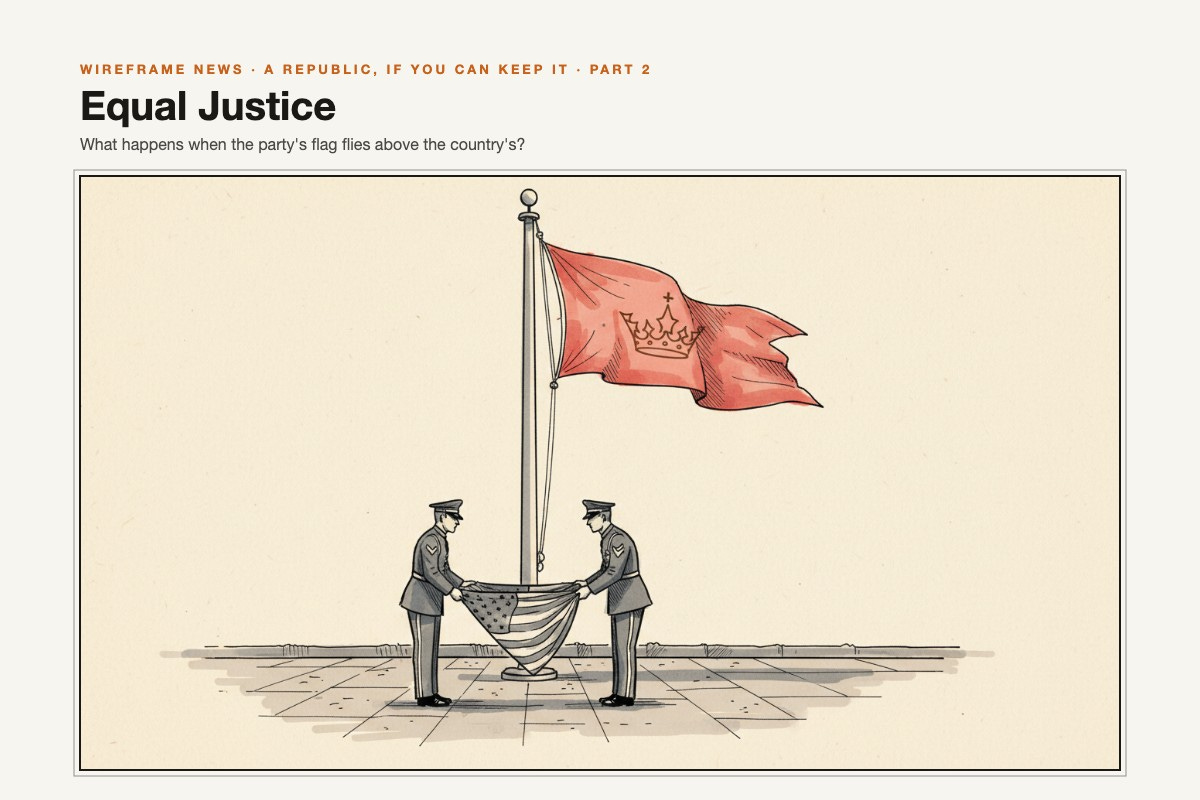
On Wednesday, October 7, the president headed to Texas and wrote a post about it. “To the people of Texas, I am headed your way, and one of the people that I am going to pay respect to today is Tano Tijerina.” Tijerina is running against Representative Henry Cuellar, a Democrat. And Cuellar, the post says, is a man Trump pardoned, in December, along with his wife. Trump wrote that he did it “at the request of his daughters, because they said, ‘Please don’t let them take our parents away!’” He wrote that they “would have gone to jail on federal fraud and conspiracy charges, for over 20 years.” The Boston Globe describes the case as a federal bribery and conspiracy case.
Then the post turns. Cuellar announced a few days after the pardon that he would stay a Democrat. Trump wrote that he had made no deal but “relied on his character, which turned out to be a faulty one.” “We call that payback for a disloyal and ungrateful person,” the president wrote. “Henry Cuellar is a LOSER who, right now, should be serving a longterm jail sentence with his wife in a top level penitentiary.”
By Trump’s own account he made no deal. He pardoned Cuellar, thought there was “a good chance” Cuellar would switch parties, and the post is a long complaint that he did not. A pardon, in that post, is not mercy. It is a loan, and the man who received it is being told what the interest is.
The Declaration says of the king that “He has made Judges dependent on his Will alone, for the tenure of their offices, and the amount and payment of their salaries.” A pardon is the president’s power to say a court’s judgment doesn’t count. What happens to justice when the person holding that power treats it as a leash?
Judges dependent on his will
On September 21, after CNN, Politico and MSNOW sued over the White House ban, the president named the judge in a post: “The Judge’s name is Tim Kelly, and he was, sadly, appointed by ‘TRUMP.’” On October 4, about the Kennedy Center, which he says is “crumbling”: “It’s been this way for years, and will only get worse unless the Radical Left Judge, with his Trump Hating lawyer wife, allows me to do what must be done!” On September 15, about the Supreme Court: “Certain Justices are petrified of these crazed and depraved Democrats, and are totally unable to show the courage necessary to save our America.”
On October 1, NBC reported that Trump is considering pre-emptive pardons for administration officials. Time asked him whether he was considering pardoning members of his administration before the end of his term. “Yeah, sure I’d do that,” he said. About 1,500 January 6 defendants were pardoned or commuted on his first day, and about 170 other grants have followed. A court has blocked a $1.776 billion “anti-weaponization fund” that critics said could be used to pay January 6 defendants. The attorney general says he terminated it on August 2; Judge Leonie Brinkema, who blocked it, said on September 18 that the issues in the case are “still alive and kicking in my view.” On September 30, about the Federal Reserve’s building renovation and Jerome Powell, the former Fed chair, Trump wrote: “If he doesn’t resign, he should be sued, at the highest level, by the United States Government, for either corruption or incompetence,” and that he had “asked Attorney General Todd Blanche to study the report.”
A union says the Bureau of Prisons is defying a judge’s injunction on its contract, and according to GovExec’s account of the union’s motion, quotes the director as saying “I take my orders from the president of the United States.” The government says it has complied; on October 8 the Bureau terminated the union contracts a second time. A contempt hearing is set for Tuesday, October 13. On September 25 a federal judge in Maryland, Stephanie Gallagher, found the government in contempt for deporting a young asylum seeker, identified in court filings as E.L.A., a second time in violation of court orders.
A free press, or else
The First Amendment is written as a limit on Congress: “Congress shall make no law respecting an establishment of religion, or prohibiting the free exercise thereof; or abridging the freedom of speech, or of the press; or the right of the people peaceably to assemble...” Courts have long read it to bind the whole government. Judge Kelly has already ruled once: on September 24 he issued a 14-day order restoring the outlets’ access, on due-process grounds, not the First Amendment, and a decision on a longer injunction is pending, per Al Jazeera. The president’s answer to the lawsuit was to name the judge.
On September 18 he announced that “effective immediately, I am banning Fake News CNN, MSNOW [...], and Politico [...], from the White House as a result of their constant ‘reporting’ FAKE NEWS!” and that “Other Fake News Media Outlets to follow.” On September 22 he wrote that CNN’s Kaitlan Collins has “a ‘TRUMP’ addiction, and so does CNN and MSDNC. They’re all sick, treasonous, and demented!” Treason is a crime the Constitution defines itself, in Article III, Section 3: “levying War against them, or in adhering to their Enemies, giving them Aid and Comfort.” A reporter covering a speech is not that. On October 5 he wrote that the New York Times “and many other Artificial Media Outlets, should be arrested for their dishonesty and disservice to our Country.” The trigger was a story that said there had been empty seats at his Ohio rally. Reporters Without Borders ranks the U.S. 64th of 180 on press freedom, down seven places, and says Trump “has turned his repeated attacks on the press and journalists into a systematic policy.”
Criticizing the press is the oldest American sport, and he is entitled to it. Calling reporters treasonous is something else. So is banning an outlet from the building, and saying who should be arrested.
The court around the throne
The king in Game of Thrones has a small council, a few people close enough to the throne to be useful and close enough to be dangerous. The story works because you keep asking who each of them is really serving. Ask it here.
The founders feared crowns enough to write: “No Title of Nobility shall be granted by the United States: And no Person holding any Office of Profit or Trust under them, shall, without the Consent of the Congress, accept of any present, Emolument, Office, or Title, of any kind whatever, from any King, Prince, or foreign State.” That clause is about gifts from foreign powers and titles from the government, not about putting your own face on a coin. It still tells you what the country that wrote it was afraid of.
A king takes what he doesn’t control, and then he puts his name on it.
Congress created the U.S. Institute of Peace in 1984 as “an independent nonprofit corporation,” outside the president’s chain of command. On Friday, March 14, 2025, a White House personnel official emailed its appointed board members that they were terminated. Three days later, staff from DOGE entered the headquarters, and officers from three police and federal agencies escorted the institute’s leaders out. Nearly all of its staff were let go. Judge Beryl Howell found that the administration “used brute force and threats of criminal process to take over USIP’s headquarters,” and called it “a gross usurpation of power.” An appeals court paused her ruling in June 2025, finding the government likely to win on whether the president can remove the board, which left the building in the government’s hands. In December, Bloomberg reported, the State Department posted: “Welcome to the Donald J. Trump Institute of Peace.”
The week before, the same thing happened at a smaller agency. Staff at the U.S. African Development Foundation refused DOGE entry on March 5, 2025. The next day Pete Marocco, a State Department official the White House had named the foundation’s acting chair, “arrived with five U.S. Marshals and a handful of DOGE employees,” according to staffers and video obtained by the Washington Post. The staff inside left by the stairwell. Marocco made himself the foundation’s president, and in March of this year Judge Richard Leon ruled that his appointment was unlawful and that his acts as chair and president have “no force or effect.”
At the Kennedy Center there were no Marshals. Trump replaced its board in February 2025, and his handpicked board added his name to the building in December. A federal judge, Christopher Cooper, ruled on May 29 that only Congress can change the center’s name and ordered his name taken down, per NPR, and the center said it would appeal.
Then count the rest. NBC News described “an aggressive push to add the president’s name to buildings, battleships, money and government websites.” There are “Trump-class” battleships, a “Gold Card” visa priced at $1 million for an individual, a limited run of passports with a large image of him on the inside cover, a national park pass with his face next to Washington’s, and plans for his signature on paper money. The Air Force has accepted from Qatar a Boeing 747 estimated to be worth $400 million, and Trump has pledged that it will go to his presidential library after his term, though in August a White House official told ABC News there was “no final decision.”
Now count the money. Trump earned more than $1.4 billion from his family’s crypto ventures last year alone, Time reported, according to his latest annual financial disclosure. The Trump family’s World Liberty Financial won a preliminary charter in August from the Office of the Comptroller of the Currency, which lets it begin the process of establishing itself as a national trust bank. Eric Trump signed what Mother Jones calls a “passivity agreement,” which prevents the family from taking an active role in the bank’s daily management. Senator Elizabeth Warren, in Mother Jones’ account, spoke of “the clear conflict of interest and corruption” in the arrangement. A World Liberty spokesman said: “There are no conflicts of interest.” The Comptroller, Mother Jones points out, was appointed by Trump, and he can be fired by Trump.
Last week, the Wall Street Journal reported that Kimberly Guilfoyle, the ambassador to Greece, allegedly asked a donor named Eric Deters to wire $100,000 to her American Express card six days before her Senate confirmation hearing. CBS reviewed texts Deters supplied. “It won’t show up anywhere if you wire money to American Express that’s all that will show,” reads one. CBS says, citing unnamed sources, that White House officials were told the texts were authentic. The Journal reports that Guilfoyle’s lawyer, Jesse Binnall, disputed their authenticity but declined to give specifics. Deters says he never paid. He told the Journal he paid her $300,000 to speak at events, and says he does not owe her anything. CBS reports that he was sanctioned by the Ohio Supreme Court in 2021 for the unauthorized practice of law, and that he wants her out of her post. Guilfoyle called a related accusation “completely false.” Neither outlet reports any independent confirmation that money was requested or paid. It rests on one man with a stake in the outcome and on texts her lawyer disputes. It is an allegation, not a finding.
When the money comes from somewhere else, and the test for everyone in the room is loyalty, you stop being the customer.
One party
A king needs a court. In a republic the court has a different name. It is a party. Every party in power wants to stay in power, and that alone is not a crime. The question is what a party does when the man at the top asks for something the Constitution doesn’t give him.
On September 21, the president wrote: “If Senate Republicans don’t TERMINATE THE FILIBUSTER, the Dumocrats will, and I will be, despite how well our Party is doing, the last Republican President!” He wrote that Democrats would “vote in Puerto Rico” and Washington, D.C., “pick up 4 Senators, 8 Congressmen/women,” and “control the Voting Mechanisms and Systems, both Legal and otherwise, throughout the United States. It will be impossible for Republicans to ever win an Election again. In other words, it will be THE END OF AMERICA!”
The record on whether the party holds is genuinely mixed. In July 2025 the Senate voted 99 to 1 to strip a moratorium on state AI laws out of the tax bill. On February 11, six House Republicans joined Democrats to pass, 219 to 211, a resolution ending the national emergency behind the Canada tariffs; it has passed the House only. On August 8 the Senate confirmed Todd Blanche as attorney general, 50 to 49, with Collins and Murkowski the only Republicans voting no. Tillis and Cornyn, who voted yes, got a deal from the Justice Department that they said eased their concerns about the $1.776 billion “anti-weaponization fund,” which the department said it had rescinded, and about audit immunity for the president. Democrats called the written assurances “decorative.”
And where it didn’t. On June 23 the Senate adopted, 50 to 48, a resolution the House had already passed calling for an end to U.S. involvement in hostilities with Iran. It was a concurrent resolution, which doesn’t go to the president, so it was nonbinding. On July 23 the House passed another nonbinding one, 214 to 208, and the Senate voted 47 to 49 on a motion to bring a binding joint resolution out of committee, and lost. Congress can say it wants the war to end. When it tried to make that binding, it fell two votes short on a motion just to bring the measure up, and even a binding resolution would have faced a veto. The Government Accountability Office found on September 29 that the administration’s September 25 “pocket rescission” of 11 budget accounts, about $810 million, violated the Impoundment Control Act. GAO can sue to force the spending, but the law makes it wait 25 days of continuous session first.
Representative Thomas Massie, who crossed the president on the Epstein files, the tax bill and Iran, lost his Kentucky primary on May 19, by roughly ten points, to a challenger Trump endorsed. Senator Bill Cassidy finished third in Louisiana’s Republican primary on May 16, after Trump endorsed a challenger, Representative Julia Letlow, in January. Senator John Cornyn lost his Texas runoff to Ken Paxton on May 26, a week after Trump endorsed Paxton. Cornyn voted to confirm Blanche, and lost anyway. Nobody has to threaten anyone. Everyone in the Senate can read that.
The Supreme Court struck down the emergency-power tariffs 6 to 3 on February 20, and on September 10 it granted a stay that leaves Missouri’s old congressional map in place for November, rather than the new one Trump backed. It also ruled 6 to 3 in June, in Trump v. Slaughter, “If anything more is left of Humphrey’s, we overrule it,” ending the 1935 protection for independent agencies, while noting that the Federal Reserve may be a special case. TIME counted 32 emergency-docket decisions on the administration’s requests since Trump returned to office, 24 of them in its favor, citing a Brennan Center tracker. “The court has sided with the Administration with jaw-dropping frequency,” the law professor Kate Shaw told TIME. Both parties are drawing congressional maps. In April the Court narrowed the Voting Rights Act in Louisiana v. Callais, 6 to 3. Republicans have drawn new maps in Texas and Ohio last year and in Florida and Louisiana since. Democrats answered in California, where voters passed Proposition 50, worth up to five seats per the Public Policy Institute of California. The congressional parties both rate poorly. A Quinnipiac poll of registered voters on September 24 to 27 found 26 percent approving of congressional Republicans and 22 percent of congressional Democrats.
The case they make
The Justice Department says it rescinded the fund. Trump says he made no deal with Cuellar and that he “relied on his character.” Guilfoyle’s lawyer disputes the texts, and she called a related accusation “completely false.” A World Liberty spokesman says there are no conflicts of interest. The White House said of the African Development Foundation’s staff that “Entitled, rogue bureaucrats have no authority to defy executive orders by the President of the United States or physically bar his representatives from entering the agencies they run,” and an appeals court has so far sided with the president on removing the Institute of Peace’s board. Presidents of both parties have pardoned allies; Joe Biden pardoned his son.
The pardon is the least of it. The problem is the second post, the one after the pardon, saying who owes what. A government of laws forgives. A court says what a person owes. A king says who owes him.
What to do
Look at the offices on your ballot that sit nearest to this: secretary of state, attorney general, county clerk, judge. They certify elections, prosecute, and decide whether the next order is lawful. Read who is running and what they say about the rule of law. Subscribe to a local newspaper, because press freedom in a county looks like someone in the room at the county board meeting. And call your senators about two specific things: a binding war-powers vote, and appropriations language that bars pocket rescissions.
Next, Part 3: the golden door.
Sources
The pardon (Cuellar): Truth Social, Oct 7 · AP via WCAX, Dec 3, 2025 · Texas Public Radio, Dec 2025 · KSAT, Oct 8
Judges dependent on his will: Truth Social, Sept 21 · Truth Social, Oct 4 · Truth Social, Sept 15 · NBC News, Oct 1 · Time interview transcript, Oct 1 · DOJ clemency list · Fox News, Sept 18 · Truth Social, Sept 30 · GovExec, Oct 7 · GovExec, Oct 8 · Bloomberg Law
A free press: Truth Social, Sept 18 · Truth Social, Sept 22 · Truth Social, Oct 5 · Al Jazeera, Sept 24 · TheWrap, Oct 8 · RSF 2026 Index
The court around the throne, taken: Judge Howell’s opinion · D.C. Circuit stay order · Bloomberg Government · Washington Post via ADN, Mar 7, 2025 · Judge Leon’s opinion, Mar 13, 2026 · NPR, May 29 · CNN via ABC7, Feb 12, 2025 (Kennedy Center board) · AP via ADN, Dec 19, 2025 (Kennedy Center name)
The court around the throne, the names: NBC News (via NBC New York) · NBC News, May 2025 (via NBC San Diego) · ABC News (Good Morning America), Aug 2026 · AP (Gold Card)
The court around the throne, the money: Time, July 1 · Mother Jones, Oct 1 · CBS News, Oct 9 · Wall Street Journal (syndicated copy, To Vima)
One party: Truth Social, Sept 21 · States Newsroom, July 2025 · KPMG Tax Newsflash · Roll Call, Aug 8 · Roll Call, June 23 · Roll Call, July 23 · GAO decision B-338788 · Kentucky State Board of Elections · Louisiana Secretary of State · NOTUS, Jan 18 · ABC affiliate WJLA (AP), May 26 · Supreme Court, Learning Resources v. Trump · Supreme Court, Trump v. Slaughter · Supreme Court, Louisiana v. Callais · PBS NewsHour, Sept 10 · Time, Oct 1 · Christian Science Monitor · California Secretary of State · WFSB (Quinnipiac) · PPIC (Prop 50)
The case they make: AP via PBS, Dec 1, 2024 (Biden pardon)
Founding documents: Declaration · Constitution · Bill of Rights